Why Vallejo
Vallejo sits at the northern edge of San Pablo Bay in southern Solano County, between Benicia to the east across the Carquinez Bridge and the North Bay and Napa Valley to the north. With a population around 126,000, it is the second-largest city in Solano County after Fairfield, and it does not behave like a single market. Mare Island, the former Naval Shipyard, is now redeveloped for housing and commercial use; the downtown waterfront is the historic core; Vallejo Heights is the central residential belt; and Glen Cove is the upscale waterfront to the south. The employer base leans on Six Flags Discovery Kingdom, the Travis Credit Union headquarters, and county government. Vallejo City Unified School District runs K-12 across 3 comprehensive high schools and ranks in the lower half of California unified districts, one of the two main constraints on local value.
That is the trade-off Vallejo asks buyers to weigh, because on price it is one of the most affordable footholds in the Bay Area. Single-family homes typically run $400K to $650K in the central, older, and Mare Island tracts, $550K to $850K in the Vallejo Heights and Sereno hillside-view tracts, and $700K to $1.2M+ for the Glen Cove waterfront. Townhomes and condos run $300K to $550K. Per square foot, Vallejo prices among the lowest in the Bay Area, and the discount is not hidden: the school district tier and the rush-hour commute (45 to 75 minutes to San Francisco or Walnut Creek via I-80 and I-580) are the two constraints holding those numbers down. Lily's 1 documented Vallejo closing, 113 Martin St at $323K in March 2019, sits right at the entry floor of that range. The Vallejo housing market rewards that homework: single-family runs $400K-$650K in the central and Mare Island tracts and up to $1.2M+ for Glen Cove waterfront, with the school tier and commute setting where a parcel lands.
A short history of Vallejo
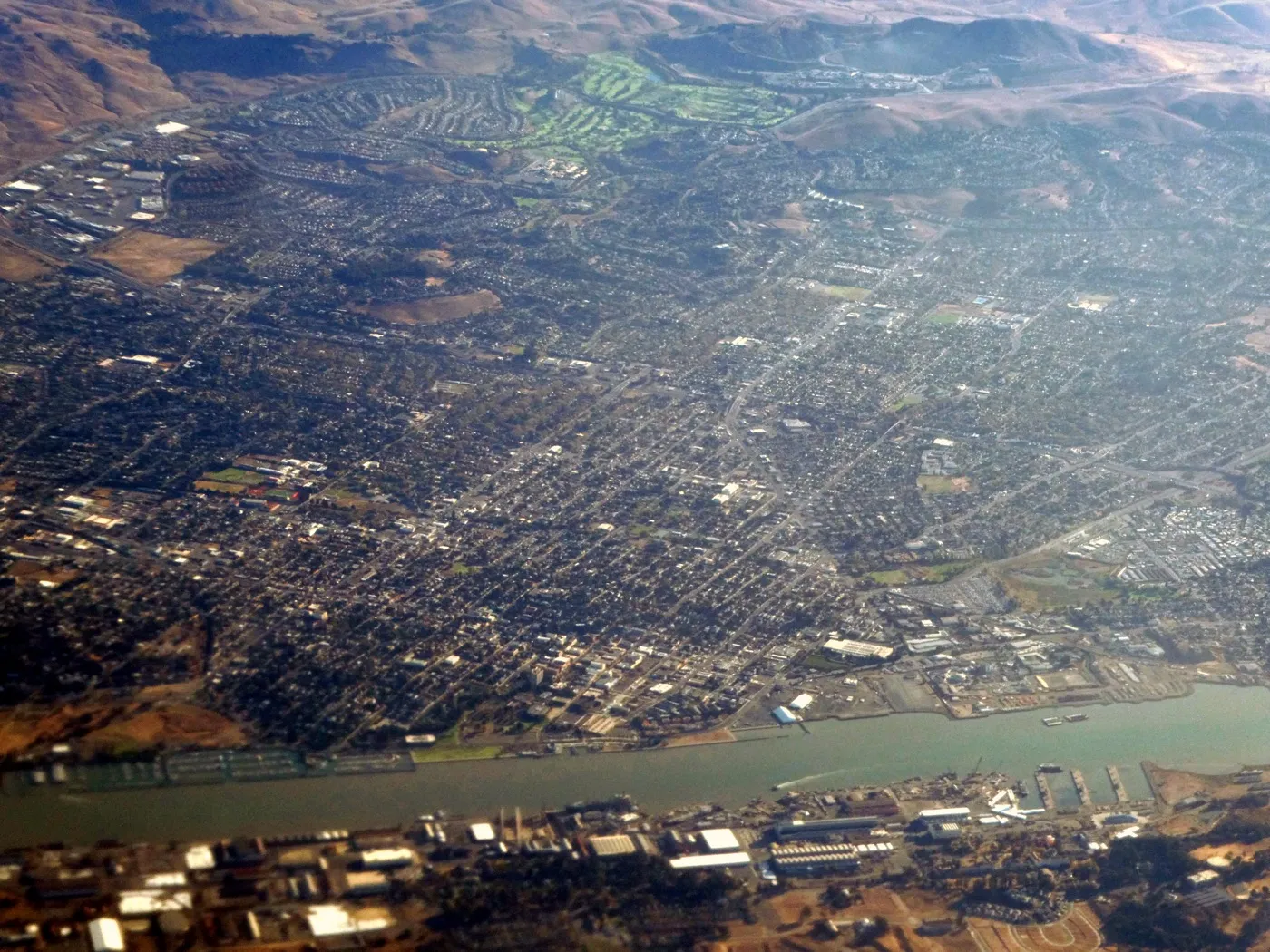
Vallejo was founded in 1851 on land that had belonged to Mariano Guadalupe Vallejo, the Californio general and statesman for whom the city is named. It briefly served as the capital of California, hosting the state legislature in 1852 before the seat of government moved to nearby Benicia in early 1853. The city was formally incorporated on March 30, 1868, and sits in Solano County.
The founding of the Mare Island Naval Shipyard in 1854, described as the first naval base on the West Coast, shaped the local economy for well over a century until the yard closed in 1996. Landmarks associated with the city include the Carquinez Bridge and Six Flags Discovery Kingdom.
Source: Wikipedia: Vallejo, California.
Vallejo by the numbers
A neutral demographic snapshot from the most recent U.S. Census Bureau American Community Survey. These are city-wide figures; individual neighborhoods and parcels vary.
| Measure | Value |
|---|---|
| Population | 124,637 |
| Median age | 40.0 years |
| Median household income | $89,496 |
| Homeownership rate | 58.9% |
| Median home value (owner-occupied) | $557,500 |
| Median gross rent (monthly) | $2,013 |
| Average commute to work (one way) | 35.7 minutes |
| Average household size | 2.79 people |
Source: U.S. Census Bureau, American Community Survey 2019-2023 5-year estimates, Vallejo city, California.
The Vallejo market right now
| Median sale price | $510,000 |
|---|---|
| Days on market | 39 |
| Homes for sale (inventory) | 243 |
| Homes sold | 75 |
| Sale-to-list | 101% |
Data: Redfin, May 2026
For broader Bay Area context behind the Vallejo numbers, read the current Bay Area market note.
What this means for you (May 2026)
With 243 homes on the market and a median 39 days to sell, Vallejo offers one of the wider selection windows I see across the Bay Area. The 101% sale-to-list ratio means prices stayed close to asking. That combination of inventory and pace typically gives you leverage to ask for repairs or credits as part of your offer.
Property taxes in Vallejo
Property tax in Vallejo starts with the Solano County PCT TAX LIMITATION of 1% under Proposition 13 (California's 1978 law capping the base rate and limiting how fast assessed value climbs), plus voter-approved bond debt, including Vallejo City Unified and Solano Community College bonds. On a verified representative single-family bill for fiscal year 2025-26, the effective rate came to 1.43%, well above the roughly 1.2% norm.
The single largest line, and the reason for that higher rate, is the Annual Sewer and Storm Fee at $1,222.68. The rest are small: Greater Vjo Recre Dist Pcl Tax $48.00 (the Greater Vallejo Recreation District parcel tax, a flat per-property levy) and SF BAY REST AUTH-MEASURE AA $12.00, for a total of $1,282.68.
The roughly $1,223 annual sewer and storm fee, not any Mello-Roos (a special tax on newer developments), pushes Vallejo above the norm. See how California property tax works, and use the true monthly cost calculator to estimate a specific home. Figures come from a representative single-family county bill (FY 2025-26); every parcel differs, so check the actual bill for any home you are weighing. Compare all 38 cities side by side on the Bay Area property tax map. This is educational, not tax or legal advice; confirm any figure with a qualified tax professional and the county assessor before relying on it.
Schools (Vallejo City Unified School District)
Vallejo City Unified School District (VCUSD, K-12) operates 3 comprehensive high schools. Jesse M. Bethel HS (U.S. News #1,263 California, #12,807 national1,696 students; the district's highest-enrolled HS, ranked 2nd of 3); Vallejo HS ranks lower. VCUSD is one of the lowest-ranked unified districts in the Bay Area; verify the current district and school rankings from the third-party sources cited below.
Charter and magnet alternatives are common pursuit paths. Mare Island Tech Academy (MIT), California Maritime Academy magnet, and several charter schools are alternatives that VCUSD families pursue for academic step-up. The district-wide K-12 stack is the structural pricing constraint on Vallejo; buyers prioritizing top-quartile California academics typically consider Benicia (BUSD) or commute alternatives in central / southern Solano.
Typical assignment by sub-area
| Sub-area | Elementary feeders | Middle | High |
|---|---|---|---|
| Central / downtown Vallejo | Pennycook / Patterson / Loma Vista | Hogan Middle | Vallejo High |
| Mare Island (former Naval Shipyard, redeveloped) | Mare Island Elementary / Pennycook | Franklin Middle | Jesse M. Bethel High |
| Vallejo Heights / Sereno (central hillside) | Highland / Wardlaw | Solano Middle | Jesse M. Bethel High |
| Glen Cove / waterfront south (premium) | Glen Cove / Wardlaw | Solano Middle | Jesse M. Bethel High |
| North Vallejo / American Canyon border | Mini / Beverly Hills | Hogan Middle | Vallejo High |
VCUSD attendance assigns by address, but the district-wide academic ranking is the more meaningful school variable than which specific comprehensive high school. Charter alternatives (Mare Island Tech Academy, California Maritime Academy magnet) require separate applications. Lily verifies the elementary assignment with the VCUSD registrar and discusses the charter / magnet alternatives before any offer.
Highlight schools
- Jesse M. Bethel High School (VCUSD, 9-12, ~1,696 students), U.S. News #1,263 California, #12,807 national; the district's highest-enrolled HS, ranked 2nd of 3 VCUSD comprehensives; the most-selected VCUSD high school by Glen Cove / Vallejo Heights buyers.
- Vallejo High School (VCUSD, 9-12), the central / downtown comprehensive; serves central Vallejo addresses.
- Mare Island Technology Academy (MIT) (charter, 6-12), an alternative for families seeking a step-up academic option; application-based.
- California Maritime Academy magnet programa specialty option tied to the in-city California State University Maritime Academy.
Sources: Vallejo City USD; PublicSchoolReview VCUSD; U.S. News Bethel HS; Bethel SchoolDigger.
Hospitals and birthing centers
Critical maternity-care caveat for Vallejo buyers: Sutter Solano Medical Center closed its L&D service on May 10, 2021. Kaiser Vallejo is now the only in-city L&D in Vallejo. Buyers on PPO plans now drive to Queen of the Valley Medical Center (Napa, ~25-30 min) or NorthBay Medical Center (Fairfield, ~20-25 min) or NorthBay VacaValley Hospital (Vacaville, ~30-35 min). Some Vallejo buyers also drive to John Muir Walnut Creek or Kaiser Vacaville depending on insurance.
| Hospital | Network | Drive time from Vallejo | Key services |
|---|---|---|---|
| Kaiser Permanente Vallejo Medical Center (in-city) | Kaiser (closed) | in-city (5-15 min) | Full Kaiser L&D + NICU support; the only in-city L&D in Vallejo since Sutter Solano closed in May 2021 |
| Queen of the Valley Medical Center (Napa) | Providence (PPO) | 25-30 min | Default Sutter-replacement PPO L&D for Vallejo since 2021; full L&D + NICU |
| NorthBay Medical Center (Fairfield) | NorthBay (PPO) | 20-25 min | Alternative PPO L&D; full L&D + NICU |
| NorthBay VacaValley Hospital (Vacaville) | NorthBay (PPO) | 30-35 min | Alternative NorthBay L&D; regional NICU for Solano County |
| Sutter Solano Medical Center (Vallejo, no L&D since May 2021) | Sutter (PPO) | in-city | Still operates as a hospital (ED, surgery, other inpatient) but L&D closed May 2021 |
Birthing centers: what matters
The 2021 Sutter Solano L&D closure means buyers on commercial PPO plans in Vallejo lost their in-city L&D option entirely. Buyers who will need labor and delivery on commercial PPO plans should know the closest non-Kaiser L&D is now 20 to 30 minutes away. Sutter Solano cited low volume (around 8 to 9 weekly deliveries on a 30-bed unit; 37 jobs eliminated) as the closure rationale. The hospital still handles ED, surgery, and other inpatient services, just not L&D.
Kaiser Vallejo is the only in-city L&D: Full Kaiser L&D + NICU support. The default for Kaiser members in Vallejo and the only in-city option for any insurance.
For PPO buyers who will need labor and deliveryplan for the 20 to 30 minute drive to Queen of the Valley (Napa), NorthBay Medical Center (Fairfield), or NorthBay VacaValley (Vacaville). Build this into prenatal-care scheduling, particularly for the final weeks of pregnancy.
Hospital network coverage depends on your insurance plan. Lily does not advise on medical coverage decisions; for in-network confirmation contact your insurer directly. Hospital information above is current as of 2026-05-28 and should be re-verified with each hospital's admissions office before relying on it for a major life decision.
Sources: Sutter Solano L&D closure Vallejo Sun; Kaiser Vallejo L&D; Queen of the Valley Napa; NorthBay Medical Center; Sutter Solano current.
Crime, hazards, and ratings
Vallejo carries higher-than-average crime exposure, carries significant flood exposure in shoreline and creek-adjacent tracts, with elevated fire hazard in hillside tracts relative to the broader Bay Area. School ratings reflect the local district's performance bands.
| Category | Rating | Detail |
|---|---|---|
| Crime | property and violent crime both well above California average; among the highest violent crime rates of the 37 cities listed | |
| Flood | Zone X over most upland tracts; Zone AE along Napa River shoreline, White Slough, and the Mare Island frontage; Zone VE on the immediate shoreline | |
| Fire | Moderate to High in northern Vallejo (Hiddenbrooke, Glen Cove ridges, American Canyon border); flatland tracts not in LRA hazard zones | |
| Earthquake | Green Valley Fault about 3 miles east (the Concord Fault's northern continuation); Rodgers Creek Fault about 6 miles west (Hayward Fault's northern continuation under San Pablo Bay); Franklin Fault on Mare Island; liquefaction: Very High on Mare Island (entire island is bay-mud and dredge fill); High along the Napa River shoreline; Moderate in central Vallejo |
School ratings
Numeric snapshots for the highlight schools above:
| School | GreatSchools | Niche |
|---|---|---|
| Bethel High / Jesse Bethel High | 3 | B- |
| Vallejo High | 3 | C+ |
| Hogan Middle | 3 | C |
Environment and infrastructure
Beyond the natural-hazard ratings above, these are the environmental and infrastructure factors buyers ask about most. Each is a city-level summary; confirm the exact parcel before any offer.
| Factor | Detail |
|---|---|
| Gas transmission pipelines | PG&E natural-gas transmission lines serve the Vallejo area as part of the regional North Bay system; precise transmission-line alignments near a property should be verified on the PHMSA National Pipeline Mapping System, which excludes local distribution mains. |
| Noise (freeway, rail, flight paths) | Vallejo is bounded by Interstate 80, Interstate 780 and State Route 37, which are the dominant traffic-noise sources; the San Francisco Bay Ferry terminal on the downtown waterfront adds localized activity, and former Mare Island is now largely quiet civilian reuse. |
| Refineries and heavy industry | Vallejo has no refinery within the city, but the Phillips 66 Rodeo refinery sits across the Carquinez Strait to the south in Contra Costa County (now converting to renewable fuels under 'Rodeo Renewed'); the refinery has drawn recent BAAQMD enforcement, including a $5 million air-quality settlement in 2024. Mare Island's former naval shipyard is the city's dominant industrial-legacy site. |
| Soil and groundwater contamination | The former Mare Island Naval Shipyard (operated 1854-1996) is a major federal-facility cleanup under the Navy's Installation Restoration Program; it is NOT on the EPA National Priorities List but is a state-lead CERCLA cleanup with the California DTSC and the San Francisco Bay Regional Water Quality Control Board as lead regulators. Documented contamination includes radiological materials, metals, PCBs, petroleum, VOCs and unexploded ordnance, with portions transferred for reuse under continuing institutional controls. |
| Air quality and wildfire smoke | Vallejo's air quality is generally moderate with bay marine influence, but it is exposed to occasional regional wildfire smoke and to emissions from nearby industrial sources across the strait; CalEnviroScreen flags pollution-burden concerns in parts of the city. |
| Wildfire zone and power shutoffs (PSPS) | Most of Vallejo is built-out lowland with limited wildfire exposure, but the city's open hill areas and wildland-urban-interface edges carry elevated CAL FIRE fire-hazard ratings and some PG&E Public Safety Power Shutoff exposure; risk is far lower than in inland Solano hill communities. |
| High-voltage power lines | Solano County carries significant high-voltage transmission infrastructure, and high-voltage corridors and substations are present in the broader Vallejo area; proximity to a specific residence should be confirmed against utility/CPUC transmission maps. |
| Sea level and shoreline flooding | Vallejo faces meaningful sea-level-rise exposure along low-lying San Pablo Bay shoreline, the downtown waterfront and ferry area, and especially Mare Island; the Adapting to Rising Tides Vallejo Adaptation Study (2018) and Solano County's vulnerability assessment document the at-risk areas. |
These are city-level summaries from public agencies and are approximate. Pipeline and power-line alignments, contamination parcels, and wildfire zones can differ block by block; verify the exact address with the agency tools linked above and your inspections before you write an offer.
Sources: PHMSA National Pipeline Mapping System; DTSC EnviroStor; State Water Board GeoTracker; EPA Superfund; BAAQMD air data; CAL FIRE Fire Hazard Severity Zones; PG&E PSPS maps; NOAA Sea Level Rise Viewer
Hazard ratings are city-level aggregates from public agencies (FEMA, CAL FIRE, USGS). Specific addresses can carry materially different risk; verify the exact parcel via the FEMA Flood Map Service Center, the CAL FIRE FHSZ viewer, and your insurance carrier before any offer. School ratings vary by year and by metric; the numbers above are point-in-time snapshots, treat them as a starting point and re-verify with the district registrar.
Sources: CrimeGrade.org (crime); FEMA Flood Map Service Center (flood); CAL FIRE FHSZ viewer (fire); USGS earthquake hazards (earthquake); GreatSchools + Niche (school ratings).
Track Record
1 documented Vallejo closings, $0.3M local volume. Career-wide: 104 documented closings, $115M+ in total volume, with 91 of 104 on the buyer side, 10 closings in the last 12 months, career range $323K to $3.3M, 5.0-star Zillow average across 38+ reviews. The full transaction record for every Bay Area city Lily has closed in is summarized at the cities index.
Ready to talk about Vallejo? Call or text me at 415-910-3958 for a free 30-minute consultation.
104 transactions · $115M+ · 5.0★ Zillow · Cal DRE #02010731
What buying a home in Vallejo actually involves
Same fiduciary discipline as on every Lily Garipova representation: read every disclosure end-to-end, model the carrying cost (mortgage + property tax + HOA + insurance), walk the property at multiple times of day, and stay willing to walk you away from a property that does not pencil. Vallejo-specific particulars are covered in the FAQ below; the hospital caveat (Sutter Solano L&D closed May 2021; Kaiser Vallejo is the only in-city L&D, PPO-plan buyers now drive 20-30 min off-island) is essential for buyers who will need labor and delivery access; the commute math to SF / Walnut Creek via the Carquinez Bridge or I-80 / I-580 is a key cost-of-living variable.
What selling a home in Vallejo involves
Strategic Listing Model applied to Vallejo: data-driven comp analysis of the specific Vallejo sub-area (central / older / Mare Island vs Vallejo Heights / Sereno hillside vs Glen Cove waterfront premium is a $300K to $700K price-spread per comparable square footage), pre-listing prep with positive-ROI improvements only, professional staging targeted to the entry-level Bay Area buyer demographic, multi-platform marketing with active bid management, and honest disclosure of every defect.
The Meticulous Protector, applied to Vallejo
The methodology that has earned Lily 38+ five-star Zillow reviews and a strong repeat-and-referral base: read every disclosure line, verify every claim, model every carrying cost, walk every property in person before recommending an offer, document the ethical "no" when the math says no. The Vallejo version of that methodology is the same as the Dublin version, the Pleasanton version, the Walnut Creek version, and every other city Lily represents, discipline does not change by city.
Vallejo FAQ
What are Vallejo price ranges in 2026?
Vallejo single-family typically runs $400K to $650K for the central / older / Mare Island tracts, $550K to $850K for the Vallejo Heights / Sereno / hillside view tracts, and $700K to $1.2M+ for the Glen Cove waterfront premium properties. Townhomes and condos run $300K to $550K. The March 2019 Martin St closing at $323K is the entry-level Vallejo single-family floor; the more typical current entry-level is closer to $450K to $550K.
Vallejo vs Benicia vs American Canyon?
Vallejo is the largest of the three (~126,000 population), with the broadest inventory variety and the lowest per-square-foot pricing. Benicia (to the east across the Carquinez Bridge) generally prices above Vallejo and is served by Benicia USD, with small-town historic downtown character; verify current comparable pricing and the exact school assignment with the district registrar before an offer. American Canyon (to the north) sits in southern Napa County with Napa Valley USD attendance and also tends to price higher for the proximity to Napa Valley; confirm current comparables and school assignment directly. Vallejo's defining structural feature: the lowest entry-point in the North Bay corridor, with the trade-off being the lower-ranked school district.
What happened to Sutter Solano's L&D?
Sutter Solano Medical Center in Vallejo closed its labor and delivery service on May 10, 2021, citing low volume (around 8 to 9 weekly deliveries on a 30-bed unit) as the rationale. 37 jobs were eliminated. The hospital still operates as a hospital handling ED, surgery, and other inpatient services, but no longer has an L&D ward. For PPO buyers in Vallejo, the closest non-Kaiser L&D is now Queen of the Valley in Napa (~25-30 min) or NorthBay in Fairfield (~20-25 min). Kaiser members can still deliver at the in-city Kaiser Vallejo facility.
Does Lily Garipova speak Russian for Vallejo transactions?
Yes. Russian is Lily's native language. Lily represents Russian-speaking buyers and sellers in Vallejo and the broader North Bay in either English or Russian. Russian-language Vallejo page: lilygaripova.com/ru/vallejo-realtor/.
What is the Mare Island redevelopment and how does it affect Vallejo home values?
Mare Island was the U.S. Navy's first West Coast shipyard (1854-1996) and is now a 5,200-acre mixed-use redevelopment with adaptive-reuse historic housing, new construction, light industrial, and the California State University Maritime Academy. Mare Island single-family typically runs $450K to $750K with the historic Officers' Row commanding the top of the range. Buyers should verify the federal-cleanup status (Naval Shipyard NPL Superfund parcels), tidal influences on the perimeter, and the entire island sits on bay-mud and dredge fill (Very High liquefaction). The Mare Island Causeway is the only road on/off; understand the single-route risk before committing.
What is Glen Cove and why does it command a price premium in Vallejo?
Glen Cove is the upscale waterfront neighborhood on the south side of Vallejo, between the Carquinez Strait and I-780. Single-family in Glen Cove typically runs $700K to $1.2M+ with waterfront and ridge-view properties pushing higher. The premium reflects mostly 1970s-1990s construction (newer than central Vallejo), larger lots, Glen Cove Marina access, ridge-and-water views, and the lower-density layout. Feeds Wardlaw Elementary and Solano Middle into Jesse M. Bethel HS. The Glen Cove Ridge area carries Moderate-to-High fire hazard; verify the parcel against CAL FIRE FHSZ before offer.
What is Hiddenbrooke and what kind of buyer does it fit?
Hiddenbrooke is a master-planned golf-course community in north Vallejo built around the Hiddenbrooke Golf Course, with HOA-maintained common areas, a clubhouse, and a uniform 1990s-2000s construction era. Single-family typically runs $650K to $1.1M. The HOA dues are substantial and include some recreation amenities; pull the reserve study and recent meeting minutes before offer. The location is the most isolated Vallejo submarket: the only access is McGary Rd off I-80, so the daily commute math runs through one chokepoint. Feeds the broader VCUSD attendance pattern.
What is Heritage and St Vincent's Hill and how do they differ from central Vallejo?
Heritage and St Vincent's Hill are central Vallejo hillside neighborhoods east of downtown, characterized by 1900s-1940s craftsman and Victorian single-family on the slope above Sonoma Blvd. Pricing typically runs $500K to $800K. The premium versus flatland central Vallejo reflects the ridge views, larger lots, and older-character architecture. The trade-off is older systems (knob-and-tube wiring, original sewer laterals, pre-code foundations) that condition the inspection contingency. St Vincent's Hill specifically has narrow streets and limited parking. Both feed Hogan Middle into Vallejo High.
What does the Vallejo to San Francisco ferry commute cost in 2026?
The San Francisco Bay Ferry Vallejo route from the Vallejo Ferry Terminal to the SF Ferry Building takes about 55-60 minutes one-way and costs roughly $14 one-way ($28 round-trip) in 2026. Monthly: about $560 if commuting 5 days a week, materially more expensive than BART or driving but with workspace-friendly travel time, no traffic stress, and direct SF Ferry Building drop. The ferry is the structural premium reason Vallejo waterfront/Glen Cove buyers will pay more: it converts a brutal I-80 / Bay Bridge drive into a productive water commute. Parking at the ferry terminal fills early.
How does the Capitol Corridor Amtrak from Vallejo work?
The Capitol Corridor Amtrak stops at the Suisun-Fairfield station (about 15 minutes east of Vallejo) and runs from San Jose through Oakland to Sacramento. From Vallejo, Capitol Corridor is the alternative for commutes into Oakland (Jack London Square, ~45 min from Suisun) or Sacramento (~50 min) when driving I-80 is congested. There is no Vallejo Amtrak station directly; buyers wanting train access drive to Suisun-Fairfield. Capitol Corridor monthly passes run $200-$300 depending on segment, materially cheaper than the ferry but with a multi-modal commute.
How does Vallejo pricing compare to Marin County 40-60% below?
Vallejo prices roughly 40% to 60% below comparable Marin County stock per square foot. A 2,000 sf single-family in central Vallejo that prices at $550K-$700K would price at $1.2M-$1.6M in Novato (the closest Marin comparable), $1.4M-$2.0M in San Rafael, and $2.0M-$3.0M+ in Mill Valley. The discount reflects the Vallejo City USD school district tier, the higher-crime perception, the longer SF commute, the older inventory mix, and the heritage industrial reputation. Buyers willing to navigate the school-district trade-off (private school, charter, magnet, or out-of-district) capture meaningful housing-cost arbitrage.
What is the Vallejo I-80 commute reality to Walnut Creek and the broader East Bay?
Vallejo to Walnut Creek via I-80 to I-680 runs about 35 to 60 minutes depending on time of day; the I-80 / I-680 Cordelia interchange is the bottleneck during peak hours. Vallejo to downtown Oakland via I-80 to the MacArthur Maze is 45 to 75 minutes peak. Vallejo to Fairfield via I-80 is a stable 15 to 20 minutes. The I-80 / I-580 split for SF or peninsula commutes adds 10-20 minutes. Buyers expecting a 30-minute Walnut Creek commute should test-drive the route during rush hour before committing; the I-80 schedule shifts the math significantly.
What is the Vallejo waterfront and downtown revitalization status in 2026?
Downtown Vallejo (Georgia St, Marin St, Sonoma Blvd) has been the focus of multi-decade municipal revitalization efforts with mixed results: the Empress Theatre is restored and active, the Vallejo Farmers Market runs weekly on Georgia St, but ground-floor retail vacancy remains material and the homeless-services concentration on Sonoma Blvd is a recurring concern for downtown-condo buyers. The waterfront (Mare Island Way) has more momentum: the Vallejo Ferry Terminal, restaurants, and the 2024 Solano Town Center redevelopment plans. Buyers should walk both corridors at multiple times of day (morning, evening, weekend) before commitment.
What is the Mare Island bay-mud foundation issue for buyers?
The entire Mare Island sits on bay-mud and dredge fill from the historic Naval Shipyard, with USGS classifying liquefaction hazard as Very High across the island. Adapted Officers' Row historic homes were originally built on the more stable parts but still carry seismic exposure. New construction on Mare Island generally meets current code, but buyers should verify the geotechnical report for any specific parcel, the foundation type (driven piles, mat foundation, or shallow footing), and the seismic-retrofit status of older historic structures. The Mare Island Naval Shipyard NPL Superfund status creates parcel-by-parcel federal-cleanup history; pull the EPA records before offer.
Vallejo property tax rate and what to expect on a $600K purchase
Vallejo's effective property tax rate runs about 1.20% to 1.35% of assessed value, reflecting Proposition 13 base of 1.0% plus voter-approved bonds and assessments (Vallejo Sanitation District, mosquito abatement, school facility bonds). On a $600K purchase, expect roughly $7,200 to $8,100 annual property tax in year one (reassessed at purchase price), or $600 to $675 per month added to PITI. Some Mare Island, Hiddenbrooke, and newer master-planned subdivisions also carry Mello-Roos special tax (CFD) for infrastructure; verify the parcel-specific Mello-Roos load before underwriting.
What is the Vallejo small-multifamily and 2-4 unit market doing in 2026?
Vallejo has substantial 2-4 unit small-multifamily stock concentrated in central Vallejo, the Heritage area, and Mare Island Officers' Row adaptations. Typical 2-unit duplex runs $550K to $900K; 4-unit runs $850K to $1.3M depending on era and rent roll. Vallejo's relatively-low entry price and the consistent rental demand from CSU Maritime, Touro University California (in-city), and Solano Community College create cash-on-cash returns that pencil better than most other Bay Area cities. Verify the unit count permit history (illegal-conversion exposure is real on older central-Vallejo stock), the rent roll, and the City of Vallejo rent-stabilization ordinance status.
Does Vallejo have rent control or rent stabilization?
California statewide AB1482 (Tenant Protection Act of 2019) applies to most Vallejo rental properties built before 2007: 5% plus CPI annual rent increase cap, just-cause eviction requirements after 12 months of tenancy. Vallejo does NOT have a separate municipal rent control ordinance beyond AB1482; some Solano County cities are considering local supplements. Single-family homes owned by individuals are typically exempt from AB1482 if proper notice is given. Small-multifamily owners must comply. Buyers acquiring tenant-occupied property should pull the rent roll, tenancy start dates, and current rent versus AB1482 maximum before underwriting cash flow.
What is the Vallejo charter and magnet school landscape beyond VCUSD?
Vallejo has several charter and magnet options that VCUSD families pursue for academic step-up: Mare Island Technology Academy (MIT, grades 6-12, charter), Caliber: Beta Academy (K-8, charter), Elite Public Schools (K-8), and the California Maritime Academy magnet program tied to the in-city Cal State Maritime. All require separate application and are not boundary-assigned. The application timelines run early in the year (typically January-March) for the following fall; lottery-based admission for most. Buyers planning to use a charter school should understand the application calendar before committing to a Vallejo address.
How does the Vallejo NPL Superfund history affect specific parcels?
The Mare Island Naval Shipyard is a designated NPL (National Priorities List) Superfund site under EPA jurisdiction, with ongoing parcel-by-parcel federal-cleanup work since 1996. Some Mare Island parcels are released for unrestricted residential use, others remain under institutional controls (deed restrictions on excavation, groundwater use, or land use). Buyers should pull the parcel-specific EPA Record of Decision and the current cleanup status before offer. Areas outside Mare Island (central Vallejo, Glen Cove, Hiddenbrooke) are not in NPL but may have local environmental history (former gas stations, dry cleaners); the State Water Board GeoTracker database is the screening tool.
Vallejo seismic risk by sub-area: Green Valley Fault and Mare Island
Vallejo sits between three active fault systems: the Green Valley Fault about 3 miles east, the Rodgers Creek Fault (Hayward Fault's northern continuation) about 6 miles west under San Pablo Bay, and the local Franklin Fault on Mare Island. Liquefaction hazard is Very High across all of Mare Island (bay-mud and dredge fill); High along the Napa River shoreline; Moderate in central Vallejo flatlands; Lower on the upland ridges of Glen Cove, Vallejo Heights, and Hiddenbrooke. Hillside parcels also carry landslide exposure. Pull the parcel-specific USGS liquefaction overlay and the structural inspection findings for foundation, soft-story garage, and chimney stability before offer.
What is the Vallejo flip and value-add investor opportunity in 2026?
Vallejo is one of the few Bay Area cities where flip and value-add math still works at scale. The low entry price ($350K to $550K for distressed central-Vallejo single-family), substantial 1900s-1960s stock requiring cosmetic and systems updates, and the resale market that supports a $150K to $300K renovation budget on a $500K-$800K exit create real value-add opportunity. The trade-offs: hard-money rates remain elevated in 2026 (8-11%); knob-and-tube and original sewer-lateral findings are common; the resale buyer pool is more price-sensitive than higher-income East Bay cities. Lily reviews ARV math, hard-money structure, and exit-comp set before any flip representation.
How does the Touro University California and CSU Maritime presence affect Vallejo housing?
Touro University California (osteopathic medicine, public health, pharmacy graduate programs) sits on Mare Island and California State University Maritime Academy sits on the western tip of Vallejo. Combined enrollment is around 1,800-2,100 students plus faculty and staff. The student/faculty rental demand stabilizes the central-Vallejo and Mare Island small-multifamily rental market, particularly for 2-3 bedroom units within walking or short-drive distance. For investor buyers, this is the most predictable Vallejo rental segment; for owner-occupant buyers, the Touro and CSU Maritime catchment areas are quieter weekdays than the downtown core.
What are the Vallejo HOA realities for condo and master-planned buyers?
Vallejo HOA (homeowners association) dues vary widely by community, from central-Vallejo small-condo associations to the Hiddenbrooke master-planned HOA (which also carries a separate golf membership) to newer Mare Island condo associations that fund bay-mud foundation reserves; pull the current HOA package for the specific community to see actual dues. SB 326 (a California law requiring periodic inspection of elevated exterior elements such as balconies and walkways) compliance is a current disclosure item for HOAs with elevated walkways; pull the inspection report and the reserve study (the association's funding plan for future major repairs). Reserve health and special-assessment exposure vary by association, so review the reserve study and recent meeting minutes before an offer. Lily pulls the full HOA package before any condo recommendation.
Vallejo vs Fairfield for first-time buyers, the honest comparison
Fairfield (the largest Solano County city, ~118,000 population) sits 15 minutes east of Vallejo on I-80 and is the Solano County seat. Entry-level single-family in Fairfield runs $500K to $750K, modestly higher than Vallejo's $400K to $650K central tier. Fairfield USD ranks better than VCUSD (top half of California districts versus bottom half). Crime is significantly lower in Fairfield. The trade-off: Fairfield is 15-20 minutes further from SF / East Bay employers, and the I-80 commute adds material monthly cost. For first-time buyers prioritizing schools and safety, Fairfield wins; for buyers prioritizing absolute lowest entry price and ferry-to-SF option, Vallejo wins.
How does Lily Garipova represent Vallejo buyers specifically?
Lily reads every disclosure end-to-end (TDS, NHD, SPQ, HOA package, preliminary title), pulls the parcel-specific FEMA, CAL FIRE, USGS liquefaction, Mare Island NPL Superfund (where applicable), and Alquist-Priolo overlays, models full carrying cost including Vallejo's property tax rate plus any Mello-Roos, verifies the VCUSD attendance and charter-application timeline, walks every property at multiple times of day, and stays willing to recommend walking from a deal that does not pencil. Free 30-minute initial consultation in English or Russian.
How does Lily Garipova represent Vallejo sellers specifically?
Strategic Listing Model applied at the Vallejo sub-area level: comp set drawn from the exact neighborhood (central / Mare Island vs Vallejo Heights / Sereno vs Glen Cove waterfront vs Hiddenbrooke master-planned), not city-wide averages; pre-listing inspection with positive-ROI improvements only; professional staging targeted to the sub-area's actual buyer pool (entry-level Bay Area buyer for central, lifestyle waterfront buyer for Glen Cove); multi-platform marketing with active bid management; full disclosure preparation including the Mare Island Superfund history where applicable to minimize post-close litigation exposure. Bay Area closings in every year since 2017, $115M+ career volume.
How do I schedule a Vallejo consultation with Lily Garipova?
Call or text 415-910-3958, or email lilyagaripova@gmail.com. Free 30-minute initial consultation by phone, Zoom, or in person at any Vallejo address that works for you. Available in English and Russian. Cal DRE #02010731. The consultation walks through your specific buying or selling math: budget, timeline, school constraints (VCUSD versus charter / magnet alternatives), commute math (ferry, BART connection, I-80 driving, Capitol Corridor), financing pre-approval, and the realistic Vallejo sub-area that fits.
What are the soft-story and knob-and-tube inspection issues in older Vallejo homes?
Vallejo's central, Heritage, St Vincent's Hill, and older Mare Island Officers' Row stock built before 1950 commonly carries knob-and-tube wiring; most major insurance carriers (State Farm, Allstate, Farmers) will not write new HO-3 policies on active knob-and-tube without a full rewire or electrician's removal letter. Budget $8K to $20K for full rewire on a 1,200-1,800 sf home. The 1940s-1970s central-Vallejo tract often carries soft-story garage configurations (open garage opening creates a structural weakness in a near-field event on Green Valley or Rodgers Creek faults); retrofit costs $5K to $15K. Lily Garipova structures the inspection contingency around these era-specific findings before contingency removal.
Does Vallejo's flood exposure along the Napa River shoreline affect insurance and offer math?
Vallejo flood exposure is concentrated along the Napa River shoreline, White Slough, and the Mare Island bay-facing frontage where FEMA Zone AE (Special Flood Hazard Area) applies; the immediate shoreline carries Zone VE coastal-velocity exposure. Properties in Zone AE require federally-backed mortgage lenders to require flood insurance; the annual premium varies with the elevation certificate, so get an actual quote for the specific parcel. Properties in Zone VE (coastal high-velocity) face materially higher rates; again, get a bound quote before removing contingencies. Most upland Vallejo tracts are in Zone X (no required coverage). Lily Garipova pulls the FEMA Flood Map Service Center overlay for every Vallejo parcel and verifies flood insurance availability and cost before contingency removal.