Lily Garipova is a REALTOR® (Cal DRE #02010731) serving Concord and the I-680 corridor in Contra Costa County, California licensed since 2016 and in real estate since 2007 (first in Nantucket, MA), with 6 documented Concord closings ($5.0M local volume) among 104 career transactions and a 5.0★ Zillow rating. Call or text 415-910-3958. I work in English and Russian.
Why Concord
Concord is the largest city in Contra Costa County, spread across the north end of the I-680 corridor, and it draws East Bay buyers who want more room and a lower price than Walnut Creek without crossing the Caldecott Tunnel. That value comes with an internal fault line of its own. West Concord, closer to Walnut Creek and within reach of BART, carries a meaningful premium; east Concord, toward Clayton with larger lots, gives back more space per dollar. The city runs two BART stations of its own, Concord and North Concord/Martinez, so the commute question gets answered differently depending on which side of that split a buyer lands on.
Lily has 6 documented Concord closings on roughly $5.0M of volume. Most of the city sits inside Mt. Diablo Unified School District, the same district that runs Northgate High over in Walnut Creek, so the district name alone tells a buyer less than the specific attendance area does. And the number that keeps Concord on shortlists holds up against the neighbors: measured by price per square foot for comparable inventory, Concord runs consistently 15% to 30% below Walnut Creek and Pleasant Hill. The Concord housing market is defined by that internal split, west Concord's BART-walkable premium set against east Concord's space per dollar toward Clayton Valley, all of it under the neighboring premium markets.
A short history of Concord
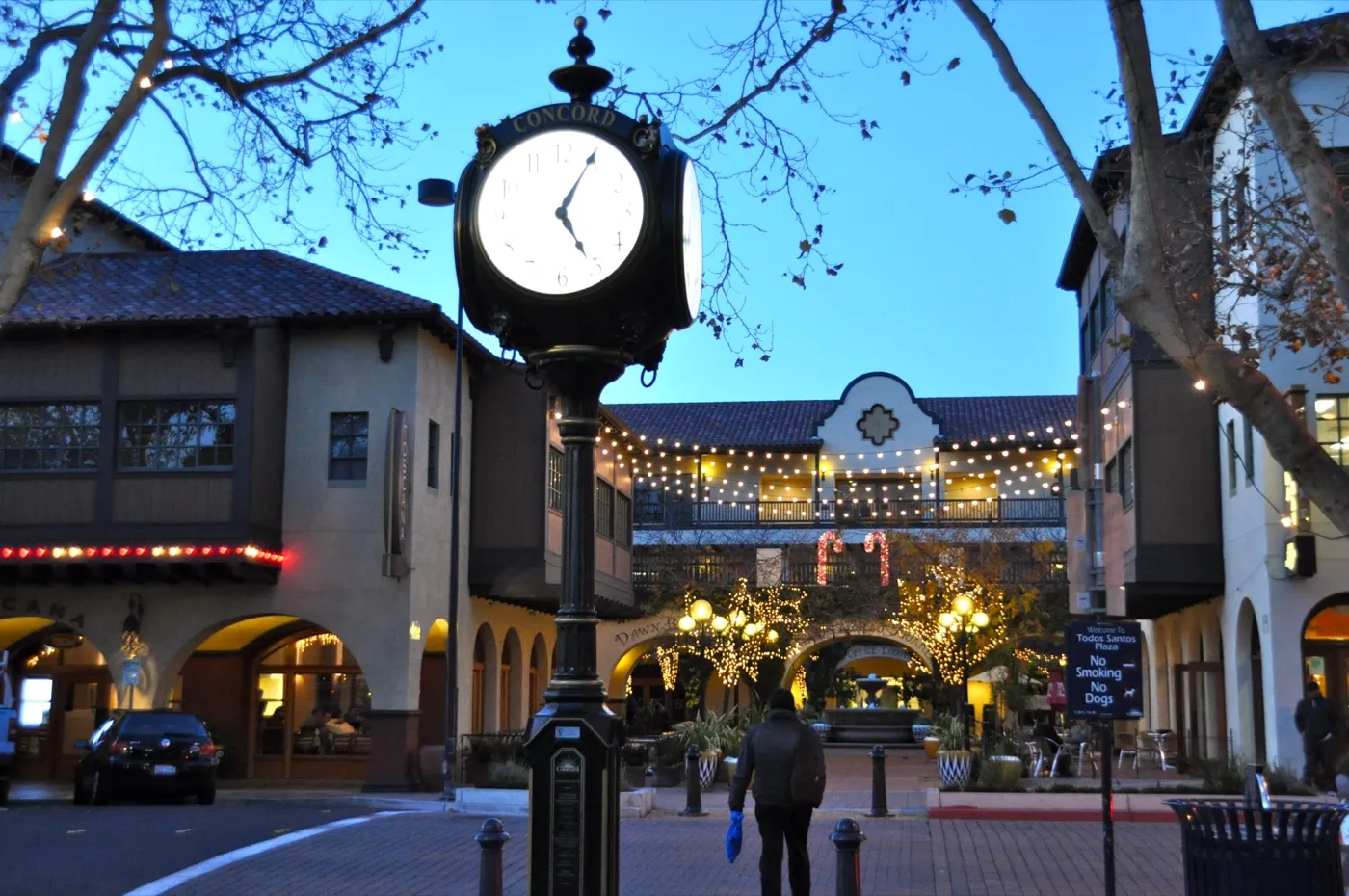
Concord is a city in Contra Costa County, California. The land was originally home to the Miwok people, and in 1834 the Mexican government granted Rancho Monte del Diablo, at the base of Mount Diablo, to Salvio Pacheco. The town was founded on Pacheco's initiative in 1869 under the name Todos Santos, Spanish for "all saints," and its name was later changed to Concord. The first Concord post office opened in 1872, and the city was incorporated on February 5, 1905.
In its early decades the surrounding Ygnacio and Clayton valleys formed a large agricultural area, producing grapes, walnuts, almonds, wheat, hay, and tomatoes. The focal point of downtown Concord is Todos Santos Plaza, a full city block that still carries the settlement's original name and is known for its farmers market and free summer concerts.
Source: Wikipedia: Concord, California.
Concord by the numbers
A neutral demographic snapshot from the most recent U.S. Census Bureau American Community Survey. These are city-wide figures; individual neighborhoods and parcels vary.
| Measure | Value |
|---|---|
| Population | 124,260 |
| Median age | 38.6 years |
| Median household income | $109,195 |
| Homeownership rate | 61.4% |
| Median home value (owner-occupied) | $755,900 |
| Median gross rent (monthly) | $2,226 |
| Average commute to work (one way) | 32.6 minutes |
| Average household size | 2.68 people |
Source: U.S. Census Bureau, American Community Survey 2019-2023 5-year estimates, Concord city, California.
The Concord market right now
| Median sale price | $809,000 |
|---|---|
| Days on market | 18 |
| Homes for sale (inventory) | 209 |
| Homes sold | 98 |
| Sale-to-list | 101% |
Data: Redfin, May 2026
For broader Bay Area context behind the Concord numbers, read the current Bay Area market note.
What this means for you (May 2026)
Concord offered 209 active listings in May, one of the widest selections in Contra Costa County. With 98 closings and a 101% sale-to-list ratio, homes are selling close to asking but not so fast that you can't compare. Buyers here get genuine variety in floor plans, neighborhoods, and price ranges, and the pace lets you take your time and choose well.
Property taxes in Concord
In Concord, property tax begins with Contra Costa County's 1% base under Proposition 13 (California's 1978 cap on the base tax at 1% of assessed value), plus voter-approved bonds. On a representative single-family bill in Concord (FY 2024-25), the total ad valorem rate (the part charged against assessed value) is 1.0992%, and the effective rate runs about 1.24%.
The biggest flat charge is CONCORD RES SEWER at $806.00. The bill also carries MT D MELLO ROOS $67.00, a small Mount Diablo Unified school Mello-Roos (an extra school tax) shared across the district's cities, plus CONCORD STREET LTS $25.00 and FED STORMWATER A-3 $35.00. Special assessments total $974.46.
Concord's bill pairs that county-wide MT D MELLO ROOS $67.00 school line with city sewer and street lights, and there is no development-tract Community Facilities District (CFD). See the Mello-Roos guide, how California property tax works, and the true monthly cost calculator. Figures come from a representative single-family county bill (FY 2024-25); every parcel differs, so check the actual bill for any home you are weighing. Compare all 38 cities side by side on the Bay Area property tax map. This is educational, not tax or legal advice; confirm any figure with a qualified tax professional and the county assessor before relying on it.
Schools (Mt. Diablo Unified School District)
Mt. Diablo Unified School District (MDUSD) serves roughly 30,000 students across 52 schools (29 elementaries, 9 middle schools, 5 comprehensive high schools, and 7 alternative programs) covering Concord, Pleasant Hill, Walnut Creek, Clayton, and parts of Lafayette and Martinez. The district is large and internally variable: high-performing schools in Walnut Creek (Northgate High) and Pleasant Hill (College Park High) anchor one end of the range, while several Concord-proper schools sit closer to the district median. Per-school verification matters more here than the district headline.
Concord buyers should focus on attendance area, not the district name. The Concord-proper high schools are Concord High (Crossings, Dana Estates, Sun Terrace neighborhoods), Mt. Diablo High (downtown / Monument Corridor), and Ygnacio Valley High (Ygnacio Valley road corridor). The most desirable MDUSD high school for Concord-adjacent buyers is Northgate High in north Walnut Creek (consistently top 100 California per U.S. News); because attendance assignment is set by parcel and third-party rankings differ by school, buyers considering the Northgate attendance area (Walnut Creek city, MDUSD (Mount Diablo Unified School District) district) should verify the exact assignment with the district registrar before an offer. Clayton Valley Charter (former MDUSD school, conversion to charter in 2012) serves Clayton and east Concord and runs its own enrollment lottery independent of attendance lines.
Typical assignment by sub-area
| Sub-area | Elementary feeders | Middle | High |
|---|---|---|---|
| Crossings / Dana Estates / Sun Terrace (south Concord) | Holbrook / Sun Terrace / Wren | El Dorado / Oak Grove Middle | Concord High |
| Downtown / Monument Corridor (central) | Meadow Homes / Monte Gardens / Westwood | Riverview / El Dorado | Mt. Diablo High |
| Ygnacio Valley corridor (north-east) | Bel Air / Ayers / Wren | Pine Hollow / Oak Grove | Ygnacio Valley High |
| East Concord / Clayton-adjacent | Mt. Diablo Elem / Highlands | Pine Hollow | Clayton Valley Charter (lottery enrollment) |
MDUSD attendance lines are granular and parts of the same Concord street can fall into different feeder patterns. Lily verifies the current assignment with the MDUSD registrar before any offer.
Highlight schools
- Northgate High School (Walnut Creek, MDUSD), consistently top 100 California per U.S. News. Buyers willing to cross into the Walnut Creek city line for this attendance area pay a noticeable premium.
- College Park High School (Pleasant Hill, MDUSD), top 250 California, deep AP catalog, the second-tier-flagship of the district.
- Clayton Valley Charter2012 charter conversion serving Clayton and east Concord; lottery enrollment, not boundary-based; strong academic record.
- Concord High School (~2,000 students), the largest in-Concord MDUSD high school; mid-tier ranking; full sports and AP catalog.
Sources: Mt. Diablo Unified School District; Clayton Valley Charter; California Department of Education DataQuest; Niche MDUSD; U.S. News MDUSD.
Hospitals and birthing centers
Concord sits in the central Contra Costa hospital pool. The main in-city option is John Muir Medical Center Concord. The regional Level III NICU for Contra Costa County is at the sister facility John Muir Medical Center Walnut Creek (~10-15 minutes south), and that is also where Kaiser Permanente members from Concord deliver since there is no Kaiser L&D in Concord proper.
| Hospital | Network | Drive time from Concord | Key services |
|---|---|---|---|
| John Muir Medical Center Concord | John Muir (PPO) | in-city (0-10 min) | Labor & delivery; full-service acute care; trauma-receiving emergency department |
| John Muir Medical Center Walnut Creek | John Muir (PPO) | 10-15 min | Regional Level III NICU (only one in Contra Costa County, Stanford Children's partnership); Level II Trauma Center; high-risk pregnancy referral center |
| Kaiser Permanente Walnut Creek Medical Center | Kaiser (closed) | 10-20 min | Closest Kaiser labor & delivery for Concord Kaiser members |
| Kaiser Permanente Antioch Medical Center | Kaiser (closed) | 15-25 min | Alternative Kaiser L&D for east-Concord Kaiser members |
| Sutter Delta Medical Center (Antioch) | Sutter (PPO) | 20-30 min | L&D with birthing center; alternative PPO option for east-Concord buyers |
Birthing centers: what matters
John Muir Concord is the default for in-city deliveries on a PPO plan for routine, low-risk births. For high-risk pregnancy, premature delivery below 32 weeks, or any need for a Level III NICU, John Muir Walnut Creek is the referral destination (and is in the same network, so the handoff is internal). The Walnut Creek Level III NICU is the only one in Contra Costa County, a partnership with Stanford Children's.
Kaiser members in Concord deliver at Kaiser Walnut Creek (most common, ~10-20 min) or Kaiser Antioch (~15-25 min) depending on east-or-west of the I-680 corridor. Both are full Kaiser L&D facilities. There is no Kaiser birthing center in Concord proper.
Hospital network coverage depends on your insurance plan. Lily does not advise on medical coverage decisions; for in-network confirmation contact your insurer directly. Hospital information above is current as of 2026-05-28 and should be re-verified with each hospital's admissions office before relying on it for a major life decision.
Sources: John Muir Concord; John Muir Walnut Creek; Kaiser Walnut Creek maternity; Sutter Delta Medical Center; California Perinatal Quality Care Collaborative NICU Directory.
Crime, hazards, and ratings
Concord carries moderate crime exposure, sits mostly outside FEMA flood zones, with elevated fire hazard in hillside tracts relative to the broader Bay Area. School ratings reflect the local district's performance bands.
| Category | Rating | Detail |
|---|---|---|
| Crime | property crime above US average; violent crime near California average; concentrated in the Monument Blvd corridor | |
| Flood | Mostly Zone X; Zone AE along Walnut Creek, Galindo Creek, and Mt. Diablo Creek | |
| Fire | Moderate to High in eastern Concord (Lime Ridge, Crystyl Ranch, Limeridge Open Space borders); flatland tracts not in LRA hazard zones | |
| Earthquake | Concord Fault traverses the city center (north-south between Pleasant Hill and Clayton); Green Valley Fault about 6 miles north; Calaveras about 10 miles east; liquefaction: Moderate; Higher along Walnut Creek and the Concord Naval Weapons Station baylands |
School ratings
Numeric snapshots for the highlight schools above:
| School | GreatSchools | Niche |
|---|---|---|
| Northgate High | 9 | A |
| College Park High | 7 | A- |
| Clayton Valley Charter | 9 | A |
| Concord High | 5 | B |
Environment and infrastructure
Beyond the natural-hazard ratings above, these are the environmental and infrastructure factors buyers ask about most. Each is a city-level summary; confirm the exact parcel before any offer.
| Factor | Detail |
|---|---|
| Gas transmission pipelines | Concord is a major node on Kinder Morgan's SFPP refined-products pipeline system: the SFPP Concord station (1550 Solano Way) feeds the 10-inch San Jose line south toward Alameda County and a separate 20-inch line to Sacramento, all carrying gasoline, diesel and jet fuel, alongside PG&E gas transmission lines shown in PHMSA's National Pipeline Mapping System. NPMS alignments are approximate and exclude local distribution mains, so proximity to a given property should be confirmed via the NPMS viewer or the operator. |
| Noise (freeway, rail, flight paths) | Concord's major noise sources are the CA-242 freeway and I-680, the BART Yellow Line with Concord and North Concord/Martinez stations, and aircraft from Buchanan Field Airport (KCCR), a general-aviation field one mile west of downtown that averages roughly 120,000 operations per year. Residents from North Concord to neighboring Pleasant Hill report piston-aircraft and touch-and-go overflight noise despite a county noise ordinance limiting hours and louder aircraft. |
| Refineries and heavy industry | Concord sits roughly 6 to 10 miles south and east of the Martinez refinery cluster (Marathon and PBF Energy / Martinez Refining Company) and the North Concord area is within range of refinery-incident smoke and the county Community Warning System, though Concord is not immediately fence-line to the plants. The city's dominant heavy-industry legacy is the former Concord Naval Weapons Station rather than petroleum refining. |
| Soil and groundwater contamination | The 12,800-acre former Concord Naval Weapons Station is a federal cleanup site, listed on the Superfund National Priorities List in December 1994, with documented soil and groundwater contamination including arsenic (from historic herbicide use), lead and other heavy metals, chlorinated solvents and munitions residue across dozens of sites; the Navy must complete cleanup before the planned master-planned reuse community can be built. Concord also has the usual scatter of smaller commercial cleanup sites in DTSC EnviroStor and SWRCB GeoTracker. |
| Air quality and wildfire smoke | Concord's air quality is generally moderate, driven by freeway traffic and regional sources, but the northern county carries an elevated pollution and refinery-flaring burden documented by BAAQMD, and the inland location sees summer ozone and regional wildfire smoke. BAAQMD and AirNow provide current conditions and CalEnviroScreen scores pollution burden by census tract. |
| Wildfire zone and power shutoffs (PSPS) | Most of Concord is valley floor and outside the high fire-hazard zones, but the open grasslands of the former Naval Weapons Station and the eastern foothills toward Mount Diablo include CAL FIRE Fire Hazard Severity Zone acreage and grass-fire risk, and parts of the area carry PG&E Public Safety Power Shutoff exposure. Exact zone designation for a parcel should be checked on the CAL FIRE FHSZ viewer. |
| High-voltage power lines | PG&E high-voltage transmission corridors and substations serve Concord and the central-county grid, with overhead lines following utility easements and freeway alignments. Exact corridor and substation proximity to a specific neighborhood should be confirmed on PG&E or CPUC mapping. |
| Sea level and shoreline flooding | Most of Concord is inland and not exposed to sea-level rise, but the far-northern Tidal Area edge of the former Naval Weapons Station along Suisun Bay is low-lying shoreline with tidal-flooding and sea-level-rise exposure under NOAA and BCDC scenarios. The developed residential core of the city is not exposed; parcels near the northern shoreline should be checked against the NOAA Sea Level Rise Viewer. |
These are city-level summaries from public agencies and are approximate. Pipeline and power-line alignments, contamination parcels, and wildfire zones can differ block by block; verify the exact address with the agency tools linked above and your inspections before you write an offer.
Sources: PHMSA National Pipeline Mapping System; DTSC EnviroStor; State Water Board GeoTracker; EPA Superfund; BAAQMD air data; CAL FIRE Fire Hazard Severity Zones; PG&E PSPS maps; NOAA Sea Level Rise Viewer
Hazard ratings are city-level aggregates from public agencies (FEMA, CAL FIRE, USGS). Specific addresses can carry materially different risk; verify the exact parcel via the FEMA Flood Map Service Center, the CAL FIRE FHSZ viewer, and your insurance carrier before any offer. School ratings vary by year and by metric; the numbers above are point-in-time snapshots, treat them as a starting point and re-verify with the district registrar.
Sources: CrimeGrade.org (crime); FEMA Flood Map Service Center (flood); CAL FIRE FHSZ viewer (fire); USGS earthquake hazards (earthquake); GreatSchools + Niche (school ratings).
Track Record
6 documented Concord closings, $5.0M local volume. Career-wide: 104 documented closings, $115M+ in total volume, with 91 of 104 on the buyer side, 10 closings in the last 12 months, career range $323K to $3.3M, 5.0-star Zillow average across 38+ reviews. The full transaction record for every Bay Area city Lily has closed in is summarized at the cities index. Every transaction below links to the address on Zillow.
 Buyer
Buyer
$0.95M
Jul 2025 · Buyer-side
1362 Meadow Glen Way, Concord
 Buyer
Buyer
$0.42M
Jul 2024 · Buyer-side
5455 Kirkwood Dr APT G8, Concord
 Buyer
Buyer
$1.22M
Apr 2023 · Buyer-side
1181 Via Doble, Concord
 Buyer
Buyer
$0.90M
Sep 2021 · Buyer-side
5000 Saint Bonaventure Ct, Concord
 Buyer
Buyer
$0.97M
Mar 2021 · Buyer-side
4400 Kearsarge Ct, Concord
 Buyer
Buyer
$0.53M
Mar 2019 · Buyer-side
1703 Trailside Cir, Concord
104 transactions · $115M+ · 5.0★ Zillow · Cal DRE #02010731
What buying a home in Concord actually involves
Buying in Concord starts with the west-east decision. West Concord, within reach of the Concord BART station and the Walnut Creek border, carries the premium; east Concord toward Clayton Valley gives back more space per dollar and a longer ride. I make you price that split deliberately: measured per square foot, Concord runs 15 to 30% below Walnut Creek and Pleasant Hill for comparable inventory, and that discount is the whole reason most buyers are here, so the job is to keep it from leaking away on the wrong block.
Then the checks. Most of the city sits inside Mt. Diablo Unified, and the district name tells you less than the specific feeder, so I confirm the school assignment by address with the registrar before any offer. I read the full disclosure package end to end, with attention to what 1950s-to-70s construction tends to disclose, model the true monthly cost with the Highway 4 or BART commute counted as part of the decision, and walk the property at more than one hour of the day. Six documented Concord closings, from a $425,000 Kirkwood Drive condo to a $1,220,000 Via Doble purchase, are the local ground under that method; when the facts stop supporting the price, I tell you to pass. Concord particulars are in the FAQ below.
What selling a home in Concord involves
Selling in Concord means pricing against the buyer's alternative, because your buyer is almost always cross-shopping Walnut Creek and Pleasant Hill and choosing Concord for the space-per-dollar math. A listing priced as if the Walnut Creek premium applied here sits; a listing priced to the Concord comp line with clean preparation converts that cross-shopping traffic into offers. West Concord near BART and east Concord toward Clayton Valley draw different buyer pools, so I build the comp set from your side of the split, not the citywide median.
The preparation is the standard Strategic Listing discipline: pre-listing inspection, positive-ROI improvements only, professional photography, full disclosure preparation, and active bid management through the launch window. Priced right, the Concord discount is your marketing: the same commute for less money is an argument that makes itself.
The Meticulous Protector, applied to Concord
What does Concord's entry price actually buy? Usually a 1950s-to-70s ranch house, and the inspection discipline starts there: the roof, the original electrical and plumbing systems, and the sewer lateral (the buried pipe that carries waste from the house to the city main) get evaluated as the fifty-year-old components they are, not waved through because the price felt like a deal. The commute is part of the price too. Lily models Highway 4 and BART access into the true monthly cost of the house, because a payment that looks comfortable on paper can stop being comfortable once the daily drive is counted honestly. Parcels near the creeks get checked against flood mapping before an offer is recommended, not discovered afterward. The checklist items are Concord's own; the refusal to skip any of them is the same standard Lily applies in every city where she works.
What the record shows in Concord
Every one of the 6 documented Concord closings in Lily's record is a buyer representation, and that is consistent with what Concord is in her practice: the city where East Bay buyers stretch a budget into a real house. The file runs from 2019 to 2025 across a band from $425,000, a two-bedroom Kirkwood Dr condo bought in 2024, to $1,220,000 on Via Doble in 2023, with four-bedroom homes filling the middle. Three closings since 2023 keep the local read current. Against the full career record, 104 documented closings and $115M+ in total volume, six is a modest count; what it shows is a steady pattern of representing buyers at Concord's entry-level and mid-level price points across six years.
- 1362 Meadow Glen Way (2025): bought for $950,000, a 4-bedroom single-family home built in 1974 and the most recent Concord closing.
- 1181 Via Doble (2023): bought for $1,220,000, a 4-bedroom property of 1,934 square feet at the top of the local band.
- 5455 Kirkwood Dr APT G8 (2024): bought for $425,000, a 2-bedroom condo built in 1980 and the entry point of the band.
- 1703 Trailside Cir (2019): bought for $530,000, a 3-bedroom townhouse built in 2008.
Concord FAQ
What are the typical Concord price ranges in 2026?
Single-family homes in west Concord (closer to Walnut Creek, walkable to BART) typically run $800K-$1.3M. East Concord (Clayton-adjacent, larger lots) runs $700K-$1.1M for comparable inventory. Condos and townhomes city-wide run $400K-$700K. Newer construction in the Bay Point and Pittsburg corridors to the north can carry Mello-Roos.
Concord vs Walnut Creek vs Pleasant Hill, how should I decide?
Walnut Creek carries the strongest schools (Acalanes UHSD) and the highest prices. Pleasant Hill sits between Concord and Walnut Creek at a moderate discount with Mt. Diablo Unified schools. Concord is the largest of the three by population with the lowest price floor and the widest inventory variety. All three share the 680 corridor + multiple BART stations; the trade-off is school district + price.
How are Concord schools?
Mt. Diablo Unified School District covers most of Concord. Some Concord students attend Northgate High (technically Walnut Creek's MDUSD high school, but the boundary runs through Lime Ridge). Mt. Diablo High and Concord High are the two main Concord-area public high schools. School quality varies by attendance area; verify assignment by exact address.
Does Concord have BART?
Yes, two stations: Concord (downtown, walkable to several neighborhoods) and North Concord/Martinez (north end of the city). Concord BART to Embarcadero/Montgomery in SF runs 40-50 minutes off-peak with one transfer or direct on the Yellow Line.
Does Lily Garipova speak Russian for Concord transactions?
Yes. Russian is Lily's native language. She represents Russian-speaking buyers and sellers in Concord with full disclosure review, school assignment verification, and negotiation in either English or Russian. Russian-language Concord page: lilygaripova.com/ru/concord-realtor/.
What is the price band for Crystyl Ranch and the east-Concord hillside?
Crystyl Ranch is the planned 1990s gated hillside community in east Concord backing to Lime Ridge Open Space; single-family typically runs $1.3M to $2.2M depending on view, lot, and remodel status. HOA (homeowners association) dues vary from home to home, so pull the current HOA package for the specific unit to confirm the dues and what they cover, such as the gate, common-area landscaping, and trail access; SB 326 (California's balcony-inspection law for attached buildings) inspection status applies to the few attached units. Pricing carries a premium over the central Sun Terrace and Holbrook Heights tracts on the strength of the planned-community uniformity and the open-space backing.
What is the price band for Clayton Valley and Dana Estates in east Concord?
Clayton Valley and Dana Estates sit on the eastern flank of Concord toward Clayton, with mostly 1960s and 1970s ranch single-family on quarter-acre-plus lots. Pricing typically runs $900K to $1.4M depending on remodel status and the Clayton Valley Charter enrollment angle. The eastern half of the city is consistently $100K to $300K below the west-Concord BART-adjacent tracts at comparable square footage, with the trade-off being the longer drive to BART and the differing school feeder pattern.
What is the price band for Sun Terrace, Holbrook Heights, and the central Concord tracts?
Sun Terrace, Holbrook Heights, and the broader central-Concord tracts run $800K to $1.2M for 1950s and 1960s tract single-family in 2026. Lots are typically 5,500 to 7,500 sf, original wood-frame, and a meaningful share still carries 1960s electrical panels and galvanized supply lines that show up in inspection. The Concord High feeder pattern covers most of this band. Walking distance to Todos Santos Plaza and the downtown commercial core is the central differentiator versus the east-Concord tracts.
How walkable is downtown Concord and the Todos Santos Plaza?
Downtown Concord, anchored by Todos Santos Plaza on Salvio Street, is a walkable mid-density commercial core with restaurants, the Thursday farmers market, the summer concert series, the Brenden Theatres complex, and BART one block north. The walkshed extends roughly six to eight blocks; single-family inside that walkshed trades at a premium versus the broader central-Concord tracts. The Salvio Pacheco Plaza historic block and the Galindo House sit inside the same radius.
Concord BART vs North Concord/Martinez BART, which station should I weigh?
Concord BART (Yellow Line, downtown, on Oakland Ave at Grant) is the primary station with the most foot traffic, the larger walkshed, and the connection to downtown amenities. North Concord/Martinez BART (Port Chicago Hwy, north end of the city near the former Concord Naval Weapons Station) is a park-and-ride anchor that serves the northern residential tracts and Bay Point commuters. The walkshed at North Concord is much smaller; if walk-to-BART matters to your daily life, Concord BART is the only realistic option. Both run direct to Embarcadero on the Yellow Line.
What does the Concord to San Francisco commute actually cost in 2026?
Concord BART to Embarcadero is about $7.55 one-way in 2026 ($15.10 round-trip), about 45 to 55 minutes door-to-platform on the Yellow Line. Monthly cost at 5 days a week is roughly $315. Driving the same route is roughly $7 in Bay Bridge toll plus parking ($25 to $45 a day in SoMa or FiDi), so the round-trip drive-and-park exceeds $50; the BART differential is roughly $35 to $40 a day in BART favor before factoring vehicle wear, gas, and time. Hybrid 2 to 3 days in-office shifts the math but BART almost always wins.
Where does the Concord Reuse Project (former Naval Weapons Station) stand in 2026?
The Concord Reuse Project covers about 2,300 acres of the former Concord Naval Weapons Station, north of the Concord BART station and east of Port Chicago Hwy. The City of Concord master plan envisions roughly 13,000 housing units, 6,300 jobs, parks, and a regional trail network. As of 2026 the project is in entitlement and developer-selection phases; no significant residential construction has broken ground. Buyer impact on adjacent neighborhoods has been minimal so far but should be tracked as parcels move forward.
How does the Mt. Diablo High vs Concord High vs Ygnacio Valley High feeder pattern affect pricing?
Concord High serves the south-Concord and Sun Terrace tracts and carries the strongest mid-tier MDUSD reputation among the three in-city comprehensive high schools; the feeder commands a modest premium. Mt. Diablo High serves the downtown and Monument Corridor and runs below Concord High on most metrics. Ygnacio Valley High serves the northeast Ygnacio Valley corridor and runs roughly mid-pack. The high school feeder is the single biggest school-related pricing variable inside MDUSD-Concord; verify by parcel before offer.
Should I worry about the Concord Fault when buying in Concord?
Yes. The Concord Fault is a known active fault that traverses the city center north-south between Pleasant Hill and Clayton, generally tracking the Cowell Road and Treat Blvd corridors. The Alquist-Priolo Earthquake Fault Zone overlay covers a narrow band along the trace. Properties inside the overlay carry construction-restriction obligations on new structures across the fault line; resale value is rarely materially affected but disclosure must be made. Pull the parcel-specific California Geological Survey overlay before offer.
How does Lily Garipova represent Concord buyers specifically?
Lily reads every disclosure end-to-end (TDS, NHD, SPQ, HOA package, preliminary title, the parcel-specific California Geological Survey overlay for the Concord Fault trace), pulls the FEMA Flood Map for the Walnut Creek and Galindo Creek corridors, runs the carrying-cost model including any Mello-Roos for the Bay Point or far-north tracts, walks the property at multiple times of day, verifies MDUSD school assignment with the district registrar by parcel, and stays willing to recommend walking from a deal that does not pencil. Free 30-minute initial consultation.
How does Lily Garipova represent Concord sellers specifically?
Strategic Listing Model at the Concord sub-area level: comp set drawn from the exact neighborhood (Crystyl Ranch, Clayton Valley, Sun Terrace, Holbrook Heights, central-downtown), not city-wide averages; pre-listing inspection with positive-ROI improvements only; professional staging targeted to the sub-area buyer pool; multi-platform marketing with active bid management; full disclosure preparation to minimize post-close litigation. 6 documented Concord closings on $5.0M of local volume, Bay Area closings in every year since 2017, $115M+ career volume.
How do I schedule a Concord consultation with Lily Garipova?
Call or text 415-910-3958, or email lilyagaripova@gmail.com. Free 30-minute initial consultation by phone, Zoom, or in person at any Concord address that works for you. Available in English and Russian. Cal DRE #02010731. The consultation walks through your specific buying or selling math: budget, timeline, MDUSD school constraints, BART commute, financing pre-approval, and the realistic Concord sub-area that fits.
Concord vs Antioch vs Pittsburg for a first home?
Antioch and Pittsburg sit further east on Hwy 4, with price floors $100K to $250K below Concord for comparable single-family but with longer BART rides (Pittsburg/Bay Point and Antioch eBART stations), and the school-district context shifts to Antioch USD and Pittsburg USD which run below MDUSD on most metrics. Concord delivers the lowest price point among the cities with a direct BART-Yellow-Line connection to downtown SF and MDUSD school assignment. For first-time buyers prioritizing commute access and a stronger school district, Concord wins; for buyers maximizing square footage and willing to take the eBART transfer, Antioch and Pittsburg pencil better.
Concord vs Clayton, what is the practical difference?
Clayton is a small, separately incorporated city of about 11,000 immediately east of Concord, with most homes built in the 1980s and 1990s, larger lots, and the Clayton Valley Charter School as the dominant high school feeder (lottery enrollment, draws from Clayton and east-Concord). Pricing in Clayton runs $1.2M to $2.0M for single-family, a roughly $200K to $400K premium over comparable east-Concord stock. For buyers prioritizing the planned-suburban feel and Clayton Valley Charter, Clayton; for buyers wanting downtown-walkable Concord or BART access, Concord proper.
What kind of construction era dominates Concord single-family stock?
Concord is largely a 1950s to 1980s tract city. Central Concord (Sun Terrace, Holbrook Heights, the Concord High feeder area) is mostly 1950s and early 1960s post-war ranch on 5,500 to 7,500 sf lots. Mt. Diablo and Ygnacio Valley corridors are 1960s and 1970s tract. Crystyl Ranch and the east-hillside tracts are 1990s planned community. Newer construction north of Hwy 4 (Bay Point) can carry Mello-Roos. The construction-era distribution affects inspection scope, insurance posture, and remodel comp valuation.
What inspection items matter most in 1950s and 1960s Concord stock?
For 1950s and 1960s Concord single-family the priority inspection items are: galvanized supply line replacement status (typical $4K to $9K rehab), original electrical panel and aluminum wiring (Federal Pacific and Zinsco panels are insurance flags), pre-1980 sewer lateral status (Contra Costa enforces compliance at sale; budget $5K to $15K for a full replacement), foundation cracks especially in the Concord Fault trace corridor, and HVAC condition since many 1950s units still ran original gravity-fed wall furnaces until a recent replacement. Pre-listing inspection on the seller side eliminates most surprise.
What is the property tax base rate in Concord and is there Mello-Roos?
Concord property tax base rate runs roughly 1.10 to 1.18% of assessed value in 2026, depending on local bond overlays for the MDUSD bond, the East Bay Regional Park bond, BART bond, and the Contra Costa fire bond. Most established Concord single-family carries no Mello-Roos. Newer construction in the Bay Point and far-north corridors and in the Concord Reuse Project (once it begins delivering) is expected to include Mello-Roos community facilities districts to fund infrastructure; verify the specific CFD number and remaining term in the preliminary title before offer.
How has Concord priced over the trailing 12 months?
Concord single-family median has been roughly flat to up low-single-digits over the trailing 12 months ending mid-2026, with Crystyl Ranch and the Clayton-adjacent hillside tracts outperforming and the Monument Corridor and entry-level central tracts underperforming. The condo segment has been flat as the post-SB326 disclosure cycle surfaces deferred-maintenance liabilities at older I-680 corridor HOAs. Days-on-market has lengthened versus the 2021-2022 peak; well-prepped, well-priced listings still draw multiple offers; overpriced listings sit and chase the market down.
Concord vs Concord-adjacent unincorporated Contra Costa, what should I know?
Some addresses with a Concord mailing address sit in unincorporated Contra Costa County (specifically the Pacheco, Vine Hill, and west-edge tracts), not inside Concord city limits. Code enforcement, building permits, business license, and police service are handled by the county Sheriff and county building department rather than the City of Concord. Property tax base rate is comparable; school district assignment can shift to MDUSD vs Martinez USD depending on the boundary. Verify the actual jurisdiction by parcel before offer.
How does the Concord Pavilion and Sleep Train Pavilion concert venue affect adjacent housing?
The Concord Pavilion (also known historically as Sleep Train Pavilion and Toyota Pavilion) is a 12,500-capacity outdoor amphitheatre at 2000 Kirker Pass Rd in north-east Concord, hosting summer concerts. The acoustic footprint reaches roughly half a mile on event nights; properties in the Ygnacio Valley and Pavilion-adjacent tracts can hear evening sound on event days but the concert calendar is bounded to roughly May through October. Visit the property during a concert night during contingency if you are sensitive to noise; no material long-term resale impact has been documented.
Concord HOA, Mello-Roos, and supplemental tax considerations?
Many established Concord single-family homes (1950s to 1990s) have no HOA (homeowners association) and no Mello-Roos special tax, but this must be confirmed parcel by parcel. Where an HOA applies, such as at Crystyl Ranch and selected planned communities, the dues vary, so pull the current HOA package for the specific home. Mello-Roos is a special tax that funds infrastructure through a CFD (Community Facilities District); newer corridors and the Concord Reuse Project, once delivering, may carry one. The Mello-Roos special tax varies tract to tract, so pull the current annual levy for the specific parcel and add it to carrying cost: the current annual levy is shown on the county property tax bill and disclosed in the seller Mello-Roos Notice of Special Tax, while the recorded special-tax lien and its tax formula appear on the preliminary title report (the prelim shows that the lien and formula exist, not the current dollar amount). Buyers should always pull the parcel-specific tax bill, the preliminary title report and CC&Rs (the recorded covenants, conditions, and restrictions), and the HOA package early in contingency to capture the full carrying-cost picture.
What flip and remodel opportunities exist in Concord?
Concord has a meaningful flip and remodel sub-market in the 1950s and 1960s tract neighborhoods: dated cosmetics, original kitchens and baths, original electrical, and original sewer laterals on 5,500 to 7,500 sf lots. Acquisition typically $750K to $950K in central tracts; remodel scope $150K to $300K for a kitchen-bath-flooring-paint package with mechanical updates; resale typically $1.1M to $1.4M depending on sub-area. Lily reviews permit history, comp sales of recent flips in the exact tract, and the cost-to-build assumption before recommending an acquisition.
Concord ADU and small-multifamily resale dynamics?
Concord follows California ADU law (SB9, AB1033, AB976) and the city has been ADU-permit-friendly. Permitted ADUs (accessory dwelling units, a secondary home on the same lot) on Concord single-family lots add appraised value, can be rented for a market rate that varies by size and finish (get an actual rent quote for the specific unit), and support house-hacking strategies. Small 2 to 4 unit multifamily clusters in central Concord around the Monument Corridor typically run $900K to $1.6M; rent roll and permit history drive the cap rate. Verify ADU permit status with the city building department; unpermitted ADUs are common and complicate financing.
How does insurance pricing work for Concord homes in 2026?
Concord insurance pricing in 2026 reflects the broader California carrier-availability tightening. Most central and west Concord addresses can find HO-3 policies with major carriers (State Farm, Allstate, Farmers, AAA) though premiums have risen 20 to 40% versus 2022. Hillside addresses in Crystyl Ranch and the Lime Ridge / Pavilion borders carry CAL FIRE FHSZ moderate-to-high overlay and some carriers have non-renewed; the California FAIR Plan plus a wrap-around DIC is the fallback for those addresses. Always quote insurance during contingency before contingency removal.
What is the Concord historical California population trajectory and how does that affect the housing supply?
Concord has been Contra Costa County's largest city by population for decades, currently roughly 130,000 residents on about 31 square miles. Population growth has been moderate over the past decade (low single digits annually) with most net new housing delivered as infill and mid-density mixed-use along the Galindo Street and Monument Boulevard corridors. The Concord Reuse Project, once delivering, is expected to add roughly 13,000 housing units over a multi-decade build-out and reshape the city's long-term housing supply. Single-family resale dynamics in 2026 are not yet materially affected by Reuse Project supply.