Why Menlo Park
Menlo Park sits between Palo Alto to the south and Atherton and Redwood City to the north, with US-101 along the bay-side edge and El Camino Real cutting through the middle, a city of roughly 35,000 that two very different economies pull in opposite directions. Meta (formerly Facebook) headquarters anchors the bay-side, while Sand Hill Road's venture-capital corridor straddles the Menlo Park / Palo Alto border on the western edge. What makes the city hard to shop is that the school boundary follows the parcel, not the neighborhood name: Menlo Park City School District (top 2% California) covers central and east Menlo Park, Las Lomitas Elementary School District (Niche #72 California elementary, #47 California middle) covers west Menlo Park and Atherton, and Ravenswood City School District covers a small east-Menlo-Park slice near East Palo Alto. All three feed a single high school, Menlo-Atherton (U.S. News #229 California), through Sequoia Union High School District at the 9-12 layer, so the K-8 (kindergarten through grade 8) assignment is where the real divergence between two addresses lives.
Those same parcel lines set the price. Menlo Park single-family typically runs $2.5M to $5M+ in the central Menlo Park City SD attendance, $3M to $8M+ on the Las Lomitas west-side and Atherton-adjacent streets, and $1.4M to $2.5M on the east-side near US-101, with condos and townhomes at $1.0M to $2.0M, so a single city name spans a range wide enough to behave like three markets. Across all of it, Menlo Park tracks 10 to 20% below Palo Alto per square foot for comparable single-family. Lily's surrounding Peninsula record covers the area, 1 Mountain View, 1 San Mateo, 1 Foster City, 1 Belmont, and 1 East Palo Alto, each within the same Stanford-anchored hospital catchment as Menlo Park, and each a reminder that on this stretch of the Peninsula the parcel decides more than the mailing address. Put together, the Menlo Park housing market spans a range wide enough to behave like three markets, and which one a buyer is in is set by parcel, not neighbourhood name.
A short history of Menlo Park
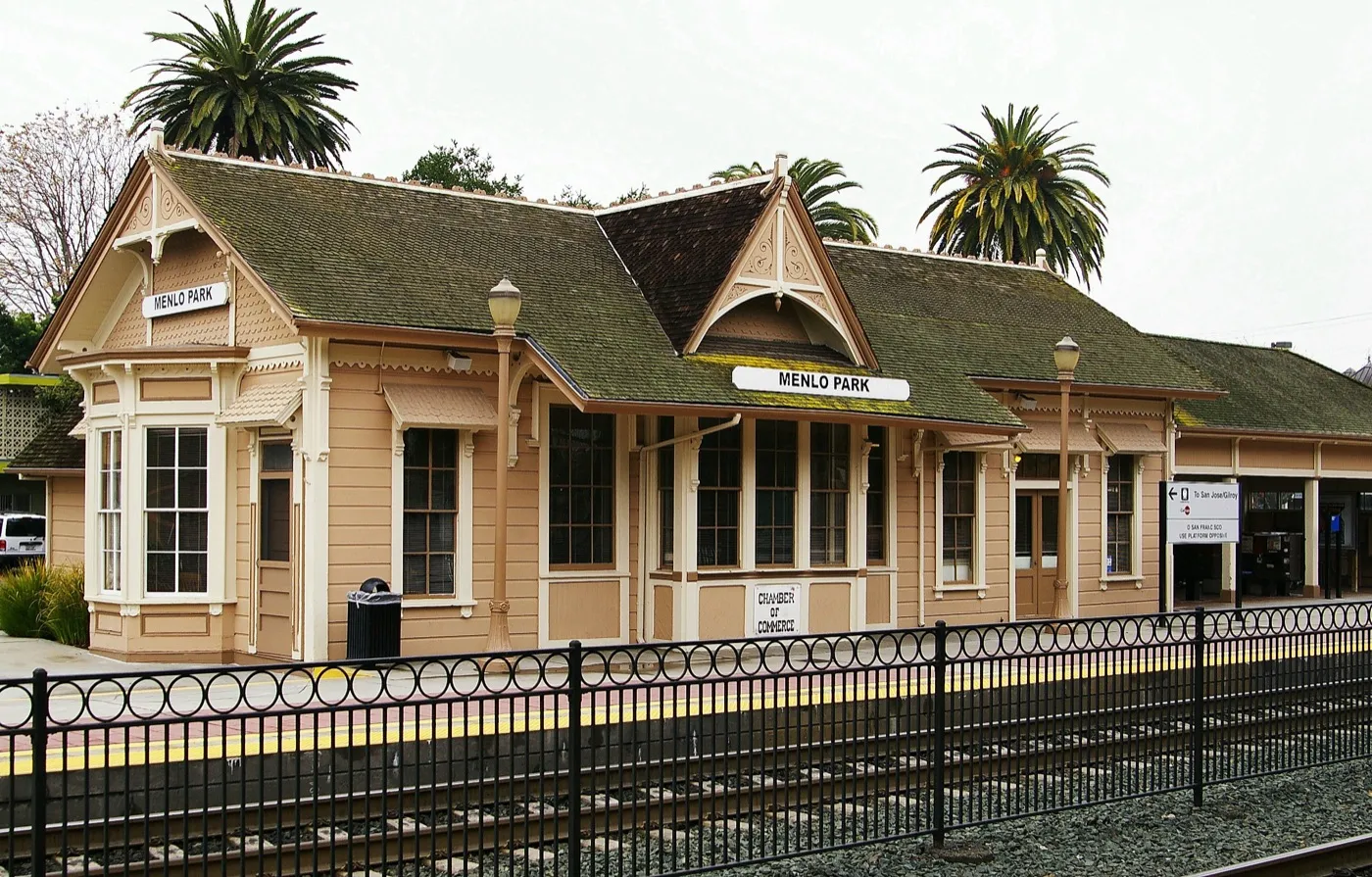
Menlo Park sits in San Mateo County on the San Francisco Peninsula, on land that was once part of Rancho de las Pulgas, a Spanish grant dating to 1795. Irish immigrants who bought a large tract here in the early 1850s gave the place its name after Menlo in County Galway, Ireland, and marked the entrance with a wooden gate inscribed "Menlo Park" and dated August 1854; that gate stood until a 1922 automobile collision destroyed it. The railroad reached the area in 1863, and the 1867 station building still stands today, recorded as the oldest continually operating train station in California.
The community first incorporated in 1874 but dissolved within two years, then incorporated permanently as a city on November 23, 1927. During World War I the U.S. Army operated Camp Fremont here as a training cantonment from 1917 to 1918, with a peak of roughly 27,000 soldiers.
Source: Wikipedia: Menlo Park, California.
Menlo Park by the numbers
A neutral demographic snapshot from the most recent U.S. Census Bureau American Community Survey. These are city-wide figures; individual neighborhoods and parcels vary.
| Measure | Value |
|---|---|
| Population | 32,775 |
| Median age | 38.5 years |
| Median household income | $206,588 |
| Homeownership rate | 55.3% |
| Median home value (owner-occupied) | $2,000,000+ |
| Median gross rent (monthly) | $3,156 |
| Average commute to work (one way) | 24.2 minutes |
| Average household size | 2.71 people |
Source: U.S. Census Bureau, American Community Survey 2019-2023 5-year estimates, Menlo Park city, California.
The Menlo Park market right now
| Median sale price | $3,762,000 |
|---|---|
| Days on market | 16 |
| Homes for sale (inventory) | 28 |
| Homes sold | 31 |
| Sale-to-list | 103% |
Data: Redfin, May 2026
For broader Bay Area context behind the Menlo Park numbers, read the current Bay Area market note.
What this means for you (May 2026)
Menlo Park saw more closings (31) than active listings (28) in May, a sign that demand is absorbing everything that comes to market. Homes sold at 103% of asking in 16 days. For sellers, this means pricing accurately will attract multiple offers and push the final sale above asking.
Property taxes in Menlo Park
Property tax in Menlo Park starts with San Mateo County's 1% base under Proposition 13 (California's 1978 law capping the base rate and limiting how fast assessed value climbs), plus voter-approved bond debt. On a verified representative single-family bill for fiscal year 2025-26, the total ad valorem rate (the value-based portion) was 1.09580%, the effective rate about 1.240%.
The direct charges are heavy, led by MP ESD COMB MEAS SP TAX at $1,553.34 (the Menlo Park City School District combined parcel taxes, flat per-property levies) and WEST BAY SANI DIST at $1,440.00 (sewer). The rest are smaller: MP TREE MAINT $116.02 and MP STORM WATER FEE $13.28, for a total of $3,158.12.
So the Menlo Park City School District combined parcel taxes and the West Bay Sanitary District sewer charge make these direct charges heavy. See how California property tax works, and use the true monthly cost calculator to estimate a specific home. Figures come from a representative single-family county bill (FY 2025-26); every parcel differs, so check the actual bill for any home you are weighing. Compare all 38 cities side by side on the Bay Area property tax map. This is educational, not tax or legal advice; confirm any figure with a qualified tax professional and the county assessor before relying on it.
Schools (Menlo Park City SD + Las Lomitas Elementary SD + Sequoia Union HSD)
Menlo Park is one of the most district-fragmented K-8 cities on the Peninsula. Menlo Park City School District (MPCSD, 2,685 students, state rank #33 of 1,908, top 2%) covers central and east Menlo Park. Las Lomitas Elementary School District (Niche #72 California elementary, #47 California middle) covers west Menlo Park and Atherton. Ravenswood City School District covers a small east-Menlo-Park slice. All three K-8 districts feed into Sequoia Union High School District (9,505 students, 10 schools), with Menlo-Atherton High School (U.S. News #229 California) as the primary high school for Menlo Park addresses.
The K-8 district fragmentation is the highest-leverage school variable in Menlo Park buying. The same street can have two different K-8 attendance areas depending on the parcel; MPCSD and Las Lomitas both rank in California's top 5% for K-8, with comparable academic outcomes; Ravenswood is among the most economically challenged K-8 districts on the Peninsula, and the Ravenswood-to-Menlo-Atherton transition is a major step-up. Lily verifies the exact K-8 district by parcel before any offer.
Typical assignment by sub-area
| Sub-area | K-8 district | Elementary feeders | High |
|---|---|---|---|
| Central Menlo Park / Allied Arts | Menlo Park City SD | Encinal / Laurel / Oak Knoll + Hillview Middle | Menlo-Atherton High |
| West Menlo Park / Sharon Heights | Las Lomitas Elementary SD | Las Lomitas / La Entrada | Menlo-Atherton High |
| East Menlo Park (Belle Haven side) | Ravenswood City SD | Belle Haven / Costaño | Menlo-Atherton High |
| South Menlo Park (near Palo Alto border) | Menlo Park City SD or Las Lomitas (varies) | verify by parcel | Menlo-Atherton High |
K-8 district fragments across 3+ districts depending on street address; verify the boundary at parcel level. Lily checks both MPCSD and Las Lomitas (and Ravenswood where relevant) registrars before any offer; this is the single most important pre-offer step for Menlo Park buyers.
Highlight schools
- Menlo-Atherton High School (Sequoia Union HSD, 9-12), U.S. News #229 California; serves all Menlo Park addresses regardless of K-8 district; the primary high school for Atherton, central Menlo Park, west Menlo Park, and East Palo Alto.
- Hillview Middle School (MPCSD, 6-8), the central / east Menlo Park MPCSD middle feeder.
- La Entrada School (Las Lomitas SD, 4-8), the west Menlo Park / Atherton middle feeder; among the top-ranked middle schools in California.
- Encinal Elementary School (MPCSD, K-3), one of the stronger MPCSD elementaries; central Menlo Park attendance.
Sources: Menlo Park City School District; Las Lomitas Elementary School District; Sequoia Union HSD; U.S. News Menlo-Atherton; PublicSchoolReview MPCSD.
Hospitals and birthing centers
Menlo Park has no in-city hospital with L&D, but the Stanford catchment makes it functionally one of the best-served cities on the Peninsula. Stanford Hospital + Lucile Packard Children's Hospital Stanford (Palo Alto, about 5 to 10 min south) is the de facto in-corridor flagship, with a Level IV NICU. Kaiser members deliver at Kaiser Redwood City (about 10 to 15 min). For north Menlo Park, Mills-Peninsula Burlingame (about 15 to 20 min) is an alternative Sutter PPO option.
| Hospital | Network | Drive time from Menlo Park | Key services |
|---|---|---|---|
| Lucile Packard Children's Hospital Stanford (Palo Alto) | Stanford (PPO) | 5-10 min | Level IV NICU (40 beds); high-risk obstetrics + neonatology + pediatric specialists 24/7; 4,500+ births / year |
| Kaiser Permanente Redwood City Medical Center | Kaiser (closed) | 10-15 min | Full Kaiser L&D (above 34 weeks); transfers premature below 34 weeks to Kaiser Santa Clara or Kaiser SF NICU |
| Mills-Peninsula Medical Center (Burlingame) | Sutter (PPO) | 15-20 min | Sutter Family Birth Center; Level II NICU; alternative for north Menlo Park |
| El Camino Health Mountain View | Independent (PPO) | 10-15 min | Alternative PPO L&D; Women's Hospital with Level III NICU (Stanford Medicine partnership) |
Birthing centers: what matters
Lucile Packard Stanford is the default for Menlo Park PPO buyers: 5 to 10 minutes south, Level IV NICU on-site (the highest available), 24/7 high-risk obstetrics and neonatology coverage. Geographic proximity to Stanford makes Menlo Park essentially a Stanford-catchment city for high-acuity OB; the catchment advantage is the same as Palo Alto.
Kaiser members in Menlo Park go to Kaiser Redwood City for routine delivery (above 34 weeks gestation). Premature delivery below 34 weeks transfers to Kaiser Santa Clara or Kaiser SF NICU.
North Menlo Park buyers can choose Mills-Peninsula Burlingame (Sutter Family Birth Center, Level II NICU) as a closer Sutter PPO alternative depending on insurance network. Higher-acuity transfers from Mills-Peninsula go to Stanford Lucile Packard or UCSF Mission Bay.
Hospital network coverage depends on your insurance plan. Lily does not advise on medical coverage decisions; for in-network confirmation contact your insurer directly. Hospital information above is current as of 2026-05-28 and should be re-verified with each hospital's admissions office before relying on it for a major life decision.
Sources: Lucile Packard L&D; Kaiser Redwood City L&D; Mills-Peninsula Burlingame; El Camino Women's Hospital; California Perinatal Quality Care Collaborative NICU Directory.
Crime, hazards, and ratings
Menlo Park carries moderate crime exposure, significant flood exposure in shoreline and creek-adjacent tracts, and moderate fire hazard in hillside tracts relative to the broader Bay Area. School ratings reflect the local district's performance bands.
| Category | Rating | Detail |
|---|---|---|
| Crime | property crime moderately above US average; violent crime variable (much lower in Allied Arts/Vintage Oaks west of US 101; higher in Belle Haven east of US 101) | |
| Flood | Zone X west of US 101; Zone AE/AO in Belle Haven and along San Francisquito Creek; Zone AE along the bay shoreline | |
| Fire | Moderate in the western tracts adjacent to Sharon Heights/Stanford foothills; flatland tracts not in LRA hazard zones | |
| Earthquake | San Andreas Fault about 3 miles west; Pulgas Fault about 4 miles west; liquefaction: High in Belle Haven and along the shoreline; Moderate in central tracts; Low in west Menlo |
School ratings
Numeric snapshots for the highlight schools above:
| School | GreatSchools | Niche |
|---|---|---|
| Menlo-Atherton High | 8 | A |
| Hillview Middle | 9 | A |
| Encinal Elementary | 9 | A |
Environment and infrastructure
Beyond the natural-hazard ratings above, these are the environmental and infrastructure factors buyers ask about most. Each is a city-level summary; confirm the exact parcel before any offer.
| Factor | Detail |
|---|---|
| Gas transmission pipelines | PG&E gas transmission lines (the same Milpitas-to-San Francisco Peninsula system that includes Line 132, which ruptured at San Bruno in 2010) serve Menlo Park. Per-address transmission-line proximity should be verified on the PHMSA NPMS Public Viewer. |
| Noise (freeway, rail, flight paths) | US-101, I-280, and the Caltrain corridor pass through or border the city; SFO arrival/departure tracks and the post-2015 NextGen flight-path changes generated overflight-noise complaints in mid-Peninsula communities including Menlo Park. |
| Refineries and heavy industry | No refineries or heavy industry. Historic light-industrial and research activity (including the former USGS campus and tech offices in the Belle Haven / bayfront area), but no operating refinery or major emitter. |
| Soil and groundwater contamination | Menlo Park has multiple documented cleanup sites in state databases, including former industrial and bayfront-fill parcels; the bayfront Belle Haven / Ravenswood area has a history of fill and industrial use. Specific site status should be checked in DTSC EnviroStor / GeoTracker. |
| Air quality and wildfire smoke | Generally good regional air quality, but the bayfront Belle Haven neighborhood carries a higher pollution-burden score (proximity to US-101, Dumbarton approach, and bayfront sources) than the western parts of the city; episodic wildfire smoke affects the whole area. |
| Wildfire zone and power shutoffs (PSPS) | Menlo Park is predominantly flatland and is not in a CAL FIRE high fire hazard severity zone; PSPS exposure is minimal compared with the western foothill communities (Woodside, Portola Valley). |
| High-voltage power lines | PG&E's Ravenswood Substation, a 230kV transmission-level substation in the Belle Haven / bayfront area of Menlo Park, feeds distribution substations across Menlo Park, Palo Alto, Redwood City, Belmont, East Palo Alto, San Carlos, and Atherton; it is itself a focus of the SAFER Bay flood-protection project. Per-address proximity to high-voltage lines should be verified. |
| Sea level and shoreline flooding | The bayfront Belle Haven / Bedwell Bayfront Park area and lands along the bay margin are exposed to projected sea level rise and bay flooding; Menlo Park and East Palo Alto are jointly protected by the SAFER Bay levee/floodwall project, and Menlo Park is included in San Mateo County / BCDC SLR planning. Western Menlo Park is not exposed. |
These are city-level summaries from public agencies and are approximate. Pipeline and power-line alignments, contamination parcels, and wildfire zones can differ block by block; verify the exact address with the agency tools linked above and your inspections before you write an offer.
Sources: PHMSA National Pipeline Mapping System; DTSC EnviroStor; State Water Board GeoTracker; EPA Superfund; BAAQMD air data; CAL FIRE Fire Hazard Severity Zones; PG&E PSPS maps; NOAA Sea Level Rise Viewer
Hazard ratings are city-level aggregates from public agencies (FEMA, CAL FIRE, USGS). Specific addresses can carry materially different risk; verify the exact parcel via the FEMA Flood Map Service Center, the CAL FIRE FHSZ viewer, and your insurance carrier before any offer. School ratings vary by year and by metric; the numbers above are point-in-time snapshots, treat them as a starting point and re-verify with the district registrar.
Sources: CrimeGrade.org (crime); FEMA Flood Map Service Center (flood); CAL FIRE FHSZ viewer (fire); USGS earthquake hazards (earthquake); GreatSchools + Niche (school ratings).
Track Record
Active Menlo Park representation backed by the surrounding Peninsula track record. Career-wide: 104 documented closings, $115M+ in total volume, with 91 of 104 on the buyer side, 10 closings in the last 12 months, career range $323K to $3.3M, 5.0-star Zillow average across 38+ reviews. The full transaction record for every Bay Area city Lily has closed in is summarized at the cities index.
Ready to talk about Menlo Park? Call or text me at 415-910-3958 for a free 30-minute consultation.
104 transactions · $115M+ · 5.0★ Zillow · Cal DRE #02010731
What buying a home in Menlo Park actually involves
Same fiduciary discipline as on every Lily Garipova representation: read every disclosure end-to-end, model the carrying cost (mortgage plus property tax plus HOA plus insurance), walk the property at multiple times of day, and stay willing to walk you away from a property that does not pencil. Menlo Park-specific particulars are covered in the FAQ below; the K-8 district fragmentation (MPCSD vs Las Lomitas vs Ravenswood) is the highest-leverage pre-offer step for buyers; verify the exact district by parcel.
What selling a home in Menlo Park involves
Strategic Listing Model applied to Menlo Park: data-driven comp analysis of the specific Menlo Park sub-area (central MPCSD, west Las Lomitas, and east Belle Haven trade in different price bands by parcel), pre-listing prep with positive-ROI improvements only, professional staging targeted to the Meta / Sand Hill Road / venture-capital buyer demographic, multi-platform marketing with active bid management, and honest disclosure of every defect.
The Meticulous Protector, applied to Menlo Park
The methodology behind Lily's 38+ five-star Zillow reviews and the strong repeat-and-referral rate of her career: read every disclosure line, verify every claim, model every carrying cost, walk every property in person before recommending an offer, and document the honest "no" when the math says no. The Menlo Park version of that methodology is the same as the Dublin version, the Pleasanton version, the Walnut Creek version, and every other city Lily represents. The discipline does not change by city.
Menlo Park FAQ
What are Menlo Park price ranges in 2026?
Menlo Park single-family typically runs $2.5M to $5M+ in the central Menlo Park City SD attendance, $3M to $8M+ in the Las Lomitas SD west-side and Atherton-adjacent areas, and $1.4M to $2.5M in the east-side near US-101 (Ravenswood SD attendance area). Condos and townhomes run $1.0M to $2.0M. Menlo Park pricing tracks 10 to 20% below Palo Alto per square foot for comparable single-family.
Why hire Lily for a Menlo Park purchase or sale?
Honest answer: Lily's documented work on the surrounding Peninsula (1 Mountain View, 1 San Mateo, 1 Foster City, 1 Belmont, 1 East Palo Alto) puts her in the same Stanford-anchored hospital catchment and the same Sequoia Union / Mountain View-Los Altos / PAUSD school-district triangle that Menlo Park sits inside. Career-wide: 104 documented closings, $115M+ in volume, 38+ five-star Zillow reviews. The Meticulous Protector discipline does not change by city.
MPCSD vs Las Lomitas vs Ravenswood, why does it matter?
Menlo Park's K-8 district fragments across three districts depending on parcel. MPCSD (Niche / state top 2%) and Las Lomitas (Niche #72 California elementary, #47 California middle) both rank in California's top 5% for K-8 with comparable academic outcomes. Ravenswood is among the most economically challenged K-8 districts on the Peninsula. All three feed Menlo-Atherton High at 9-12, but the K-8 experience differs sharply. Because K-8 (kindergarten through grade 8) attendance is assigned by parcel and third-party school rankings differ by school, verify the exact district with the district registrar before an offer.
Does Lily Garipova speak Russian for Menlo Park transactions?
Yes. Russian is Lily's native language. Lily represents Russian-speaking buyers and sellers in Menlo Park and the broader mid-Peninsula in either English or Russian. Russian-language Menlo Park page: lilygaripova.com/ru/menlo-park-realtor/.
What is West Menlo Park and how does Las Lomitas attendance change the math?
West Menlo Park (Sharon Heights, Stanford Hills, the Las Lomitas-attended Atherton-adjacent west of El Camino) is the Las Lomitas Elementary SD carve-out, typically $3M to $8M+ for single-family in 2026 on quarter-acre to half-acre lots. Stock is 1950s-1970s ranch and 1980s-2000s custom remodels. Sharon Heights condos and townhomes ($1.5M to $3M) ride the same Las Lomitas attendance. Both districts rank in California's top 5% for K-8 (kindergarten through grade 8), but attendance is assigned by parcel and third-party rankings differ by school, so verify the exact assignment with the district registrar before an offer.
What is Allied Arts and how does the Stanford Park neighborhood differ?
Allied Arts is the historic district between downtown Menlo Park (Santa Cruz Avenue) and the Stanford border, with 1900s-1940s craftsman, Spanish revival, and English Tudor architecture on 6,000-8,000 sf lots, $3.5M to $6M for single-family in 2026. Stanford Park sits adjacent to Stanford University with mid-century moderns and 1970s contemporaries on slightly larger lots, $3M to $5M. Both feed MPCSD K-8 (Encinal Elementary, Hillview Middle) and Menlo-Atherton High. Allied Arts carries an architectural-character premium versus Stanford Park; Stanford Park trades closer to the university.
What is Felton Gables and how does it compare to Linfield Oaks?
Felton Gables is a small, tightly-knit central Menlo Park neighborhood between Middlefield Road and Laurel Street with 1920s-1940s English Tudor and craftsman on 6,500-8,500 sf lots, $3.5M to $5.5M for single-family in 2026. Linfield Oaks sits adjacent with similar era stock and slightly smaller lots, $3M to $5M. Both feed MPCSD K-8 (Laurel Elementary, Hillview Middle) and Menlo-Atherton High. The neighborhoods are walkable to downtown Menlo Park and the Menlo Park Caltrain station, which drives a downtown-proximity premium.
What is Sharon Heights and what should I know about the country club premium?
Sharon Heights is the planned hillside community in west Menlo Park anchored by Sharon Heights Country Club and the Sharon Park shopping center. Single-family typically $3M to $6M for 2026 on quarter-acre to half-acre lots in 1960s-1970s ranch and contemporary, plus 1980s-2000s custom infill. The Las Lomitas Elementary SD attendance (La Entrada Middle) is the dominant pricing driver. Country club membership is separate from HOA dues. Sharon Heights condos at Sharon Hills and Sharon Park run $1.5M to $2.5M, in the same Las Lomitas attendance.
How does the Sand Hill Road venture capital corridor affect Menlo Park pricing?
Sand Hill Road straddles the Menlo Park / Palo Alto border on the western edge, anchoring the global venture capital industry (Sequoia, Andreessen Horowitz, Kleiner Perkins). The corridor brings a wealth concentration effect to adjacent west Menlo Park residential (Sharon Heights, Stanford Hills, Felton Gables) and supports the Las Lomitas-attendance premium. Sand Hill Road employment density is much lower than Meta's east-side employment density; the effect is wealth concentration rather than commuter volume. The corridor's existence is part of why west Menlo Park stays expensive even when broader Bay Area pricing softens.
What is the Meta Headquarters effect on east-side Menlo Park pricing?
Meta (formerly Facebook) headquarters sits east of US-101 in the Belle Haven area of Menlo Park, with around 17,000 employees across the Menlo Park campus. The Meta presence has driven significant gentrification pressure on east-side Menlo Park since 2011, with Belle Haven single-family rising from $400K to roughly $1.4M to $2.5M for 2026. The Belle Haven block-by-block variance is high; some streets have fully gentrified, others retain older Ravenswood-SD-attendance character. The Ravenswood K-8 vs MPCSD K-8 boundary is a meaningful resale variable for buyers thinking about future appreciation.
What is the Menlo Park Caltrain commute math?
Menlo Park Caltrain (downtown, at Santa Cruz Avenue and El Camino Real) is a Baby Bullet stop. Express to San Francisco 4th & King is about 45 minutes; to San Jose Diridon is about 25 minutes; to Palo Alto Caltrain is about 4 minutes (one stop). The station-adjacent residential blocks (Allied Arts, Felton Gables, Linfield Oaks) trade at a premium for the walk-and-ride access. East Menlo Park / Belle Haven addresses use the Atherton or Palo Alto Caltrain stations as alternatives via Dumbarton Express bus. Monthly Caltrain pass Zone 3 to Zone 1 is about $237 in 2026.
Why does Stanford Hospital plus Lucile Packard make Menlo Park functionally a Stanford-catchment city?
Stanford Hospital (adult care, Level I Trauma Center) and the adjacent Lucile Packard Children's Hospital Stanford (Level IV NICU, the highest available, 40 NICU beds, 4,500+ deliveries per year) sit 5 to 10 minutes south of Menlo Park on Welch Road in Palo Alto. The proximity makes Menlo Park functionally one of the best-served maternal-fetal medicine and pediatric subspecialty catchments in the United States. For high-risk pregnancy, complex congenital cases, and pediatric subspecialty care, Stanford is the destination. PPO buyers typically deliver here; Kaiser members deliver at Kaiser Redwood City.
What is the East Palo Alto / Belle Haven boundary and how do I read it?
The municipal boundary between Menlo Park (Belle Haven) and East Palo Alto runs irregularly through the east-of-US-101 area, with Bayfront Expressway, Willow Road, and Bay Road as approximate dividing arteries. Some streets cross the boundary block-by-block. Belle Haven addresses are Menlo Park municipally but feed Ravenswood City SD K-8 (same district as East Palo Alto); the Menlo-Atherton High assignment applies to both. Police, fire, and city services differ by parcel. Verify the municipal jurisdiction with the parcel APN before any offer.
What does the SLAC (Stanford Linear Accelerator) and adjacent west Menlo Park area look like?
SLAC National Accelerator Laboratory sits west of Menlo Park on the western hillside, operated by Stanford for the U.S. Department of Energy. The lab provides a stable employer base for the western Menlo Park residential area but does not generate the high-volume commuter or wealth concentration effect of Meta or Sand Hill Road. Adjacent residential addresses in west Menlo Park typically feed Las Lomitas Elementary SD and Menlo-Atherton High. The SLAC presence is a quiet contributor to the western Menlo Park residential profile, not a major price driver.
What are the Vintage Oaks and Suburban Park neighborhoods?
Vintage Oaks is the small central Menlo Park neighborhood between Middlefield Road and Coleman Avenue with 1950s-1970s ranch and contemporaries on 7,000-9,000 sf lots, $3M to $4.5M for single-family in 2026. Suburban Park sits adjacent with similar era stock and slightly more uniform tract pattern, $2.8M to $4M. Both feed MPCSD K-8 (Encinal Elementary, Hillview Middle) and Menlo-Atherton High. The neighborhoods are quieter than Allied Arts or Felton Gables and offer larger lots within MPCSD attendance, which is why the pricing premium has stayed elevated.
How does Menlo Park property tax and Mello-Roos compare to Palo Alto?
Menlo Park property tax base rate is the San Mateo County standard 1.0% under Prop 13, plus local assessments. Total effective rate typically runs 1.10% to 1.22% depending on parcel-specific bond and assessment overlays. Sequoia Union HSD bond assessments add about 0.04% to 0.06%; MPCSD and Las Lomitas SD bond assessments add another 0.03% to 0.07%. Newer Menlo Park townhome developments (especially east of US-101) may carry community facilities district assessments. The total is comparable to Palo Alto's Santa Clara County rate; Menlo Park sometimes runs slightly lower due to absence of large Mello-Roos-heavy new construction.
What is the seismic and liquefaction profile of Menlo Park?
The San Andreas Fault sits about 3 miles west of central Menlo Park; the Pulgas Fault sits about 4 miles west. Liquefaction is High in Belle Haven and along the bay shoreline; Moderate in central tracts; Low in west Menlo Park and Sharon Heights. The Alquist-Priolo Earthquake Fault Zone overlay does not touch Menlo Park directly. Hayward Fault sits about 15 miles east. Soft-story garage retrofit is the dominant pre-1980 inspection finding; pull the parcel-specific California Geological Survey overlay and the structural inspection report before offer.
What is the flood risk for east Menlo Park and Belle Haven buyers?
East Menlo Park (Belle Haven, the Meta campus periphery, the bayfront marshlands) sits in significant FEMA flood Zone AE/AO tracts with base flood elevations between 7 and 10 feet NAVD88. San Francisquito Creek overflowed in the December 2022 / January 2023 storms, flooding portions of Woodland Avenue and adjacent EPA / Menlo Park boundary areas. Lender-required flood insurance premiums in east Menlo Park vary by parcel and elevation, so get an actual quote for the specific address. West of US-101 is largely Zone X (minimal). Pull the parcel-specific FEMA flood map before offer.
How does the Atherton boundary work and what does it mean for resale?
Atherton (town of, the wealthiest US zip code by median home price) sits north of central Menlo Park with a meandering boundary that cuts through the West Menlo Park / Atherton-adjacent area. Some Menlo Park mailing addresses are actually in Atherton (the address shows Atherton mailing); some Atherton mailing addresses are actually in Menlo Park. Atherton Las Lomitas-attended addresses trade at a meaningful premium versus comparable Menlo Park Las Lomitas-attended addresses driven by the Atherton municipal cache. Verify the actual city by APN before relying on the mailing address for school district or municipal services.
Are there condo and townhome SB326 hazards specific to Menlo Park?
Menlo Park condos and townhomes (downtown along Santa Cruz Avenue, Sharon Heights, El Camino Real corridor) built 1980s through 2000s carry meaningful California SB326 exposure. SB326 requires HOAs to inspect exterior elevated elements every nine years with the first round due 2025; Menlo Park HOA (homeowners association) assessment and reserve figures vary by association, so pull the HOA package and current reserve study before an offer. Some downtown townhomes carry additional EIFS (synthetic stucco) repair obligations. Always pull the SB326 inspection report, current reserve study, and 12 months of HOA meeting minutes before any condo or townhome offer.
Menlo Park vs Palo Alto on schools, how does the math actually work?
Palo Alto Unified SD (PAUSD) feeds Gunn High and Palo Alto High (both U.S. News top 20 California); MPCSD and Las Lomitas K-8 + Menlo-Atherton High are slightly behind on the high-school ranking but K-8 is comparable. Attendance is assigned by parcel and third-party rankings differ by school, so verify the exact assignment with the district registrar before an offer. Where the Gunn or Paly high-school assignment is the priority, Palo Alto fits; where Menlo-Atherton High plus a larger home for the same carrying cost is the priority, central Menlo Park fits. Las Lomitas-attended west Menlo Park closes the gap further.
Menlo Park vs Atherton for premium buyers, what's the distinction?
Atherton single-family typically starts at $5M and runs to $30M+ on 1-acre minimum lot zoning; west Menlo Park Las Lomitas-attended runs $3M to $8M+ on quarter-acre to half-acre lots. Both feed Las Lomitas K-8 and Menlo-Atherton High at 9-12. Atherton offers town-of-Atherton private security patrols, larger lot mandate, and the municipal brand cache; Menlo Park west-side offers comparable schools at a meaningfully lower entry. For buyers where the 1-acre lot and Atherton cache are core requirements, Atherton; for buyers where the Las Lomitas school plus a 6,000-15,000 sf lot is the requirement, west Menlo Park.
What is the Menlo Park ConnectMenlo / housing element rezoning effect on east-side property?
The Menlo Park ConnectMenlo specific plan and the 2023-2031 Housing Element rezone significant portions of the M2 (light industrial) east-side area for residential mixed-use, with new transit-oriented housing entitlements approved through the late 2020s. The rezoning enables Meta-adjacent rental and condo development at higher densities than historic east Menlo Park. For east-side buyers, the rezoning means a higher-density future neighborhood profile, increased rental supply pressure on near-term resale, and potentially upzoning value on parcels eligible for residential conversion. Pull the current zoning and overlay status for any east-side parcel before offer.
What are the private and parochial school options near Menlo Park?
Menlo Park has Sacred Heart Schools Atherton (K-12, Catholic, on the Atherton border), Menlo School (6-12, independent, on Valparaiso Avenue), Phillips Brooks School (K-5, on University Avenue), Trinity School (preschool through grade 5), Nueva School (PK-12, with the upper school on the SF Peninsula), and several Stanford-affiliated programs. Private school enrollment is common in Menlo Park even with strong MPCSD and Las Lomitas K-8; the private alternative is a meaningful K-8 supply variable. For Russian-speaking buyers, the closest Russian-language weekend schools are in Palo Alto and Mountain View; no weekday Russian immersion is available in Menlo Park.
How does Lily Garipova represent Menlo Park buyers specifically?
Lily reads every disclosure end-to-end (TDS, NHD, SPQ, HOA package, preliminary title), pulls the parcel-specific FEMA Flood Zone, CAL FIRE FHSZ, and California Geological Survey liquefaction overlays, verifies the K-8 district by parcel (MPCSD vs Las Lomitas vs Ravenswood) and the Atherton-vs-Menlo-Park municipal boundary where relevant, models full carrying cost including LLMD and CFD assessments where applicable, walks the property at multiple times of day, and stays willing to recommend walking from a deal that does not pencil. Free 30-minute initial consultation in English or Russian.
How does Lily Garipova represent Menlo Park sellers specifically?
Strategic Listing Model applied at the Menlo Park sub-area level: comp set drawn from the exact neighborhood (Allied Arts, Felton Gables, Linfield Oaks, Sharon Heights, Stanford Hills, Vintage Oaks, Suburban Park, Belle Haven), not city-wide averages; pre-listing inspection with positive-ROI improvements only; professional staging targeted to the sub-area's actual buyer pool (Meta tech / Sand Hill Road VC / Stanford academic / Atherton overflow); multi-platform marketing with active bid management; full disclosure preparation including SB326 status. Bay Area closings in every year since 2017, $115M+ career volume.
How do I schedule a Menlo Park consultation with Lily Garipova?
Call or text 415-910-3958, or email lilyagaripova@gmail.com. Free 30-minute initial consultation by phone, Zoom, or in person at any Menlo Park address that works for you. Available in English and Russian. Cal DRE #02010731. The consultation walks through your specific buying or selling math: budget, timeline, K-8 district priorities (MPCSD vs Las Lomitas vs Ravenswood), Caltrain or 101 commute, Stanford or Meta proximity, mortgage pre-approval, and the realistic Menlo Park sub-area that fits.
How has Menlo Park priced over the trailing 12 months?
Menlo Park single-family median has been flat to up low-single-digits over the trailing 12 months ending mid-2026, with Las Lomitas-attended west Menlo Park slightly outperforming (Atherton overflow demand) and east-side Ravenswood-attended tracts slightly underperforming on tighter Meta hiring. Days-on-market has lengthened versus the 2021-2022 peak; well-priced and well-prepped listings still draw multiple offers, while overpriced listings sit. Condo segment has been flat to mildly negative as SB326 disclosure surfaces deferred-maintenance liabilities.
What is downtown Menlo Park along Santa Cruz Avenue and how does walkability affect pricing?
Downtown Menlo Park runs along Santa Cruz Avenue from El Camino Real west toward the Stanford border, with the Menlo Park Caltrain station anchoring the eastern edge. Restaurant cluster, library, train station, and grocery (Trader Joe's, Draeger's nearby) are all walkable. Single-family within a half-mile of Santa Cruz Avenue (Allied Arts, Felton Gables, Linfield Oaks, Stanford Park) trades at a premium versus comparable inventory further north or east. The walkability is a meaningful resale variable; downtown-walkable Menlo Park is one of the most car-light premium-school addresses on the Peninsula.
What is the Menlo Park residential parking and ADU regulatory environment?
Menlo Park's residential parking permit program covers downtown-adjacent blocks to manage Caltrain commuter spillover. California ADU law (SB9, AB1033, AB976) plus Menlo Park's local ADU ordinance allows ADU and JADU on most single-family parcels. The ConnectMenlo zoning plus the 2023-2031 Housing Element open additional residential entitlement on east-side parcels. ADU (accessory dwelling unit) permit timelines run 3 to 6 months; the appraised value contribution varies by size and condition, so get an actual appraisal for the specific parcel. Lily Garipova checks ADU permit history and entitlement status on every single-family transaction.