Lily Garipova is a REALTOR® (Cal DRE #02010731) serving San Francisco and the wider Bay Area, California licensed since 2016 and in real estate since 2007 (first in Nantucket, MA), with 4 documented San Francisco closings ($5.0M local volume) among 104 career transactions and a 5.0★ Zillow rating. Call or text 415-910-3958. I work in English and Russian.
Why San Francisco
San Francisco is the 49-square-mile peninsula city anchoring the northern Bay Area. Population around 808,000. The city is divided into distinct neighborhoods with very different price tiers and lifestyle profiles: the Marina / Cow Hollow / Pacific Heights / Presidio Heights premium tier on the northern bay-side; Noe Valley / Castro / Mission / Bernal Heights central residential; Sunset / Richmond western residential single-family rows; Bayview / Hunters Point / Visitacion Valley southeast entry-level; SoMa / Mission Bay / Yerba Buena urban-core condos; Pacific Heights / Russian Hill / Nob Hill / Telegraph Hill premium hillside; and the SF financial district / civic center commercial core. SFUSD operates a choice-enrollment system (NOT boundary-based) at K-12, with around 89% of applicants getting one of their listed choices; Lowell HS is the application-based academic magnet (U.S. News #88 national), Ruth Asawa School of the Arts is the audition magnet.
Lily has 4 documented San Francisco closings: 555 Innes Ave #309 ($475K, October 2025, Bayview / Hunters Point condo), 2760 19th Ave Unit 44 ($1M, October 2023, Sunset condo), 3154 Baker St ($2.8M, April 2023, Pacific Heights / Marina single-family), and 551 Hudson Ave Unit 201 ($690K, September 2021, Bayview condo). The range from $475K Bayview condo to $2.8M Pacific Heights single-family illustrates the structural neighborhood spread. Single-family across SF varies enormously by sub-area: $1.0M to $1.6M entry-level Bayview / Visitacion Valley; $1.4M to $2.5M central Sunset / Richmond / Bernal Heights; $2.5M to $5M+ Noe Valley / Castro / Mission Dolores / Outer Mission; $5M to $30M+ Pacific Heights / Marina / Russian Hill / Sea Cliff premium estates. Condos and TICs run $400K to $1.5M depending on neighborhood, building, and HOA structure. That range is the San Francisco housing market in miniature: the neighborhood, not a citywide number, sets both the price tier and whether the choice is a condo or a single-family home.
San Francisco is the Bay Area's urban specialist market: the choice for buyers who want walkability, transit, neighborhood culture, and a real downtown over a yard. The economy mixes tourism (the largest single sector by spending), finance (the city is a major US banking centre), technology (Salesforce, Airbnb, OpenAI, Anthropic, and most large AI labs are here), and biotech and life sciences concentrated in Mission Bay; roughly 800,000 jobs anchor downtown and SoMa office space. Typical buyers include tech professionals, buyers who want walkability and transit over a yard, and investors looking at small multi-unit Victorians. Structural pros are walkability, transit, and the AI-driven downtown rebound that began in 2025; structural cons are the parking, the property condition of older Victorians, and the property-tax-versus-income-tax pressure on long-term holds.
A short history of San Francisco
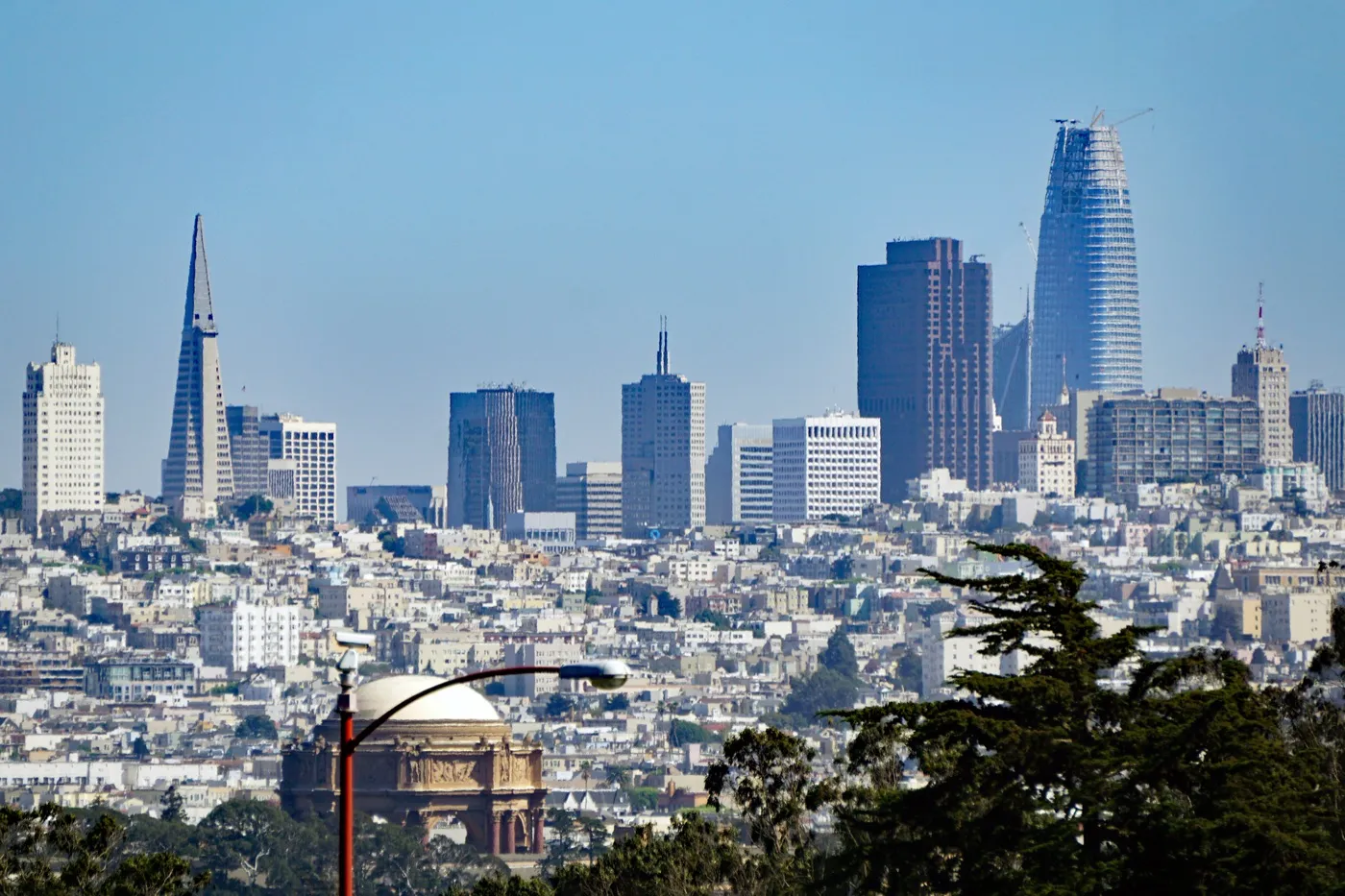
Spanish settlers established the Presidio of San Francisco and the Mission San Francisco de Asis, also known as Mission Dolores, in 1776, both named for Francis of Assisi. The trading settlement that later grew on the bay was originally called Yerba Buena, and in 1847 it was renamed San Francisco. The California Gold Rush of 1848 and 1849 transformed the town almost overnight, with its population rising from about 1,000 in 1848 to roughly 25,000 by December 1849.
California achieved statehood in 1850, and in 1856 the state government created the consolidated City and County of San Francisco. A major earthquake struck the city on April 18, 1906, and the fire that followed destroyed much of it, after which San Francisco was extensively rebuilt. The Golden Gate Bridge, one of the city's best-known landmarks, was completed in 1937.
Source: Wikipedia: San Francisco, California.
San Francisco by the numbers
A neutral demographic snapshot from the most recent U.S. Census Bureau American Community Survey. These are city-wide figures; individual neighborhoods and parcels vary.
| Measure | Value |
|---|---|
| Population | 836,321 |
| Median age | 39.7 years |
| Median household income | $141,446 |
| Homeownership rate | 38.5% |
| Median home value (owner-occupied) | $1,380,500 |
| Median gross rent (monthly) | $2,419 |
| Average commute to work (one way) | 31.2 minutes |
| Average household size | 2.24 people |
Source: U.S. Census Bureau, American Community Survey 2019-2023 5-year estimates, San Francisco city, California.
The San Francisco market right now
| Median sale price | $1,770,000 |
|---|---|
| Days on market | 16 |
| Homes for sale (inventory) | 925 |
| Homes sold | 561 |
| Sale-to-list | 116% |
Data: Redfin, May 2026
For broader Bay Area context behind the San Francisco numbers, read the current Bay Area market note.
What this means for you (May 2026)
At 116% sale-to-list, San Francisco posted the highest ratio in the Bay Area in May. Homes moved in a median 16 days, and buyers routinely paid well above list price to win. Expect multiple offers on well-priced listings. Reach out early so we can build a plan before you start touring.
Property taxes in San Francisco
Property tax in San Francisco starts with the 1% base under Proposition 13 (California's 1978 law capping the base rate and limiting how fast assessed value climbs), plus voter-approved bond debt. San Francisco is both a city and a county, so one City and County of San Francisco bill covers it. On a verified representative single-family bill for fiscal year 2025-26, the total ad valorem rate (the value-based portion) was 1.18268325%, the effective rate 1.20%.
The direct charges are light and school-driven: SFUSD - Teacher Support $319.34, SFCCD Parcel Tax $99.00, SFUSD Facilities District $43.00, and San Francisco Bay Restoration Authority $12.00, for a total of $473.34 in direct charges and special assessments.
A San Francisco bill leans on the ad valorem rate, with only a small set of school-based charges and no Mello-Roos, a special tax some newer developments carry. See how California property tax works, and use the true monthly cost calculator to estimate a specific home. Figures come from a representative single-family county bill (FY 2025-26); every parcel differs, so check the actual bill for any home you are weighing. Compare all 38 cities side by side on the Bay Area property tax map. This is educational, not tax or legal advice; confirm any figure with a qualified tax professional and the county assessor before relying on it.
Schools (San Francisco Unified School District, choice-enrollment)
San Francisco Unified School District (SFUSD, K-12 single district) operates a choice-enrollment system, NOT boundary-based. Citywide lottery via the Student Assignment Policy; ~14,080 TK-12 applications in 2025, 89% receive one of their listed choices (>60% get first choice). Lowell HS application-based magnet ranks U.S. News #88 national; Ruth Asawa School of the Arts (audition-based) ranks U.S. News #97 California; George Washington HS (boundary-flexible) ranks U.S. News #119 California; Galileo HS ranks #256 California.
SFUSD's choice system means address does NOT guarantee neighborhood school assignment. Around 5% of applicants do not get any listed choice; the lottery uses tiebreakers (neighborhood priority being one). Lowell admissions requires a separate competitive academic application. Buying a home in a specific SF neighborhood does NOT lock in a specific elementary or high school. The pre-offer school due diligence for SFUSD is fundamentally different from boundary-based districts; buyers prioritizing school assignment should understand the choice-enrollment timeline and the realistic likelihood of getting a preferred school assignment.
Typical assignment by sub-area
| Sub-area | Choice-enrollment dynamic | Neighborhood priority schools | Magnet / specialty options |
|---|---|---|---|
| Pacific Heights / Marina / Cow Hollow (north) | Choice-enrollment, address gives no guarantee | Sherman / Yick Wo / Claire Lilienthal (closer-neighborhood tiebreaker) | Lowell HS (citywide application); Ruth Asawa (citywide audition) |
| Noe Valley / Castro / Mission (central) | Choice-enrollment, address gives no guarantee | Alvarado / Fairmount / Buena Vista Horace Mann | Lowell HS; Ruth Asawa; Mission HS (citywide) |
| Sunset / Richmond (western residential) | Choice-enrollment | Lawton / Jefferson / Lafayette / Sunset Elementary | Washington HS; Lowell HS |
| Bayview / Hunters Point / Visitacion Valley (southeast) | Choice-enrollment; high-priority for SES-based tiebreakers | Bret Harte / Malcolm X / Visitacion Valley Elementary | Thurgood Marshall HS; Lowell HS application option |
SFUSD's Student Assignment Policy lottery runs on a fixed annual timeline; the 89% one-of-listed-choices statistic does not mean 89% get their first choice. Buyers should plan to apply early, list a broad set of acceptable schools, and have a backup plan (private, parochial, charter, or an SFUSD school that was NOT first-choice). Lily walks new SF buyers prioritizing school assignment through the SFUSD timeline before committing to a property in any specific neighborhood.
Highlight schools
- Lowell High School (SFUSD, 9-12), U.S. News #88 national; the application-based academic magnet; the city's most selective public high school option.
- Ruth Asawa School of the Arts (SFUSD, 9-12), U.S. News #97 California; audition-based for arts disciplines; the city's arts magnet.
- George Washington High School (SFUSD, 9-12), U.S. News #119 California; boundary-flexible; the strongest non-magnet SFUSD comprehensive.
- Galileo Academy of Science and Technology (SFUSD, 9-12), U.S. News #256 California; a citywide application option with STEM focus.
Sources: SFUSD Student Assignment Policy; SFUSD applications data; U.S. News Lowell HS; San Francisco Unified School District.
Hospitals and birthing centers
San Francisco is one of the most hospital-dense Bay Area cities. UCSF Medical Center at Mission Bay + UCSF Benioff Children's Hospital operates the only Level IV NICU in SF (Neuro-NICU first in US; only California hospital offering nitrous oxide for labor pain). CPMC (California Pacific Medical Center) Van Ness, Mission Bernal, and California Campus operate multiple Sutter L&D facilities. Zuckerberg San Francisco General Hospital is the city public + Level I Trauma Center. Saint Francis Memorial and additional Dignity Health options. Kaiser SF (Geary Blvd) for Kaiser members.
| Hospital | Network | Drive time across SF | Key services |
|---|---|---|---|
| UCSF Medical Center at Mission Bay + Benioff Children's | UCSF (PPO) | varies (5-25 min) | Level IV NICU (only one in SF); Neuro-NICU (first in US); only CA hospital offering nitrous oxide for labor pain; regional referral center |
| CPMC Van Ness / Mission Bernal / California Campus | Sutter (PPO) | varies (5-25 min) | Multiple L&D facilities with NICU; major delivery volume in SF |
| Zuckerberg San Francisco General Hospital (ZSFG) | San Francisco Health Network (public; accepts Medi-Cal + many PPOs) | varies | L&D + Level I Trauma Center; the city public hospital |
| Kaiser Permanente San Francisco Medical Center | Kaiser (closed) | varies (5-20 min) | Full Kaiser L&D + on-site NICU |
| Saint Francis Memorial + California Pacific (Dignity) | Dignity (PPO) | varies | Additional Dignity Health L&D options across the city |
Birthing centers: what matters
SF is one of the most hospital-dense Bay Area cities; insurance network is typically the binding constraint, not geographic proximity. Whichever neighborhood you buy in, multiple L&D options are within 10 to 25 minutes; the choice is usually made by which network is in your insurance plan rather than by raw distance.
UCSF Mission Bay has the only Level IV NICU in SF: Neuro-NICU first in the US, regional referral center for the highest-acuity neonatal cases, and the only California hospital offering nitrous oxide for labor pain. For high-risk pregnancy or anticipated premature delivery below 32 weeks, UCSF is the regional destination.
For PPO members, CPMC (Sutter) operates multiple L&D facilities (Van Ness, Mission Bernal, California Campus) with broad neighborhood coverage and major delivery volume in SF. CPMC is the largest Sutter footprint in the city.
Kaiser members deliver at Kaiser SF (Geary Blvd): full L&D + on-site NICU.
Hospital network coverage depends on your insurance plan. Lily does not advise on medical coverage decisions; for in-network confirmation contact your insurer directly. Hospital information above is current as of 2026-05-28 and should be re-verified with each hospital's admissions office before relying on it for a major life decision.
Sources: UCSF Mission Bay L&D; UCSF NICU Level IV; CPMC; Zuckerberg SF General; SF Birth Locations Glow Guide.
Crime, hazards, and ratings
San Francisco carries higher-than-average crime exposure, moderate flood exposure along the local creek corridors, and moderate fire hazard in hillside tracts relative to the broader Bay Area. School ratings reflect the local district's performance bands.
| Category | Rating | Detail |
|---|---|---|
| Crime | property crime well above California and US average (auto burglary the dominant driver); violent crime moderately above California average; varies dramatically by neighborhood (Tenderloin/SoMa highest, west-side Sunse... | |
| Flood | Zone X over most of the city; Zone AE along the Embarcadero and bay shoreline; Zone VE/AE on the Ocean Beach / Great Highway frontage; storm-drain-driven pluvial flooding repeatedly affects Mission/Folsom and Cayuga Terrace tracts | |
| Fire | Moderate in the Twin Peaks/Mt. Sutro/Mt. Davidson and Glen Canyon open-space-fronting tracts (the 2025 CAL FIRE update added the city to the LRA map for the first time in some western tracts); other tracts not in LRA hazard zones | |
| Earthquake | San Andreas Fault about 7 miles west (offshore at Mussel Rock to the south); Hayward Fault about 14 miles east; liquefaction: Very High in the Marina, SoMa, Mission Bay, Embarcadero, and Bayview-Hunters Point fill tracts; High in the Mission flats; Low on Pacific Heights/Twin Peaks bedrock |
School ratings
Numeric snapshots for the highlight schools above:
| School | GreatSchools | Niche |
|---|---|---|
| Lowell High | 10 | A+ |
| Mission High | 4 | B |
| Galileo High | 7 | A- |
| Washington High | 8 | A |
| Lincoln High | 8 | A |
Environment and infrastructure
Beyond the natural-hazard ratings above, these are the environmental and infrastructure factors buyers ask about most. Each is a city-level summary; confirm the exact parcel before any offer.
| Factor | Detail |
|---|---|
| Gas transmission pipelines | PG&E operates high-pressure gas transmission lines through San Francisco and the Peninsula, including Lines 109 and 132 (a segment of Line 132 ruptured in the 2010 San Bruno explosion, killing 8 and destroying 38 homes, just south of the city); transmission-line proximity to a parcel should be verified on the PHMSA National Pipeline Mapping System. |
| Noise (freeway, rail, flight paths) | Dominant noise corridors are US-101 and I-280 and the elevated/at-grade freeway segments, plus Muni, BART and the Caltrain terminus at 4th and King; aircraft noise from SFO and Oakland flight paths affects parts of the city, and SFO-area noise complaints rose sharply in 2023. |
| Refineries and heavy industry | San Francisco has no petroleum refineries; the principal industrial-legacy sites are the former Hunters Point Naval Shipyard and the Bayview-Hunters Point / Potrero industrial areas, where former power-plant and shipyard uses left an environmental footprint now in cleanup (see contamination). |
| Soil and groundwater contamination | Hunters Point Naval Shipyard is an EPA Superfund site (added to the National Priorities List in 1989) with radiological contamination tracing to the postwar Naval Radiological Defense Laboratory and Operation Crossroads ship decontamination, plus industrial contamination; cleanup was compromised by contractor Tetra Tech's documented falsification of radiological data (two supervisors pleaded guilty to federal fraud charges in 2018), forcing extensive retesting. Treasure Island is a separate former-Navy site with radiological cleanup overseen by DTSC and CDPH, and Bayview-Hunters Point carries a recognized environmental-justice pollution burden. |
| Air quality and wildfire smoke | San Francisco's air quality is generally good thanks to persistent ocean breezes and the marine layer, but the city is subject to episodic regional wildfire smoke, including the unhealthy-to-hazardous PM2.5 levels and the orange-sky smoke event of September 9, 2020. |
| Wildfire zone and power shutoffs (PSPS) | As a dense, fully built-out urban environment, San Francisco has essentially no wildland fire-hazard severity zones or High Fire-Threat District designation and effectively no PG&E Public Safety Power Shutoff exposure; fire risk is structural/urban rather than wildland. |
| High-voltage power lines | San Francisco is served by underground and surface electric distribution with substations distributed across the city; it is not on the major long-distance high-voltage transmission corridors that cross the inland North Bay. Proximity to substation infrastructure should be confirmed per address. |
| Sea level and shoreline flooding | San Francisco has major documented sea-level-rise exposure along the Embarcadero, Mission Bay, Mission Creek, Islais Creek and Treasure Island, plus bluff erosion at Ocean Beach on the west side; the city's Sea Level Rise Action Plan and BCDC mapping identify these as priority vulnerable areas. |
Happiness and livability: WalletHub ranks San Francisco #17 of 182 on WalletHub's Happiest Cities in America (2026).
These are city-level summaries from public agencies and are approximate. Pipeline and power-line alignments, contamination parcels, and wildfire zones can differ block by block; verify the exact address with the agency tools linked above and your inspections before you write an offer.
Sources: PHMSA National Pipeline Mapping System; DTSC EnviroStor; State Water Board GeoTracker; EPA Superfund; BAAQMD air data; CAL FIRE Fire Hazard Severity Zones; PG&E PSPS maps; NOAA Sea Level Rise Viewer
Hazard ratings are city-level aggregates from public agencies (FEMA, CAL FIRE, USGS). Specific addresses can carry materially different risk; verify the exact parcel via the FEMA Flood Map Service Center, the CAL FIRE FHSZ viewer, and your insurance carrier before any offer. School ratings vary by year and by metric; the numbers above are point-in-time snapshots, treat them as a starting point and re-verify with the district registrar.
Sources: CrimeGrade.org (crime); FEMA Flood Map Service Center (flood); CAL FIRE FHSZ viewer (fire); USGS earthquake hazards (earthquake); GreatSchools + Niche (school ratings).
Before an offer: the San Francisco property brief
In San Francisco, the neighborhood and ownership form can change the diligence more than the city name does. A condo, TIC, tenant-occupied building, and older single-family home need different evidence before the offer is priced.
- Identify the ownership and use: confirm condo, TIC, single-family, or multi-unit status and whether any unit is occupied.
- Reconcile the records: compare the physical layout with permit history, assessor data, stated unit count, and any renovation or conversion claims.
- Match inspections to the building: examine foundation/seismic condition, roof, drainage, electrical, plumbing, and the HOA package where applicable.
- Check address-specific constraints: review liquefaction or slope exposure, insurance, parking/storage rights, and SFUSD's choice-enrollment process if schools matter.
- Use a neighborhood comp set: value the property against the same building type and immediate buyer pool, not a citywide median.
The page's local evidence includes four documented San Francisco closings from Bayview condos to a Pacific Heights/Marina single-family home. See the address-linked record, then review the disclosure guide and inspection-contingency guide.
Track Record
4 documented San Francisco closings, $5.0M local volume. Career-wide: 104 documented closings, $115M+ in total volume, with 91 of 104 on the buyer side, 10 closings in the last 12 months, career range $323K to $3.3M, 5.0-star Zillow average across 38+ reviews. The full transaction record for every Bay Area city Lily has closed in is summarized at the cities index. Every transaction below links to the address on Zillow.


104 transactions · $115M+ · 5.0★ Zillow · Cal DRE #02010731
What buying a home in San Francisco actually involves
Buying in San Francisco means unlearning the suburban school playbook first. SFUSD assigns by choice enrollment, not by boundary, so buying in a specific neighborhood does not buy a specific school, and I walk buyers through what the system actually delivers before schools drive a neighborhood decision they do not need to make. The second unlearning is the spread: my own four closings here run from a $475,000 Bayview condo to a $2,800,000 Pacific Heights single-family, and each of those sub-markets prices, negotiates, and moves on its own logic.
The building itself gets the deepest read I do anywhere. San Francisco's older stock means foundation, structural, and seismic review well beyond the suburban standard: soft-story history, retrofit documentation, and on condos and TICs the full HOA package, reserves, SB326 balcony-inspection status, litigation, and owner-occupancy ratio. Parking, permits on Victorian-era alterations, and the tenant history on small multi-unit buildings all belong in the file before the offer, not after. When a building's paper does not support its price, I will tell you to keep looking. SF particulars are covered in the FAQ below.
What selling a home in San Francisco involves
Selling in San Francisco is neighborhood marketing in the strictest sense: the buyer pool for a Sunset single-family barely overlaps the pool for a SoMa condo or a Pacific Heights property, so the comp set, the staging, and the marketing channel all come from your specific sub-market. I price against the closed comps for the neighborhood and the property type, not against a citywide median that blends entry-level Bayview and estate-tier Pacific Heights into a number nobody actually pays.
Preparation here front-loads the structural story. Seismic and foundation documentation, permit history on any altered Victorian, and, for condos, a complete HOA disclosure package presented up front: San Francisco buyers discount uncertainty aggressively, and the listing that answers the engineering questions before they are asked defends its price. From there the Strategic Listing Model runs as it does everywhere: positive-ROI preparation only, professional photography, and active management of the offer date.
The Meticulous Protector, applied to San Francisco
The methodology behind Lily's 38+ five-star Zillow reviews and the highest repeat-and-referral rate of her career: read every disclosure line, verify every claim, model every carrying cost, walk every property in person before recommending an offer, and document the ethical "no" when the math says no. The San Francisco version of that methodology is the same as the Dublin version, the Pleasanton version, the Walnut Creek version, and every other city Lily represents; the discipline does not change by city.
San Francisco FAQ
What are San Francisco price ranges in 2026?
Single-family across SF varies enormously by sub-area: $1.0M to $1.6M entry-level Bayview / Visitacion Valley; $1.4M to $2.5M central Sunset / Richmond / Bernal Heights; $2.5M to $5M+ Noe Valley / Castro / Mission Dolores / Outer Mission; $5M to $30M+ Pacific Heights / Marina / Russian Hill / Sea Cliff premium estates. Condos and TICs run $400K to $1.5M depending on neighborhood, building, and HOA structure. Lily's four documented SF closings span the full structural range: $475K Bayview condo (October 2025) to $2.8M Pacific Heights single-family (April 2023).
How does the SFUSD choice-enrollment system work?
SFUSD does not assign students by neighborhood. Instead, parents list a ranked set of choice schools, and the district runs a citywide lottery using tiebreakers (younger sibling already enrolled, neighborhood priority, SES-based priority for some schools). Around 89% of applicants get one of their listed choices, but only ~60% get their first choice. The system does NOT guarantee a specific school assignment from a specific home purchase. Lowell HS (the academic magnet, U.S. News #88 national) requires a separate competitive application. Buyers prioritizing school assignment should understand the SFUSD timeline and not assume that buying in a neighborhood locks in a school.
Pacific Heights vs Noe Valley vs Sunset vs Bayview?
Pacific Heights / Marina is the premium tier ($5M to $30M+ estates, bay views, walkable Union Street / Chestnut Street). Noe Valley / Castro / Mission Dolores is the central residential tier ($2.5M to $5M+ Victorians and Edwardians, walkable 24th Street / Castro Street). Sunset / Richmond is the western residential single-family tier ($1.4M to $2.5M, more affordable, fog-belt weather). Bayview / Hunters Point is the southeast entry-level tier ($475K to $1.5M condos and single-family), the most accessible price point in SF, with ongoing neighborhood transition. The SF neighborhood choice is structurally about lifestyle and housing type as much as price.
Does Lily Garipova speak Russian for San Francisco transactions?
Yes. Russian is Lily's native language. Lily represents Russian-speaking buyers and sellers in San Francisco and the broader Bay Area in either English or Russian. Russian-language San Francisco page: lilygaripova.com/ru/san-francisco-realtor/.
What is the Marina district and how does it compare to Cow Hollow and Pacific Heights?
The Marina is the bay-flat residential district from Lyon Street to Van Ness, between Lombard and the Marina Green. Single-family typically runs $2.5M to $6M+, with bay-view parcels on Marina Blvd pushing $8M+. Cow Hollow sits between the Marina and Pacific Heights along Union Street, with mixed single-family and condo at $2.0M to $5M+. Pacific Heights sits on the hill above with $4M to $30M+ premium estates. The Marina sits entirely on bay-mud and dredge fill from the 1915 Panama Pacific International Exposition; Very High liquefaction hazard. The 1989 Loma Prieta earthquake destroyed approximately 60 Marina structures. Foundation inspection and seismic retrofit verification are essential pre-offer steps.
What is Russian Hill and Nob Hill pricing and what does each offer?
Russian Hill (the hill bounded by Pacific Ave, Polk St, Bay St, and Mason St) carries premium hillside single-family at $4M to $20M+ for view stock, with substantial condo at $1.5M to $5M+. Nob Hill (the hill bounded by California, Powell, Bush, and Larkin) is denser with most stock as condo and small-multifamily at $1.0M to $4M, plus the premium Mark Hopkins / Fairmont / Huntington Park corridor. Both neighborhoods are walkable to FiDi, the cable car runs through both, and the elevation provides Bay-and-city views. Russian Hill carries the larger single-family lots; Nob Hill is denser with more rental and pied-a-terre stock.
What is the Mission and Mission Dolores neighborhood profile?
The Mission District is one of SF's largest central residential neighborhoods, bounded by 14th Street, Cesar Chavez, Guerrero, and Potrero. Single-family Victorians and Edwardians typically run $1.6M to $4M+ for the inner Mission (24th to Cesar Chavez between Mission and Potrero); Mission Dolores (the sub-neighborhood west of Dolores Park) runs $2.5M to $5M+. The Mission has a high concentration of small-multifamily and rent-controlled stock; many properties have sitting tenants subject to SF Rent Ordinance. The neighborhood carries a deep cultural and culinary heritage and one of the highest-density restaurant and bar corridors in the city (Valencia Street, 16th Street, 24th Street).
What is the Castro neighborhood profile in 2026?
The Castro is a historic neighborhood centered on Castro Street between Market and 19th Street. Single-family Victorians and Edwardians typically run $2.5M to $5M+, with view-hill stock (Twin Peaks side, Liberty Hill, Eureka Valley) pushing higher. The Castro Theatre, Harvey Milk Plaza, the LGBTQ History Museum, and the Castro Street commercial corridor anchor the neighborhood character. The Castro is walkable to Mission Dolores, Noe Valley, and the F-Market historic streetcar to FiDi. SFUSD lottery considerations apply; popular elementary feeders include Sanchez and Mission Education Center. The Castro carries strong condo and small-multifamily stock plus the historic Victorian single-family.
What is the Sunset District east-vs-west pricing split?
The Sunset District (south of Golden Gate Park, between 19th Avenue and the Pacific) splits into Inner Sunset (east of 19th), Central Sunset (19th to Sunset Blvd), and Outer Sunset (Sunset Blvd to the ocean). Inner Sunset single-family typically runs $1.8M to $3M+ (Cole Valley adjacency, Golden Gate Park north edge, UCSF Parnassus proximity); Central Sunset runs $1.5M to $2.5M; Outer Sunset runs $1.4M to $2.2M. The fog-belt premium discount widens westward. Stock is mostly 1920s-1950s Marina-style single-family on small lots. The Sunset has strong single-family buyer demand. SFUSD lottery considerations apply but Sunset elementaries (Lawton, Jefferson, Lafayette) draw strong applications.
What is the Richmond District profile and how does it compare to the Sunset?
The Richmond District (north of Golden Gate Park, between Arguello and the Pacific) splits into Inner Richmond, Central Richmond, and Outer Richmond. Inner Richmond single-family typically runs $1.6M to $2.8M+ (Presidio Heights adjacency, Sacramento Street corridor); Central Richmond runs $1.4M to $2.3M; Outer Richmond (the foggiest western reach) runs $1.3M to $2.0M. Like the Sunset, the Richmond is single-family-dominant with 1920s-1940s stock. The Richmond has a long-established base of Russian-language and Chinese-language institutions, businesses, and houses of worship along Geary, Clement, and Balboa. Lily Garipova has experience representing Russian-speaking Richmond buyers and sellers.
What is Bernal Heights and Glen Park profile in 2026?
Bernal Heights (the hill east of Mission, between Cesar Chavez and Alemany) is one of SF's established central residential neighborhoods. Single-family typically runs $1.6M to $3.5M+ with Bernal Hill view properties pushing higher. Stock is a mix of Victorian, Edwardian, and 1940s-1950s craftsman; substantial small-multifamily. Glen Park sits south of Bernal across the I-280 freeway with a small-village center on Diamond Street and walking access to Glen Canyon Park. Single-family in Glen Park typically runs $1.5M to $3M+. Both neighborhoods carry hillside fire-hazard exposure (the 2025 CAL FIRE update added Twin Peaks / Mt Davidson / Glen Canyon-fronting tracts to the SF LRA map).
What is the Excelsior and Outer Mission neighborhood profile?
The Excelsior (the southern central neighborhood, bounded by I-280, Mission Street, Geneva, and McLaren Park) is one of SF's largest residential neighborhoods with single-family typically running $1.0M to $1.8M, the most accessible price point in central SF. Outer Mission (south of Cesar Chavez, around Mission Street) overlaps with the Excelsior. Stock is mostly 1920s-1960s tract single-family. The neighborhoods have a strong owner-occupier base. McLaren Park is the second-largest park in SF after Golden Gate. BART access at the Balboa Park station serves the western Excelsior; the J-Church line ends at Balboa Park.
What is SoMa and Mission Bay urban-core condo profile in 2026?
SoMa (South of Market) and Mission Bay are the urban-core condo neighborhoods, with most stock as 2000s-2020s mid-rise and high-rise condo. SoMa condos typically run $500K to $1.5M for 1-2BR; Mission Bay condos (around the UCSF Mission Bay campus and Oracle Park) run $700K to $1.8M with newer construction and biotech-employer adjacency. Yerba Buena, Rincon Hill, and Transbay are SoMa sub-districts with the densest high-rise stock. SB326 inspection, soft-story retrofit, and HOA reserve study are the dominant pre-offer due diligence variables for any SoMa or Mission Bay condo. The neighborhoods are walkable to FiDi, Oracle Park, Caltrain, and BART/Muni Metro.
How does the SF transfer tax tier structure work for sellers in 2026?
San Francisco's documentary transfer tax is tier-stepped at the sale price: $0-$250K at 0.50%; $250K-$1M at 0.68%; $1M-$5M at 0.75%; $5M-$10M at 2.25%; $10M-$25M at 5.50%; over $25M at 6.00%. The seller customarily pays in SF (the city/county side); the buyer pays the small state-level 0.11%. On a $3M Pacific Heights sale, expect approximately $22,500 in seller-paid transfer tax. On a $15M Sea Cliff sale, expect approximately $825,000 in transfer tax. The tier structure creates real seller-side planning incentive for properties near the $5M and $10M thresholds. Lily Garipova models the transfer tax exposure in every seller-side listing math.
What is the SF soft-story retrofit ordinance and how does it affect specific buildings?
The SF Mandatory Soft-Story Retrofit Program (effective 2013) applies to wood-frame multi-unit buildings of 3 or more stories and 5 or more residential units permitted before January 1, 1978. Most affected buildings have completed retrofits per the staged compliance deadlines (2017-2020 depending on tier). Buyers acquiring affected condo units should verify the building's Notice of Completion is on file with the SF Department of Building Inspection (DBI) and that any deferred-maintenance retrofit cost has been resolved. Buildings still under retrofit obligation carry substantial special-assessment exposure; the retrofit typically cost $50K-$300K per building depending on size, and a completed retrofit improves both insurability and resale narrative. The retrofit verification is the single highest-leverage condo-buyer pre-offer step in SF.
What is the SF rent control profile for buyers of tenanted single-family and small-multifamily?
San Francisco Rent Ordinance (the city's rent stabilization ordinance, the strictest in California) applies to buildings of two or more units built before June 13, 1979. Single-family homes are exempt from rent control but still subject to AB1482 statewide limits (5%+CPI annual cap, just-cause eviction after 12 months). Buyers acquiring SF Rent Ordinance buildings inherit the existing tenancies at the existing rents; market-rent reset requires owner-move-in eviction (OMI), Ellis Act, or buyout, each with specific legal-procedure requirements. The Costa-Hawkins Rental Housing Act allows market-rent reset only when units become voluntarily vacant. Lily Garipova reviews the rent roll, tenancy history, and rent-stabilized status before recommending any SF small-multifamily offer.
What is the SF condo vs TIC vs condo-mapped TIC distinction for buyers?
True condos in SF are subdivided units with individual deeds and HOA governance under California Davis-Stirling Act. TICs (Tenants in Common) are co-ownership arrangements where 2 or more parties co-own one parcel with a TIC agreement governing use and finance; lender-required fractional financing is portfolio-only, typically 50-150 bps above conforming, through TIC-specific lenders (Sterling Bank, Bank of Marin's legacy desk). Condo-mapped TICs are TICs that have applied for SF Condo Conversion (limited via lottery to 200 buildings annually historically; the program was paused and restructured) and may convert to true condos over time. Pricing reflects the financing complexity: equivalent TIC typically prices 10-15% below comparable true condo; condo-mapped TICs sit between. Lily Garipova reviews the TIC agreement, lender requirements, and condo-conversion eligibility before any SF TIC offer.
How does the SF Soft Story Retrofit ordinance interact with insurance for condo buyers?
Insurance carriers (State Farm, Allstate, Farmers, USAA) increasingly require evidence of SF Mandatory Soft-Story Retrofit completion before binding HO-6 condo coverage. Buildings without the Notice of Completion on file face limited carrier options and elevated premiums; the California FAIR Plan does not write condo HO-6 coverage so the carrier-of-last-resort path is narrower than for single-family. Buyers should request the building's retrofit completion documentation from the HOA, verify with SF DBI directly, and confirm the carrier will write before contingency removal. This is the single most common SF condo-financing surprise.
What does the Muni Metro plus BART plus CalTrain commute landscape actually look like across SF neighborhoods?
SF's transit network covers different neighborhoods differently: BART (Embarcadero, Montgomery, Powell, Civic Center, 16th/Mission, 24th/Mission, Glen Park, Balboa Park) serves the central and Mission corridor; Muni Metro J/K/L/M/N/T lines cover west and southeast neighborhoods (J-Church to Balboa Park, N-Judah to Ocean Beach, K-Ingleside, L-Taraval, M-Ocean View, T-Third Street); CalTrain at 4th/King and 22nd Street serves Peninsula and South Bay commutes. Pacific Heights, Marina, and the western Richmond have no rail; bus-only access. Walkability varies: Russian Hill and Nob Hill are dense walkable with cable car; Outer Sunset is single-family-dominant with bus-only access. Always test the specific address commute before commitment.
What is the SF balcony SB326 exposure for condo buyers in 2026?
California SB326 requires HOAs to inspect exterior elevated elements (balconies, decks, walkways) every nine years, with the first round due January 1, 2025. Most SF HOAs have completed or are completing the SB326 inspection; the inspection report and any deferred-maintenance findings (waterproofing, structural connections, dry rot) are now disclosure items. Inspection cost typically runs $200-$800 per balcony, with repair budgets of $5K-$80K per unit depending on findings; many buildings issue special assessments through 2027-2029. Buildings with substantial balcony stock (Marina, Russian Hill, SoMa high-rise) face larger reserve obligations or special assessments. Lily Garipova pulls the SB326 inspection report, the reserve study, and the last 12 months of HOA meeting minutes before recommending any SF condo offer.
What is the AI rebound's specific effect on SF neighborhoods in 2026?
The 2024-2026 AI-employer return-to-office wave (OpenAI, Anthropic, xAI, Scale AI, Glean and others physically located in SF) is concentrated in Hayes Valley, SoMa, Mid-Market, and Mission. Those neighborhoods have seen renter and condo-buyer absorption increase, partially offsetting the 2022-2023 condo declines. Single-family in adjacent residential neighborhoods (Castro, Mission, Lower Haight, NoPa) has seen stabilization rather than the further declines that broader narrative might suggest. The AI footprint is meaningfully smaller than the pre-2022 broader tech footprint, but it is concentrated by neighborhood and creates real localized demand. Lily Garipova maps the AI-employer footprint to the specific buyer's commute and lifestyle math.
What is the SF Bayview and Hunters Point shipyard environmental disclosure?
The Hunters Point Naval Shipyard is a designated NPL (National Priorities List) Superfund site under EPA jurisdiction, with ongoing parcel-by-parcel cleanup. The Lennar / FivePoint redevelopment (Candlestick Point + Hunters Point Phase 1) has released certain parcels for residential use, with others still under institutional controls. Bayview / Hunters Point single-family outside the Naval Shipyard footprint is not directly NPL-affected but may carry local environmental history (former gas stations, industrial uses); the State Water Board GeoTracker database is the screening tool. Buyers should pull the EPA Record of Decision for any Shipyard-area parcel and the geotechnical / soils report. Lily Garipova has documented Bayview buyer-side closings ($475K Innes Ave 2025, $690K Hudson Ave 2021).
What is the SF jumbo financing landscape for $2M+ buyers in 2026?
SF jumbo financing (above the 2026 SF County conforming limit of approximately $1,209,750) typically requires 20% down minimum on owner-occupied single-family, 25% down on investment, and full income documentation. Major jumbo lenders in SF include First Republic (post-acquisition by Chase), Bank of America Private Bank, Wells Fargo Private Mortgage, Goldman Sachs Private Wealth, and SF-focused regional credit unions. Asset-pledge and securities-backed lending are common at the $3M+ level. Rate differential between conforming and jumbo has narrowed in 2026 to approximately 0.15-0.30%. Pre-approval timeline is materially longer for jumbo than conforming; start the pre-approval process 60-90 days before offer-writing.
What is the SF Sea Cliff and Presidio Heights premium-estate profile?
Sea Cliff (the cliff-front neighborhood between the Presidio and China Beach) is one of SF's highest-priced sub-neighborhoods, with single-family estates typically running $10M to $35M+. Stock is mostly 1920s-1950s grand single-family on large lots with Pacific Ocean and Golden Gate views. Presidio Heights (the residential hill south of the Presidio, between Arguello and Spruce) runs $5M to $20M+ for single-family. Both neighborhoods carry premium pricing for the views, the Presidio National Park adjacency, the low-density layout, and the historic architecture. Sea Cliff carries coastal-erosion exposure on some bluff parcels; verify the parcel-specific geotechnical history and the California Coastal Commission file before offer.
How does Lily Garipova represent SF buyers specifically?
Lily reads every disclosure end-to-end (TDS, NHD, SPQ, 3R Report, HOA package, preliminary title, SB326 inspection, soft-story retrofit Notice of Completion where applicable), pulls the parcel-specific FEMA, CAL FIRE LRA, USGS liquefaction, Alquist-Priolo, and Hunters Point NPL overlays where applicable, models full carrying cost including SF's specific transfer tax exposure and any Mello-Roos, walks the property at multiple times of day across the morning fog and evening conditions, verifies the SFUSD lottery realities for buyers prioritizing school assignment, and stays willing to recommend walking from a deal that does not pencil. Free 30-minute initial consultation in English or Russian.
How does Lily Garipova represent SF sellers specifically?
Strategic Listing Model applied at the SF neighborhood level: comp set drawn from the exact micro-neighborhood (Inner Sunset versus Outer Sunset, Mission Dolores versus inner Mission, Russian Hill versus Nob Hill), not city-wide averages; pre-listing inspection with positive-ROI improvements including SF-specific seismic retrofit and SB326 compliance documentation; professional staging targeted to the sub-neighborhood's actual buyer pool; SF transfer tax tier modeling for any sale near the $5M or $10M threshold; multi-platform marketing with active bid management; full disclosure preparation. Bay Area closings in every year since 2017, $115M+ career volume, 4 documented SF closings on $5.0M local volume.
How do I schedule an SF consultation with Lily Garipova?
Call or text 415-910-3958, or email lilyagaripova@gmail.com. Free 30-minute initial consultation by phone, Zoom, or in person at any SF address that works for you. Available in English and Russian. Cal DRE #02010731. The consultation walks through your specific buying or selling math: budget, timeline, neighborhood-fit (the 49 SF neighborhoods sort by lifestyle, school-lottery realism, commute pattern, fog tolerance, and price band), SFUSD application timeline, financing pre-approval (conforming vs jumbo), and the realistic SF sub-area that fits.
What is the SF 3R Report and why does every SF buyer need to read it?
The 3R Report (Report of Residential Building Record) is a SF Department of Building Inspection document summarizing permitted work history, building violations, and Notices of Violation for a specific property. Required disclosure for most SF residential sales. The 3R surfaces unpermitted additions (illegal ADU conversions are common SF Mission, Sunset, and Excelsior), open building permits, and outstanding violations. Buyers should read the 3R end-to-end and cross-reference against the property's physical reality (every bedroom claimed by the listing should match the permit history). Discrepancies are negotiating leverage and may affect appraisal, insurance, and financing. Lily Garipova reads the 3R before recommending any SF offer.
What is the SF Hayes Valley and NoPa profile and how do they compare to Lower Haight?
Hayes Valley (around Hayes Street between Van Ness and Divisadero) has emerged as one of SF's most desirable central neighborhoods: walkable village character on Hayes Street, the Patricia's Green park, Octavia Boulevard residential, mixed Victorian and Edwardian single-family at $2.5M to $5M+, and condo at $900K to $2.0M. NoPa (North of the Panhandle, between Divisadero and Stanyan) runs $1.8M to $4M+ single-family. Lower Haight (south of the Panhandle near Haight Street) runs $1.6M to $3.5M+ Victorians and Edwardians. All three benefit from the AI-employer return-to-office wave centered in Hayes Valley / Mid-Market and the SoMa corridor. Walkable to multiple Muni Metro lines plus the Wiggle bike route.
What is the SF condo HOA monthly assessment reality in 2026?
SF condo homeowners association (HOA) monthly assessments vary widely by building class and amenity level: small pre-war Edwardian and Victorian condos with limited amenities sit at the low end, 1960s-1990s mid-rise condos higher, and full-service 2000s-2020s high-rise buildings (doorman, gym, pool, concierge, valet) at the top. The dues figure is set per building, so pull the HOA package and the current dues schedule for the specific building rather than relying on a range. SB326 inspection compliance, soft-story retrofit reserves, elevator maintenance, and roof replacement are the main reserve-study drivers. HOA delinquency rates rose materially in 2023-2024 for SoMa high-rise as remote-work absorption declined; partial recovery in 2025-2026 with the AI rebound. Always pull 12 months of HOA financials and meeting minutes.
Why are SF condos cheaper than Bay Area townhomes and what's the catch?
Two reasons. First, SF condo prices have not recovered post-2022: many neighborhoods are down 15-25% from peak while suburban townhomes have moved sideways or up. Second, SF HOA monthly costs are typically $700-$1,500+ vs $300-$600 in suburban townhomes, and many SF buildings carry SB326 balcony-inspection special assessments coming through 2027-2029. The condo discount IS real, but the carrying-cost gap eats some of the price advantage; run the full PITI + HOA comparison, not just the headline price.
How much have SF condos actually dropped since 2022, by neighborhood?
South Beach, Mission Bay, and Rincon Hill (the 2010s-built high-rise corridor) have dropped 18-28% from 2022 peaks at the 1-bedroom and small-2-bedroom level. SoMa lofts and the Yerba Buena corridor have dropped 12-22%. Pacific Heights, Russian Hill, and Cow Hollow vintage Edwardian conversions have dropped less (5-12%) because supply is structurally limited. Sunset and Richmond District flats have held value better than central neighborhoods. The 23% drop figure circulating reflects high-rise downtown specifically, not the whole city.
Is buying an SF condo in 2026 a value play or a value trap?
It depends on the building, the assessment exposure, and the buyer's horizon. Buildings with healthy reserves, no pending SB326 assessments, and stabilized HOA dues are arguably the best per-sqft value the city has shown in 10+ years. Buildings with thin reserves, pending litigation, deferred maintenance, or balcony-inspection assessments due 2026-2028 can shift from value play to value trap fast. The diagnostic is the HOA financial packet, not the price-per-sqft.
SF HOA monthly fees: what's reasonable, what's a red flag in 2026?
Sub-$500/month HOAs on a building over 20 units are a red flag for underfunded reserves. $700-$1,200/month is normal for mid-size SF buildings without elevators or amenities. $1,200-$2,500+/month for full-service buildings (doorman, gym, pool) is structural and stable. The diagnostic is the reserve study and 12 months of meeting minutes, not the headline HOA dollar figure; some $400/month HOAs are about to special-assess $30K and some $1,500/month HOAs are fully funded.
How does SF's HOA reserve study practice differ from suburban buildings?
California Civil Code requires every HOA to maintain a reserve study updated at least every three years and to disclose it to prospective buyers in the HOA package. SF buildings often face thinner reserve cushions than suburban condos because of older building age, deferred-maintenance accumulation, and recent SB326 inspection findings. A healthy SF HOA reserve sits at 50-100% of fully-funded calculation; below 30% signals likely special-assessment exposure. Pull the reserve study, 12 months of meeting minutes, current budget, and pending-litigation disclosure before every condo or TIC offer.
SF rent-controlled tenant in unit: should a buyer ever take that risk?
Buying a property with a sitting rent-controlled tenant is buying the property minus the value of vacant possession, which can be $200K-$500K+ depending on unit size and current contract rent. Owner-move-in (Ellis Act-adjacent) is heavily restricted and personally complex; some buyers take the risk for the tenant-occupied discount but most should not. The math only works for buyers with a multi-year horizon, alternative housing available, and tolerance for SF Rent Board procedure.
How does SF's transfer tax affect closing costs vs. Peninsula or East Bay?
SF's transfer tax is the highest in the Bay Area: roughly 0.75% to 6.0% depending on price band (the $25M+ tier carries the steepest rate). Peninsula and East Bay counties charge the standard $1.10 per $1,000 with city add-ons of $1-$3 per $1,000. On a $1.5M condo, SF transfer tax is roughly $11,250; the same purchase in Oakland is roughly $1,650 plus the $7,500 city tax. Sellers usually pay it but it's negotiable; budget for it in the offer math.
What is SF's downtown high-rise market doing in 2026 with the AI rebound?
Downtown SF office vacancy peaked around 35% in 2024 and has compressed to roughly 26-28% by mid-2026 as OpenAI, Anthropic, xAI, and several AI labs expanded SoMa and FiDi footprints. The downtown high-rise condo market is responding: 1-bed and small 2-bed inventory in The Infinity, ORO, 199 Fremont, 181 Fremont, and similar towers has tightened modestly. Pricing remains 15-25% below 2022 peaks but with reduced days-on-market. SB326 balcony assessment status and HOA reserve health remain the dominant individual-unit price variable, regardless of tower.
What is SF's Lower Polk, Tendernob, and Nob Hill condo market doing in 2026?
Lower Polk, Tendernob, and Nob Hill cover central SF's mid-rise condo stock spanning 1920s pre-war full-service buildings (980 Bush, 1100 Sacramento) to 1960s-1990s mid-rise (1170 Sacramento, Crown Towers). 1-bed condos run $550K-$900K, 2-bed $800K-$1.6M, 3-bed and view units $1.5M-$3M+. SB326 inspection status and elevator-modernization assessment exposure are the dominant variables. Nob Hill view units in pre-war full-service buildings carry the strongest long-run resale narrative; thin-reserve mid-rise carries the highest assessment risk.
What is the Mission Bay and Dogpatch market doing in 2026 with biotech and AI adjacency?
Mission Bay (UCSF Mission Bay campus, Chase Center, biotech and AI office cluster) condo pricing runs $900K-$1.8M in 2026 with the high-rise corridor (One Mission Bay, The Madrone, The Arden) holding stronger than 2010s-built mid-rise. Dogpatch (adaptive-reuse warehouse lofts, Pier 70 redevelopment) condo pricing runs $850K-$1.5M with single-family Edwardian and Victorian on Tennessee, Texas, and Indiana Streets at $1.6M-$2.4M. UCSF's biotech and the AI labs anchor 24/7 walking traffic that supports neighborhood resilience; SB326 inspection status is the dominant building-level price variable.
How does the SF Russian-speaking community map across neighborhoods?
The Russian-speaking community in San Francisco has historic roots in the Richmond District (specifically Inner Richmond around Clement Street and Geary Boulevard) dating to multiple waves of emigration since 1917. Holy Virgin Cathedral on Geary remains a cultural anchor. Smaller concentrations sit in the Sunset, Marina, and Pacific Heights. The 2022-2024 tech-relocation wave added Russian-speaking professionals across SoMa, Mission Bay, and Hayes Valley high-rise condos. Lily Garipova represents Russian-speaking buyers and sellers across SF with full California disclosure review in Russian on request.
How does the SF Sea Level Rise and the Embarcadero Seawall affect waterfront buyers?
The Port of San Francisco's Embarcadero Seawall, built starting in 1878, is undergoing a multi-decade seismic and sea-level-rise resilience program funded by 2018's Proposition A ($425M) and follow-on bonds. Waterfront condos in South Beach, Rincon Hill, and the Embarcadero corridor sit landside of the seawall and benefit indirectly from the upgrades. The SF Sea Level Rise Action Plan models 1.9-2.7 feet of rise by 2050; specific Mission Bay, Embarcadero, and Treasure Island parcels carry FEMA Special Flood Hazard Area exposure. Pull parcel-specific FEMA FIRM and SF Bay Conservation and Development Commission overlays before any waterfront offer.