Lily Garipova is a REALTOR® (Cal DRE #02010731) serving Union City and the I-880 corridor, California licensed since 2016 and in real estate since 2007 (first in Nantucket, MA), with 5 documented Union City closings ($4.9M local volume) among 104 career transactions and a 5.0★ Zillow rating. Call or text 415-910-3958. I work in English and Russian.
Why Union City
Almost everything in Union City runs through a single point. There is one BART station on the Fremont Line, and because it is the only one, the half-mile you can walk from it carries more value than any address that requires a daily drive. There is one comprehensive high school, James Logan, which most of New Haven Unified feeds into; the size supports a deep course catalog and the New Haven Aviation pathway that few public high schools offer, but it also means the school question comes down to which elementary and middle feeder an address draws rather than which high school. Much of the housing stock is built for multi-generational layouts, and a meaningful share of local demand comes from buyers who prioritize exactly that.
Lily has 5 documented Union City closings on roughly $4.9M of volume. The price map follows the same in-between logic: the Mission Hills and Decoto Road corridor mixes older single-family with newer master-planned stock at $900K-$1.3M, central Union City near BART runs $800K-$1.1M, and the eastern hillside of newer construction runs $1.1M-$1.6M. Across all of it, Union City is priced consistently between Hayward below and Fremont above for comparable inventory, which is the whole reason a household reverse-commuting to Fremont can pay meaningfully less here than for a comparable Fremont address. That is the logic of the Union City housing market: from the $800K-$1.1M central tracts near BART to the $1.1M-$1.6M eastern hillside, every band lands below comparable Fremont for the same inventory.
A short history of Union City
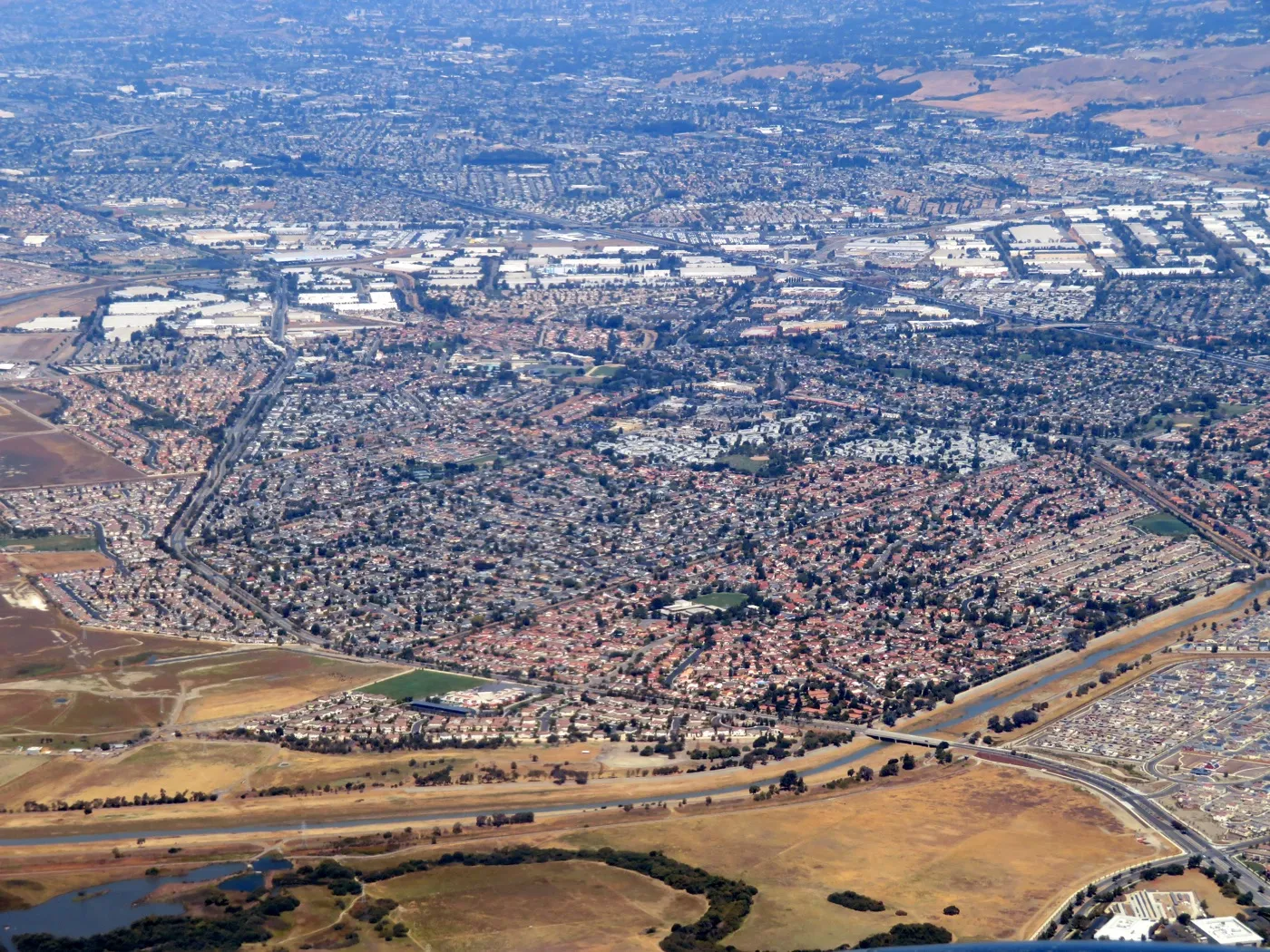
Union City traces its roots to 1850, when brothers John and William Horner established a settlement on the east side of San Francisco Bay and named it Union City after their Sacramento River steamship, the Union. In 1854 the community merged with neighboring New Haven to form Alvarado, named for former Mexican governor Juan Bautista Alvarado. Alvarado served as the first county seat of Alameda County until 1865, when the seat moved to San Leandro. The modern city of Union City incorporated on January 26, 1959, uniting the historic communities of Alvarado and Decoto under one government, with Tom Kitayama serving as its first mayor.
The area's early economy centered on agriculture and industry. The California Beet Sugar Company opened in Alvarado in 1870 and is recognized as the first successful sugar beet mill in the United States; the plant operated until it was demolished in 1977. To the east, Decoto grew up around the railroad after 1870, tied to the first transcontinental line. Rail access remains part of the city's identity today, with the Union City BART station opening on September 11, 1972 and linking the community to the wider Bay Area transit network.
Source: Wikipedia: Union City, California.
Union City by the numbers
A neutral demographic snapshot from the most recent U.S. Census Bureau American Community Survey. These are city-wide figures; individual neighborhoods and parcels vary.
| Measure | Value |
|---|---|
| Population | 68,141 |
| Median age | 42.1 years |
| Median household income | $137,194 |
| Homeownership rate | 67.0% |
| Median home value (owner-occupied) | $1,058,200 |
| Median gross rent (monthly) | $2,713 |
| Average commute to work (one way) | 32.9 minutes |
| Average household size | 3.16 people |
Source: U.S. Census Bureau, American Community Survey 2019-2023 5-year estimates, Union City city, California.
The Union City market right now
| Median sale price | $1,340,000 |
|---|---|
| Days on market | 19 |
| Homes for sale (inventory) | 77 |
| Homes sold | 33 |
| Sale-to-list | 103% |
Data: Redfin, May 2026
For broader Bay Area context behind the Union City numbers, read the current Bay Area market note.
What this means for you (May 2026)
Seventy-seven active listings in Union City gave buyers meaningful variety in May. Homes sold at 103% of asking in a median 19 days, and the inventory is large enough to compare across neighborhoods and styles without losing out to frantic competition. Look at which listings are priced to move and which leave room to negotiate.
Property taxes in Union City
In Union City, property tax begins with Alameda County's 1% base under Proposition 13 (California's 1978 cap on the base tax at 1% of assessed value), plus voter-approved bonds. The verified single-family bill here (FY 2025-26) sits on a very old Prop 13 basis, so its effective rate (total bill as a share of value) reads about 1.89%. The total ad valorem rate (the part charged against assessed value) is 1.2621%.
The flat charges include UNION SEWER SVC $636.02, billed by Union Sanitary, plus the city's STORM WATER UTIL $84.26 and CITY LANDSCP/LIGHT $90.18, then minor paramedic and mosquito charges. Special assessments total $935.82, with no Community Facilities District (CFD) line.
A current-market buyer would face those flat charges on top of the 1.2621% ad valorem rate, not the old parcel's inflated 1.89%. For the base and bonds, see how California property tax works, then estimate monthly cost with the true monthly cost calculator. Figures come from a representative single-family county bill (FY 2025-26); every parcel differs, so check the actual bill for any home you are weighing. Compare all 38 cities side by side on the Bay Area property tax map. This is educational, not tax or legal advice; confirm any figure with a qualified tax professional and the county assessor before relying on it.
Schools (New Haven Unified School District)
New Haven Unified School District (NHUSD) is the unified K-12 district that covers Union City and the southern Hayward area near Tennyson. The district has a long tradition of multilingual academic programs. The district is mid-tier on California-wide rankings (state rank ~#596 of unified districts), but the in-Union-City consistency is its main feature: most of the city feeds the same single high school (James Logan), so the school question reduces to elementary and middle assignment.
James Logan High School is the single comprehensive NHUSD high school for Union City (~3,151 students, U.S. News #619 California, top 25% per SchoolDigger). The size means a deep AP catalog, strong athletics, and a wide range of CTE pathways, including the unique New Haven Aviation pathway (one of the few US public high school aviation programs). Logan is in the southern half of the city; central and Decoto-area buyers should know which middle school feeder (Alvarado, Cesar Chavez, Itliong-Vera Cruz) services their address.
Typical assignment by sub-area
| Sub-area | Elementary feeders | Middle | High |
|---|---|---|---|
| Decoto / Old Alvarado (historic central) | Pioneer / Cabello | Cesar Chavez Middle | James Logan High |
| Alvarado area (south-central) | Alvarado / Hillview Crest | Alvarado Middle | James Logan High |
| Mission Hills / east hillside | Searles / Tom Kitayama / Eastin | Itliong-Vera Cruz Middle | James Logan High |
| South Union City near Logan | Searles / Hillview Crest | Alvarado Middle | James Logan High |
NHUSD attendance lines are stable; Lily verifies the current assignment with the NHUSD registrar before any offer.
Highlight schools
- James Logan High School (9-12, ~3,151 students), U.S. News #619 California, top 25% per SchoolDigger. The single Union City comprehensive high school; large enrollment supports a deep AP catalog and the unique New Haven Aviation CTE pathway.
- Itliong-Vera Cruz Middle School (6-8), named for the Filipino American labor leaders; the east-side feeder.
- Tom Kitayama Elementary (K-5), one of the strongest NHUSD elementaries; east-side / Mission Hills attendance.
- Eastin Elementary (K-5), consistently above-district-median; east-side / Mission Hills attendance.
Sources: New Haven Unified School District; U.S. News NHUSD; California Department of Education DataQuest; Niche NHUSD.
Hospitals and birthing centers
Union City has no in-city hospital with labor and delivery. The two main destinations are Washington Hospital Healthcare System in Fremont (~10-15 minutes south, PPO) and Kaiser Permanente San Leandro Medical Center (~15-20 min north, Kaiser members). The previously-listed St. Rose Hospital in Hayward had a Family Birthing Center within ~10 minutes; that birthing center is currently suspended for 12 to 18 months per Alameda Health System.
| Hospital | Network | Drive time from Union City | Key services |
|---|---|---|---|
| Washington Hospital Healthcare System (Fremont) | Independent (PPO) | 10-15 min | Full labor & delivery birthing center; on-site NICU; UCSF Health neonatology 24/7; Baby-Friendly + CMS Birthing Friendly designation |
| Kaiser Permanente San Leandro Medical Center | Kaiser (closed) | 15-20 min | Closest Kaiser L&D for Union City Kaiser members |
| Kaiser Permanente Hayward Medical Center | Kaiser (closed) | 10-15 min | Alternative Kaiser L&D for Union City Kaiser members; often closer than San Leandro |
| Sutter Eden Medical Center (Castro Valley) | Sutter (PPO) | 15-25 min | Family-centered birth center; alternative PPO option for Union City buyers |
| UCSF Benioff Children's Hospital Oakland (high-acuity NICU referral) | UCSF (PPO) | 25-35 min | Level IV NICU; only pediatric Level I trauma center for Alameda + Contra Costa County |
Birthing centers: what matters
Washington Hospital Fremont is the default in-network L&D (Labor and Delivery) for most Union City PPO (Preferred Provider Organization) buyers: ~10-15 minutes south, full L&D with on-site NICU, UCSF Health neonatology on-floor 24/7, and both Baby-Friendly and CMS Birthing Friendly designations.
Kaiser members in Union City typically deliver at Kaiser Hayward or Kaiser San Leandro depending on traffic and which is closer to the specific Union City address. Both are full Kaiser L&D facilities.
The temporary closure of St. Rose Hospital Family Birthing Center in Hayward removed what had been the closest PPO birthing center for some northern Union City addresses; that closure runs through approximately 2025-2026 per Alameda Health System.
Hospital network coverage depends on your insurance plan. Lily does not advise on medical coverage decisions; for in-network confirmation contact your insurer directly. Hospital information above is current as of 2026-05-28 and should be re-verified with each hospital's admissions office before relying on it for a major life decision.
Sources: Washington Hospital Birthing Center; Kaiser San Leandro maternity; Kaiser Hayward maternity; Sutter Eden Birth Center; Tri City Voice on St. Rose closure; California Perinatal Quality Care Collaborative NICU Directory.
Crime, hazards, and ratings
Union City's foothill tracts sit roughly two miles from the Hayward Fault at the base of the Mission hills, and the baylands west of I-880 carry High liquefaction. The city is not in CAL FIRE LRA fire hazard zones, and crime sits near the California average.
| Category | Rating | Detail |
|---|---|---|
| Crime | property and violent crime near California average | |
| Flood | Mostly Zone X; Zone AE along Alameda Creek and the baylands west of I-880 | |
| Fire | Not in LRA fire hazard zones; flat city | |
| Earthquake | Hayward Fault about 2 miles east (at the base of the Mission hills); Calaveras Fault about 7 miles east; liquefaction: High in baylands tracts west of I-880; Moderate east of I-880; Lower on the foothill bench |
School ratings
Numeric snapshots for the highlight schools above:
| School | GreatSchools | Niche |
|---|---|---|
| James Logan High | 7 | A |
| Itliong-Vera Cruz Middle | 6 | B+ |
| Tom Kitayama Elementary | 8 | A |
| Eastin Elementary | 6 | B |
Environment and infrastructure
Beyond the natural-hazard ratings above, these are the environmental and infrastructure factors buyers ask about most. Each is a city-level summary; confirm the exact parcel before any offer.
| Factor | Detail |
|---|---|
| Gas transmission pipelines | PG&E gas transmission lines run through the Union City/Fremont/Newark corridor and are shown in PHMSA's National Pipeline Mapping System. NPMS alignments are approximate and exclude distribution mains, so property-specific proximity should be verified via the NPMS viewer or PG&E. |
| Noise (freeway, rail, flight paths) | Union City noise comes from I-880 and CA-84/Dumbarton corridor, the Union Pacific freight line and the Union City BART station, plus the adjacent Capitol Corridor/ACE rail alignment. The city sees San Jose (SJC) overflight at altitude. |
| Refineries and heavy industry | Union City is not adjacent to a petroleum refinery; the Contra Costa refineries are far to the north. The city has a light-industrial and warehouse belt near I-880 and the western baylands edge that is the relevant local source. |
| Soil and groundwater contamination | Union City's largest documented cleanup site is the former Pacific States Steel Corporation mill (a state-overseen DTSC site with soil and groundwater contamination from decades of steelmaking), and the city has additional GeoTracker and EnviroStor records tied to industrial and former-landfill areas. Specific parcels should be checked against GeoTracker by address. |
| Air quality and wildfire smoke | Union City's air quality is generally moderate and traffic-driven (I-880 corridor) with regional wildfire-smoke exposure and no single dominant local industrial source. BAAQMD, AirNow and CalEnviroScreen provide current and tract-level data. |
| Wildfire zone and power shutoffs (PSPS) | Union City is predominantly flatland and outside the CAL FIRE / CPUC High Fire Threat District, with limited PSPS exposure; only the easternmost hill fringe near the county line approaches elevated wildfire risk. |
| High-voltage power lines | PG&E high-voltage transmission corridors and substations serve the Union City/Newark/Fremont industrial belt near the I-880 and rail corridors; exact proximity to a neighborhood should be confirmed on PG&E or CPUC mapping. |
| Sea level and shoreline flooding | Western Union City along the baylands and former salt-pond/marsh edge has projected sea-level-rise and tidal-flooding exposure under NOAA and BCDC scenarios, while the central and eastern parts of the city are not exposed. |
These are city-level summaries from public agencies and are approximate. Pipeline and power-line alignments, contamination parcels, and wildfire zones can differ block by block; verify the exact address with the agency tools linked above and your inspections before you write an offer.
Sources: PHMSA National Pipeline Mapping System; DTSC EnviroStor; State Water Board GeoTracker; EPA Superfund; BAAQMD air data; CAL FIRE Fire Hazard Severity Zones; PG&E PSPS maps; NOAA Sea Level Rise Viewer
Hazard ratings are city-level aggregates from public agencies (FEMA, CAL FIRE, USGS). Specific addresses can carry materially different risk; verify the exact parcel via the FEMA Flood Map Service Center, the CAL FIRE FHSZ viewer, and your insurance carrier before any offer. School ratings vary by year and by metric; the numbers above are point-in-time snapshots, treat them as a starting point and re-verify with the district registrar.
Sources: CrimeGrade.org (crime); FEMA Flood Map Service Center (flood); CAL FIRE FHSZ viewer (fire); USGS earthquake hazards (earthquake); GreatSchools + Niche (school ratings).
Track Record
5 documented Union City closings, $4.9M local volume. Career-wide: 104 documented closings, $115M+ in total volume, with 91 of 104 on the buyer side, 10 closings in the last 12 months, career range $323K to $3.3M, 5.0-star Zillow average across 38+ reviews. The full transaction record for every Bay Area city Lily has closed in is summarized at the cities index. Every transaction below links to the address on Zillow.
 Buyer
Buyer
$0.72M
Feb 2026 · Buyer-side
35560 Monterra Ter APT 301, Union City
 Seller
$1.33M
Nov 2023 · Seller-side
2535 Begonia St, Union City
 Buyer
Buyer
$1.18M
May 2021 · Buyer-side
34925 Osprey Dr, Union City
 Buyer
Buyer
$0.91M
May 2019 · Buyer-side
2578 Windsor Ct, Union City
 Seller
$0.74M
Sep 2017 · Seller-side
2745 Meadowlark Dr, Union City
104 transactions · $115M+ · 5.0★ Zillow · Cal DRE #02010731
What buying a home in Union City actually involves
Union City buying runs through its single anchor. One BART station serves the whole city, so the walkable half-mile around it holds value differently from the addresses that need a daily drive, and I make that distance explicit in every pricing conversation. The school question is inverted here too: nearly everything in New Haven Unified feeds James Logan High, so what varies by address is the elementary and middle feeder, and that is what I confirm with the district registrar before an offer, not the high school everyone already knows.
The stock itself rewards a careful read. Much of Union City was built with multi-generational layouts, and homes that genuinely deliver that use carry real demand, so I flag which floor plans work for it and which just list a bonus room. Price-wise the city sits between Hayward below and Fremont above for comparable inventory, from the Mission Hills and Decoto corridor at $900K-$1.3M to the eastern hillside at $1.1M-$1.6M, and my five documented Union City closings span both ends of that map, from a $720,000 Monterra Terrace condo to a $1,175,000 Osprey Drive purchase. As everywhere, the disclosures get read in full and the walk-away option stays open; Union City particulars follow in the FAQ below.
What selling a home in Union City involves
Selling in Union City means leading with the anchor your buyer is buying: the BART walk, the Logan feeder path, or the layout. Those are the demand drivers in this market, and the listing that names its driver clearly outperforms the one that markets generic square footage. I set the comp line from the specific corridor, Mission Hills and Decoto, central Union City near BART, or the eastern hillside, because the three bands price differently for comparable homes.
Preparation follows the same Strategic Listing discipline I run everywhere: pre-listing inspection, positive-ROI work only, professional photography, complete disclosures, and managed bidding through the opening weekends. My Union City file includes seller-side work, Begonia Street at $1,330,000 in 2023 and Meadowlark Drive in 2017, alongside the buyer-side closings, so the pricing read here comes from both sides of the table.
The Meticulous Protector, applied to Union City
Union City prices on a gradient: the closer a tract sits to the BART station, the more the same floor plan costs, and Lily's first job is making sure a client pays that premium knowingly or skips it deliberately. From there the checklist follows the city's actual stock. Most of it is 1970s and 80s tract construction, so inspections focus on what forty-year-old houses wear out rather than on a generic punch list. School assignment is verified by address with the New Haven Unified registrar before any offer, because boundary assumptions are how buyers get surprised after closing. And in the townhouse corridors, the HOA document file is read in full, budgets, reserve funds, rules, and meeting minutes, before a client commits to anything. None of this is unique to Union City in spirit; all of it is specific to Union City in detail, and the details are where deals go right or wrong.
What the record shows in Union City
The Union City file holds 5 documented closings spread across nearly a decade, and the spread is what makes it useful. The earliest entry closed in 2017, the latest in February 2026, and the band runs from a $720,000 condo at the bottom to a $1,330,000 single-family sale at the top. Three of the five were buyer representations and two were seller representations, so Lily has priced Union City homes from both directions, advising on what to offer and on what to ask. A nine-year presence in a city this size is its own data point: the boundary, pricing, and HOA knowledge stays current instead of being relearned for each deal. Those five entries sit inside a career record of 104 documented closings and $115M+ in total volume.
- A 3-bedroom condo built in 2001: 35560 Monterra Ter APT 301, bought for a client at $720,000 in 2026, the most recent closing.
- A 3-bedroom single-family home built in 1972: 2535 Begonia St, sold at $1,330,000 in 2023, the top of the local band.
- A 4-bedroom property built in 1978: 34925 Osprey Dr, bought for a client at $1,175,000 in 2021.
- A 4-bedroom home built in 1975: 2745 Meadowlark Dr, sold at $745,000 in 2017, the earliest entry in the file.
Union City FAQ
What are Union City price ranges in 2026?
Single-family in eastern Union City hillside (newer construction) typically runs $1.1M-$1.6M. Central Union City and Decoto Road corridor (mixed older + newer) runs $900K-$1.3M. Condos and townhomes city-wide run $500K-$800K. Union City sits about $100K-$300K below comparable Fremont inventory and $100K-$200K above comparable Hayward inventory.
How are Union City schools?
New Haven Unified School District covers most of Union City. James Logan High School is the main public high school. Schools are mid-tier within Alameda County, below Castro Valley Unified and Fremont's Mission San Jose attendance area but above Hayward Unified on most published measures. Verify exact attendance by address; some addresses on the northern boundary fall into Hayward Unified.
Union City BART, what's the commute story?
Union City has one BART station on the Fremont-South line. BART to Embarcadero / Montgomery in SF runs ~45-55 minutes off-peak. Reverse commute to Fremont and Berryessa/North San Jose runs 10-25 minutes. Driving to Tesla Fremont via I-880 + 84 is 10-20 minutes off-peak. The single-station situation makes the walkshed around the station meaningfully more valuable than addresses further out.
Union City vs Hayward vs Fremont?
Fremont is the most expensive of the three, with strong schools (Mission San Jose specifically). Hayward is a large city with lower entry prices and a wide inventory variety. Union City sits between them on price + school quality, with a smaller geographic footprint that makes the BART-walkshed premium more pronounced. For buyers who prioritize established local community amenities and multi-generational-friendly housing, Union City compares well among the three.
Does Lily Garipova speak Russian for Union City transactions?
Yes. Russian is Lily's native language. Lily represents Russian-speaking buyers and sellers in Union City in either English or Russian. Russian-language Union City page: lilygaripova.com/ru/union-city-realtor/.
What is the price band for eastern Union City hillside single-family?
The eastern Union City hillside, covering the Searles area, the upper Mission Hills tracts, and the newer Old Alvarado hillside infill east of Mission Boulevard, runs $1.1M to $1.6M for single-family in 2026. Construction era is largely 1990s through 2010s with contemporary floor plans, attached two-car garages, and a meaningful view premium for parcels above the 300-foot contour. Lot size, ridge view, and a clean Searles Elementary or Tom Kitayama Elementary assignment drive the spread within the band.
What is the price band for the Decoto Road corridor?
The Decoto Road corridor through historic Old Alvarado runs $900K to $1.3M for single-family in 2026. The corridor mixes 1950s through 1970s single-story stucco with 1990s and 2000s infill on the parcels that survived the original Alvarado town footprint. The Pioneer Park and Cabello Elementary feeders dominate this sub-area, and Cesar Chavez Middle is the middle-school anchor. Buyers should pull the original parcel history because some Alvarado lots predate modern setback codes.
What is the price band for Union City condos and townhomes?
Union City attached housing runs $500K to $800K in 2026, with the densest cluster around Union City BART (Station East TOD), the Mission Boulevard corridor, and the Alvarado-Niles infill complexes. HOA (homeowners association) dues vary by complex, so pull the HOA package for the actual figure. SB 326 (a California law requiring inspection of elevated exterior elements such as balconies) compliance, reserve study (the HOA's funded-reserves analysis) health, and any pending special assessment dominate the price variable. Always pull the SB 326 report, the most recent reserve study, and 12 months of HOA meeting minutes before offer.
What are the main Union City neighborhoods and how do they differ?
Union City breaks into five practical neighborhoods: Decoto / Old Alvarado (historic central, Decoto Road spine), Alvarado (south-central single-family between Alvarado-Niles and Whipple), Searles (south near Logan High and the New Haven corporation yard), Mission Hills / east hillside (newer construction east of Mission Boulevard), and Cabello / Pioneer Park (older flatland near the western boundary). The price spread across these five exceeds $400K for comparable square footage; the feeder pattern is the dominant driver.
What is the Station East TOD and how does it affect condo pricing?
Station East is the planned transit-oriented development around Union City BART on the east side of the tracks, with mixed-use multifamily, retail, and a planned bus + BART intermodal facility. Resale condos in the existing Station East complexes run $550K to $850K in 2026 depending on layout, parking, and HOA health. New construction phases continue through 2026 and beyond; resale buyers should weigh future construction noise and dust as a near-term carry consideration.
What does Tom Kitayama Elementary's reputation actually rest on?
Tom Kitayama Elementary in the Mission Hills feeder is a frequently cited stronger New Haven Unified School District (NHUSD) elementary among buyers in 2026, with a GreatSchools 8 and a Niche A. The school carries above-district-median CAASPP (California Assessment of Student Performance and Progress) scores in both ELA (English Language Arts) and math and parent engagement metrics in the top quartile of Alameda County elementaries. Attendance assignment is set by parcel and third-party rankings differ by school, so verify the exact assignment with the district registrar before an offer.
What is the New Haven Aviation pathway at James Logan High?
James Logan High School's New Haven Aviation pathway is one of the few US public high school career-technical education programs in aviation, with FAA Part 141 ground-school curriculum, simulator labs, and partnership pipelines into community-college and four-year aviation tracks. The pathway draws students from across NHUSD and from out-of-district transfers, and is one of the reasons Logan's CTE catalog ranks deeper than the Newark Memorial or Hayward Unified comparable. The program is a meaningful student-pool differentiator, not a pricing variable per se.
Which Union City addresses fall into Hayward Unified instead of NHUSD?
A narrow strip of Union City addresses on the northwestern boundary near the Hayward city line, particularly some parcels north of Industrial Parkway West and west of Union City Boulevard, are actually assigned to Hayward Unified School District despite a Union City mailing address. The HUSD (Hayward Unified School District) versus NHUSD assignment is set parcel by parcel, and third-party rankings differ by district. Verify with both district registrars by exact parcel before any offer in this corridor.
What does the Union City BART to San Francisco commute actually cost in 2026?
Union City BART to Embarcadero is roughly $7.55 one-way in 2026 ($15.10 round-trip), about 45-55 minutes off-peak and 50-60 minutes at peak with the Lake Merritt and West Oakland transfers in the routing. Monthly cost at a 5-day commute is about $310. Parking at Union City BART runs $3 to $5 per day in the metered lot or free in the residential 0.5-mile walkshed. The single-station Union City situation makes the walkshed around the station meaningfully more valuable than any address requiring a daily drive.
What is the Union City to Tesla Fremont commute math?
Union City to Tesla's Fremont factory at 45500 Fremont Boulevard via I-880 south plus 84 east is 10 to 20 minutes off-peak and 20 to 35 minutes at shift-change peaks (4am, 12pm, 8pm). The reverse-commute pattern means most Tesla shift workers in Union City face minimal traffic in their direction. The Union City BART to Fremont Warm Springs / Berryessa route is also reverse-commute, which is part of why Union City is materially undervalued relative to Fremont addresses for any household with a Tesla, Lam Research, or south-Fremont semiconductor employer.
How does the Hayward Fault affect Union City foothill parcels?
The Hayward Fault runs roughly two miles east of Union City at the base of the Mission hills, with the Alquist-Priolo Earthquake Fault Zone overlay covering portions of the easternmost hillside tracts. The Calaveras Fault sits about seven miles further east. Liquefaction risk is High in the baylands west of I-880 and Moderate east of I-880; the hillside bench is lower-risk. Always pull the parcel-specific California Geological Survey overlay and verify any seismic retrofit completion before offer.
What community institutions and amenities anchor Union City?
Union City has an established base of community institutions, including parishes, business associations, and civic groups, along with New Haven Unified's multilingual and English-as-a-second-language programs and a mid-tier price floor that supports larger and multi-generational households. For buyers who value established local networks and services, these amenities can reduce search and settling-in cost relative to comparable Hayward or Fremont addresses.
What is the Alvarado-Niles Road corridor and what does it carry?
Alvarado-Niles Road is Union City's primary east-west arterial, running from the Niles district of Fremont east through the city center past Union Landing shopping to the I-880 interchange and continuing west to Union City Boulevard. The corridor carries Union City's heaviest retail, commercial, and arterial traffic. Single-family on or backing to Alvarado-Niles trades at a $40K to $100K discount versus interior tracts due to noise and traffic; condos along the corridor carry no such discount because the layout puts the bedrooms toward the interior courtyards.
Should I buy near Union Landing or in residential interior?
Union Landing is the regional shopping center off I-880 at the Alvarado-Niles interchange, anchored by Costco, Target, In-N-Out, and a dense restaurant cluster. Single-family within a half-mile of Union Landing carries the convenience premium but also the I-880 noise discount; net price impact is mildly positive for interior-facing parcels and mildly negative for parcels with line-of-sight to the freeway. The residential interior tracts (Pioneer Park, Searles, Mission Hills) trade higher because they buy quiet without sacrificing arterial access.
How does the Dumbarton Bridge factor into Union City commute math?
The Dumbarton Bridge (84 west from Newark) gives Union City buyers a 25 to 40 minute commute to Meta in Menlo Park, Stanford in Palo Alto, and the Sand Hill Road venture corridor; the bridge is 6 to 12 minutes south of central Union City via I-880. Peak-hour westbound congestion adds 10 to 20 minutes. For Peninsula-employed buyers, Union City delivers a materially shorter commute than going around the bay via San Mateo Bridge or via BART through SF, at a meaningfully lower entry price than Fremont addresses on the same Dumbarton routing.
What is the Quarry Lakes / east Union City open-space context?
Quarry Lakes Regional Recreation Area sits at the Union City / Fremont border along Alameda Creek, with fishing, swimming, walking trails, and a major trailhead for the Alameda Creek Regional Trail extending all the way to the bay. East Union City hillside tracts above Mission Boulevard back to open-space conservation easements, with the Mission Peak Regional Preserve trailhead system within 10 minutes. The open-space buffer is a quiet value driver for hillside resale and an Air Quality (no neighbor downwind) plus.
Does Union City have meaningful small-multifamily or ADU inventory?
Union City's 2-to-4-unit small-multifamily stock is concentrated in Old Alvarado / Decoto Road and along Mission Boulevard, typically $1.1M to $1.8M depending on unit count, era, and rent roll. California ADU (accessory dwelling unit) law (SB9, AB1033, AB976) plus Union City's permit-friendly ADU ordinance has made permitted ADU additions common on Pioneer Park and Searles parcels, supporting house-hacking and multi-generational use. An existing permitted ADU adds appraised value and rent-roll cushion for the I-880 corridor commute pool.
What about Mello-Roos and special assessments in newer Union City tracts?
Newer Union City master-planned tracts in the eastern hillside (post-1995 construction) can carry a Mello-Roos special tax, an add-on special tax levied through a CFD (Community Facilities District) to repay infrastructure bonds, on top of the base property tax. The Mello-Roos special tax varies tract to tract, so pull the current annual levy for the specific parcel and add it to carrying cost. The current annual levy is shown on the county property tax bill and disclosed in the seller Mello-Roos Notice of Special Tax; the recorded special-tax lien also appears on the preliminary title report, but the prelim shows only that the lien and tax formula exist, not the current dollar amount. The CFD term and pay-off date also matter; some 1990s CFDs are near expiration and others have been re-bonded into the 2040s, so confirm the remaining bond schedule before offer.
What does flood risk look like west of I-880 in Union City?
Most Union City parcels sit in FEMA Zone X (low risk), but Zone AE flood overlays cover the parcels along Alameda Creek and the baylands west of I-880 toward the San Mateo Bridge approach. Zone AE (a Special Flood Hazard Area, or SFHA) properties require federal flood insurance for any federally-backed mortgage; premiums vary by elevation, so get an actual quote for the specific parcel. The bay-mud and alluvial fill underneath west-of-I-880 also drives the liquefaction risk; Lily pulls the parcel-specific FEMA Flood Map and CGS liquefaction overlay for every west-of-I-880 transaction.
How does Lily Garipova represent Union City buyers specifically?
Lily reads every disclosure end-to-end (TDS, NHD, SPQ, HOA package, preliminary title, CFD disclosure), pulls the parcel-specific FEMA Flood Map, CAL FIRE FHSZ, and Alquist-Priolo overlays, verifies NHUSD vs HUSD attendance with both district registrars by parcel on any boundary address, models full carrying cost including Mello-Roos and projected SB326 condo assessments, walks the property at morning commute, midday, evening, and weekend, and stays willing to recommend walking from any deal that does not pencil. Free 30-minute initial consultation.
How does Lily Garipova represent Union City sellers specifically?
Strategic Listing Model applied at the Union City sub-area level: comp set drawn from the exact neighborhood (Decoto / Old Alvarado, Alvarado, Searles, Mission Hills, Pioneer Park), not city-wide averages; pre-listing inspection with positive-ROI improvements only; professional staging targeted to the layouts and features Union City buyers prioritize; multi-platform marketing with active bid management; full disclosure preparation including SB326, CFD, and attendance verification to minimize post-close litigation exposure. 5 documented Union City closings on roughly $4.9M of volume.
Union City vs Newark for first-time buyers, what's the comparison?
Newark sits south of Union City between Fremont and the bay, with Newark Unified (state rank #795 of unified districts) versus Union City's New Haven Unified (state rank ~#596). Newark single-family runs roughly $100K to $200K below Union City for comparable stock; Newark has no BART station of its own (transfer at Fremont or Union City). For first-time buyers without strict school requirements who want Dumbarton Bridge access at the lowest entry, Newark wins; for first-time buyers wanting BART access plus a meaningfully stronger high-school feeder (James Logan vs Newark Memorial), Union City wins.
How has Union City priced over the trailing 12 months?
Union City single-family median has been roughly flat to up low-single-digits over the trailing 12 months ending mid-2026, with the Mission Hills hillside slightly outperforming the city median and the Decoto Road corridor slightly underperforming. Condo segment has been flat to mildly negative as SB326 disclosure surfaces deferred-maintenance liabilities and special assessment risk. Days-on-market lengthened versus the 2021-2022 peak; well-prepped listings still attract multiple offers, while overpriced listings sit and chase the market down. Steady owner-occupier demand keeps the market relatively stable through softer cycles.
How do I schedule a Union City consultation with Lily Garipova?
Call or text 415-910-3958, or email lilyagaripova@gmail.com. Free 30-minute initial consultation by phone, Zoom, or in person at any Union City address that works for you. Available in English and Russian. Cal DRE #02010731. The consultation walks through your specific buying or selling math: budget, timeline, NHUSD school constraints, BART or Dumbarton commute, financing pre-approval, and the realistic Union City sub-area that fits.
Where do Union City residents go for hospital labor and delivery?
Union City has no in-city hospital with labor and delivery. Washington Hospital Healthcare System in Fremont is the default PPO L&D destination, 10 to 15 minutes south, with full L&D, on-site NICU, and UCSF Health neonatology 24/7, plus Baby-Friendly and CMS Birthing Friendly designations. Kaiser members deliver at Kaiser Hayward or Kaiser San Leandro, both 10 to 25 minutes north depending on the specific Union City address. The St. Rose Hospital Family Birthing Center in Hayward is currently suspended through approximately 2025-2026 per Alameda Health System; that closure removed the closest PPO birthing center for some northern Union City addresses.