Why Berkeley
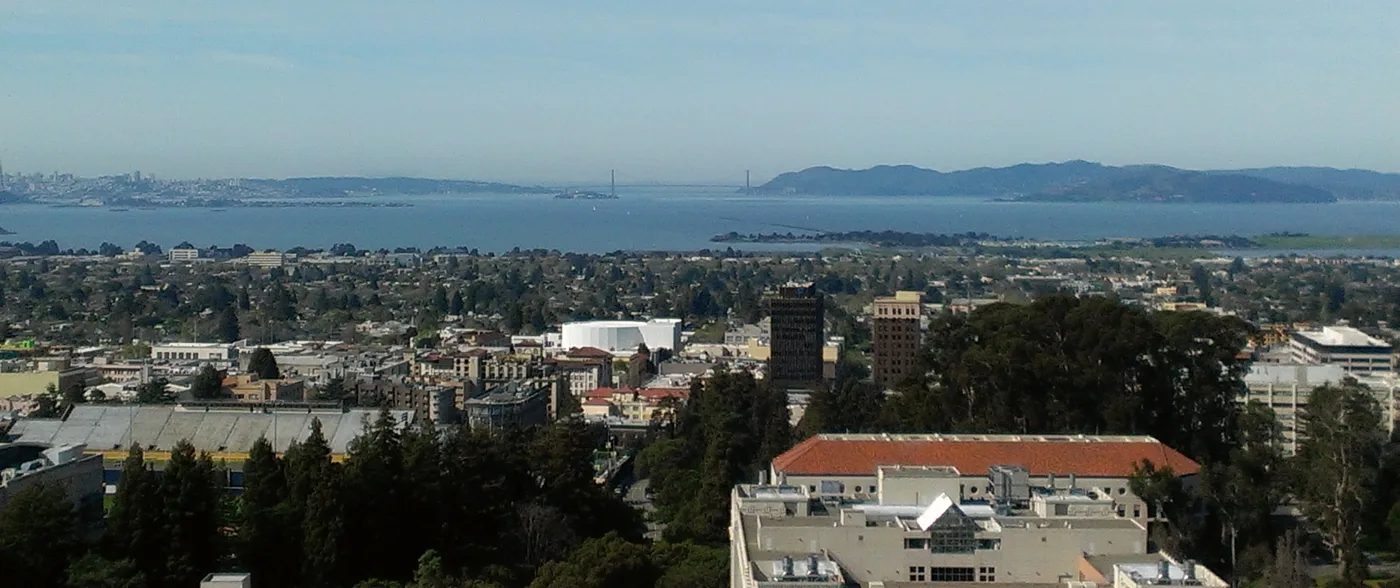
Berkeley is a city in northern Alameda County on the eastern shore of San Francisco Bay, population 124,321 at the 2020 census, home to the University of California's oldest campus and to Lawrence Berkeley National Laboratory. Those are the facts everyone knows. The fact that matters more if you are buying or selling here is that Berkeley runs its own regulatory layer on top of California and county rules. It is thick.
The city levies its own transfer tax with a cliff that can cost a seller tens of thousands of dollars on a small price difference. It enforces a time-of-sale energy ordinance that went live in January 2026. It requires a sewer lateral certificate (a compliance check on the underground pipe connecting a building to the city sewer main) before close of escrow on every building, condominiums included. It operates a Rent Stabilization Board with its own registration, fee, and just-cause regime, and it assesses most of its voter-approved taxes per building square foot rather than per parcel. A buyer or seller coming from any other Bay Area city will encounter rules here that did not exist in their last transaction.
The market is competitive. Over the three months ending June 2026, the median sale price was about $1.5 million, up 2.6% from a year earlier, with a median of 15 days on market, about six offers per home, and a Redfin Compete Score of 93 out of 100. Three BART stations serve the city: Downtown Berkeley, Ashby, and North Berkeley. Downtown Berkeley to Embarcadero is about 25 minutes direct, no transfer. The Eastshore Freeway (I-80 and I-580) runs along the bayshore with exits at Ashby Avenue, University Avenue, and Gilman Street.
The neighbourhoods locals use include Downtown Berkeley, Southside, Northside, Claremont, Elmwood, South Berkeley, West Berkeley (including the historic Ocean View area, the Berkeley Marina, and Aquatic Park), North Berkeley (home to the Gourmet Ghetto concentration of food businesses), Westbrae, Northbrae, Thousand Oaks, Cragmont, La Loma Park, and the Berkeley Hills along the eastern ridge. The city recognizes ten commercial districts, from Telegraph and Fourth Street to Solano Avenue and the Gilman District. These are the names locals use, not official boundaries, and each carries its own commercial character.
The Berkeley market right now
| Median sale price | $1,500,000 |
|---|---|
| Days on market | 15 |
| Homes for sale (inventory) | 118 |
| Homes sold | 70 |
| Sale-to-list | 128% |
Data: Redfin, May 2026
For broader Bay Area context behind the Berkeley numbers, read the current Bay Area market note.
What this means for you (May 2026)
Redfin puts Berkeley homes at 128% of asking in May, the highest ratio among the cities tracked here, and that gap commonly reflects a local convention: sellers often list below expected value to draw multiple offers, so part of it is by design. With a median of 15 days on market, the window is short. If you're buying here, evaluate recent comparable sales rather than anchoring on list price.
Berkeley Coverage
My practice spans the Bay Area: 104 documented transactions and $115M+ in total volume from 2017 to 2026, most of it buyer-side (91 of 104 closings), concentrated in Alameda, Santa Clara, and Contra Costa counties. California licensed since 2016, in real estate since 2007, Cal DRE #02010731. That work includes cities across the East Bay where the same county rules apply and the same disclosure frameworks operate.
What transfers to Berkeley is the method, and it happens to be exactly the method a city with this many regulatory layers needs. Disclosure review, pricing discipline with comparable sales (comps, the recent sale prices of genuinely similar nearby homes), and the ability to read Berkeley's city-level requirements into a transaction timeline so nothing surfaces late.
The transfer tax cliff, BESO, the sewer lateral certificate, the rent board, the per-square-foot tax structure: each adds a line item, a deadline, or a liability that has to be identified before you commit, not after. I work in English and Russian, and I bring the same diligence to Berkeley that has earned a 5.0-star Zillow rating across 38+ reviews.
Buying in Berkeley
Start with the closing cost that surprises buyers from other cities: Berkeley's transfer tax. The rate is 1.5% on properties up to $1.7 million and 2.5% on properties over $1.7 million, and it applies to the entire sale price, not just the amount above the threshold. This is not a marginal bracket. The City of Berkeley publishes its own worked examples: a property that sells for $1.7 million owes $25,500 in transfer tax, and a property that sells for $2 million owes $50,000. A $300,000 price difference results in $24,500 more in city transfer tax. That arithmetic matters. This is in addition to the transfer tax charged by Alameda County. Under Measure W, a new tier structure with rates up to 3.5% takes effect on January 1, 2027, and the City has stated that the threshold amounts will be recalculated before the effective date.
Next is BESO, the Building Emissions Saving Ordinance, live since January 1, 2026. Every seller of a single-family home or duplex in Berkeley must now obtain a Home Energy Score before listing, post the score in the Multiple Listing Service (MLS) listing's Property Notes section, and include the report in disclosure and transfer documents. Non-compliance carries a $500 fee. After that, the seller has three paths: complete upgrades reaching at least six credits under the City's Resilience Standard, qualify for a heat pump exemption, or defer the upgrades to the buyer with a $5,000 deposit to the City split evenly between seller and buyer ($2,500 each). If the seller deferred, the buyer has two years from the date of sale to complete the upgrades and reclaim the deposit. BESO replaced Berkeley's earlier time-of-sale energy ordinance. Condominiums and ADUs are exempt, and triplexes and fourplexes phase in starting January 2028. As a buyer, check the MLS Property Notes for the Home Energy Score, ask which path the seller chose, and if the seller deferred, understand that you are accepting a $2,500 obligation and a two-year timeline.
A Sewer Lateral Certificate of Compliance is required before close of escrow (the process in which a neutral third party holds funds and documents until all conditions of the sale are met) on all buildings in Berkeley, including condominiums and developments with shared laterals. If the work cannot be completed before closing, the owner may submit a $4,500 deposit and an agreement for a six-month time extension. Failure to complete the work within six months forfeits the deposit, and the City can perform the work and bill any excess to the current owner or place a lien (a legal claim against the property for an unpaid debt) on the property.
If you are buying a rental property, Berkeley's rent control reaches most of the city's approximately 29,000 rental units, with over 20,000 at regulated rents. Vacancy decontrol (the right to set the initial rent for a new tenancy, with subsequent increases limited by the ordinance) has applied since January 1999. The fact that matters most for a buyer is this: sale, foreclosure, and change of ownership are not just causes for eviction in Berkeley, and in most cases the terms of tenancy, including rent levels, transfer to the new owner. A buyer also inherits the prior owner's outstanding Rent Board registration fees and penalties. Before making an offer on a rental property here, check the Rent Board's Unit Information Lookup database and its Reference Guide for Realtors/Buyers.
One correction to state plainly, because competing agent pages often get it wrong: Berkeley's mandatory seismic retrofit ordinances, BMC 19.38 for unreinforced masonry buildings and BMC 19.39 for soft, weak, or open-front wood-frame residential buildings with five or more units permitted before 1978, are triggered by building type and inventory listing. They are not point-of-sale requirements, and they do not reach single-family homes, duplexes, triplexes, or fourplexes. Do not confuse these mandates with the time-of-sale requirements that do apply (BESO and the sewer lateral certificate).
Schools run differently here than in most Bay Area cities. Berkeley Unified School District operates a zone-based "controlled choice" assignment process for its eleven elementary schools (K-5), not address-based neighbourhood assignment. Students in grades 6 through 8 attend one of three zone middle schools. There is one public high school, Berkeley High. The practical consequence for buyers: purchasing a specific address does not guarantee a specific school. Enrollment runs in published rounds, and transfer requests within BUSD are only available during Round 1. BUSD publishes a Find your Elementary or Middle School Zone tool on its website.
One more item to note: Berkeley's property tax structure is unusual. Beyond the 1% countywide ad valorem (value-based) base and voter-approved bond debt service, the city levies nine City taxes and three BUSD taxes, most of them assessed per building square foot rather than per parcel or per dollar of value. FY 2025-26 residential rates run from $0.01080 to $0.54000 per square foot. Refuse collection, storm water fees, street light assessments, and business improvement district assessments are billed separately by other formulas. This means the total annual tax bill depends not just on the assessed value but on the building's square footage, and it is higher than what the base ad valorem rate alone would suggest.
Selling in Berkeley
The transfer tax is typically the seller's responsibility in Berkeley, and the cliff makes pricing strategy matter in ways it does not in other cities. A home listed at $1.71 million triggers the 2.5% rate on the entire sale price, producing a city transfer tax bill about $17,400 higher than at $1.69 million ($42,750 against $25,350). That arithmetic is real, and it has to be part of the pricing conversation from the start, not a surprise at the closing table.
Most sellers do not know about the seismic retrofit rebate. If you have completed qualifying voluntary seismic upgrades on a building used exclusively for residential purposes, or a mixed-use building with at least two residential units, including foundation bolting to mudsills, shear walls, cripple wall bracing, chimney work, or water heater anchoring, you may be eligible for a rebate of up to one third of the base 1.5% transfer tax. The rebate covers work completed before or within one year of sale, and the combined cap with the Home Hardening Rebate is also one third of the base 1.5%. A separate permit application is required. This is money most sellers leave on the table because they do not know the program exists.
BESO compliance is the seller's obligation. Before listing a single-family home or duplex, you must hire a registered BESO Energy Assessor, obtain a Home Energy Score, post it in the MLS Property Notes, and include the report in your disclosures. Then choose your path: complete upgrades to at least six credits, qualify for the heat pump exemption, or defer to the buyer with the $5,000 deposit. The sewer lateral certificate is also your responsibility before close of escrow, and if you need the six-month extension, the $4,500 deposit sits with the City until the work is done.
If you are selling a rent-controlled property, confirm that your Rent Board registration is current and all fees are paid before listing. The buyer inherits any outstanding registration fees and penalties, and a buyer who discovers unpaid Rent Board debt during diligence has a reason to renegotiate or walk. Clean records before you go to market.
Methodology
Berkeley is a city where the regulatory complexity can cost you money if it is not surfaced early. My job is to identify every city-level requirement, every deposit, every deadline, and every liability that applies to your specific transaction, and to walk you through each one before you commit. The transfer tax cliff, the BESO path, the sewer lateral timeline, the rent board lookup, the seismic mandate that does or does not apply to your building type: each is a concrete question with a concrete answer, and each is better answered before your contingencies (the conditions in your contract that let you exit the deal) expire than after.
I will walk you away from the wrong property or the wrong deal structure. That is the whole ethic. If the numbers do not work, if the disclosures reveal risk, if the regulatory costs change the math, my obligation is to tell you plainly and let you decide with the full picture in front of you. Call or text (415) 910-3958, email lilyagaripova@gmail.com, or book at lilygaripova.com/schedule.
Berkeley FAQ
What is the transfer tax in Berkeley?
Berkeley charges a city transfer tax of 1.5% on properties up to $1.7 million and 2.5% on properties over $1.7 million, applied to the entire sale price rather than just the amount above the threshold. The City publishes two examples: $25,500 on a $1.7 million sale and $50,000 on a $2 million sale. A $300,000 price difference results in $24,500 more in city transfer tax. This is in addition to the transfer tax charged by Alameda County. Under Measure W, a new tier structure with rates up to 3.5% takes effect on January 1, 2027, with threshold amounts to be recalculated before the effective date.
What is BESO and does it apply to my sale?
BESO is the Building Emissions Saving Ordinance, live since January 1, 2026. If you are selling a single-family home or duplex in Berkeley, you must obtain a Home Energy Score, post it in the MLS listing Property Notes, and include the report in disclosures. Non-compliance carries a $500 fee. After that, you either complete upgrades reaching at least six credits, qualify for a heat pump exemption, or defer the upgrades to the buyer with a $5,000 deposit split evenly between seller and buyer. Condominiums and ADUs are exempt. Triplexes and fourplexes phase in starting January 2028.
What is the sewer lateral certificate in Berkeley?
A Sewer Lateral Certificate of Compliance is required before close of escrow on all buildings in Berkeley, including condominiums and developments with shared laterals. The property owner hires a contractor to inspect and repair the lateral, then schedules a verification test with a City inspector. If the work cannot be completed before closing, a $4,500 deposit and a six-month extension agreement are available. Failure to complete the work within six months forfeits the deposit, and the City can perform the work and bill excess costs to the current owner or place a lien on the property.
How does rent control affect buying a rental property in Berkeley?
Most of Berkeley's approximately 29,000 rental units are covered by the Rent Stabilization and Eviction for Good Cause Ordinance, with over 20,000 at regulated rents. Sale, foreclosure, and change of ownership are not just causes for eviction, and in most cases the tenancy terms, including rent levels, transfer to the new owner. A buyer also inherits the prior owner's outstanding Rent Board registration fees and penalties. Before making an offer on a rental property, check the Rent Board's Unit Information Lookup database and request tenant estoppels to confirm actual rent levels and outstanding issues.
Do I need a seismic retrofit to sell my home in Berkeley?
Probably not, and competing pages often get this wrong. Berkeley's mandatory seismic retrofit ordinances, BMC 19.38 for unreinforced masonry and BMC 19.39 for soft, weak, or open-front wood-frame buildings, are triggered by building type and inventory listing, not by sale. BMC 19.39 applies only to wood-frame residential buildings with five or more units permitted before 1978. Single-family homes, duplexes, triplexes, and fourplexes are not covered. The time-of-sale requirements that do apply are BESO (the energy ordinance) and the Sewer Lateral Certificate of Compliance.
How are schools assigned in Berkeley?
Berkeley Unified School District runs a zone-based controlled choice assignment process for its eleven elementary schools, not address-based neighbourhood assignment. Buying a specific address does not guarantee a specific school. Students in grades 6 through 8 attend one of three zone middle schools, and the city has one public high school, Berkeley High. Enrollment runs in published rounds, and transfer requests within BUSD are only available during Round 1. BUSD publishes a Find your Elementary or Middle School Zone tool on its website.
How competitive is the Berkeley housing market?
Competitive. Over the three months ending June 2026, the median sale price was about $1.5 million, up 2.6% from a year earlier. Homes sold in a median of 15 days and received about six offers on average. Redfin rates the market 93 out of 100, or Most Competitive. Pricing discipline and thorough preparation matter in a market where multiple offers are the norm and the regulatory layer adds costs that many buyers from other cities do not anticipate.
Why work with you in Berkeley?
Because the complexity is where careful representation earns its keep. Berkeley layers a transfer tax cliff, an energy ordinance, a sewer lateral certificate, rent control, and a per-square-foot tax structure on top of the standard California transaction. My practice covers 104 documented transactions and $115M+ in volume from 2017 to 2026, most of it buyer-side, concentrated in the same Alameda, Santa Clara, and Contra Costa counties Berkeley sits in. California licensed since 2016, in real estate since 2007, Cal DRE #02010731. I work in English and Russian, and the method is disclosure review, pricing discipline, and surfacing every city-level requirement before you commit. Call or text (415) 910-3958 or email lilyagaripova@gmail.com.