About South Bay
History
The Santa Clara Valley was Ohlone land, then mission territory after Mission Santa Clara de Asís was founded in 1777, then a patchwork of Mexican ranchos. After statehood, the valley became one of the country's most productive fruit-growing regions; the moniker "Valley of Heart's Delight" referred to orchards of apricot, cherry, and prune that covered the floor of what is now San Jose, Sunnyvale, and Cupertino. The shift to electronics began with Stanford's Federal Telegraph Corporation in Palo Alto (1909), accelerated when William Shockley founded Shockley Semiconductor in Mountain View in 1956, and grew fast after journalist Don Hoefler coined "Silicon Valley" in 1971. San Jose was the fastest-growing US city between 1970 and 1980, paving over the orchards in one generation.
Geography and economy
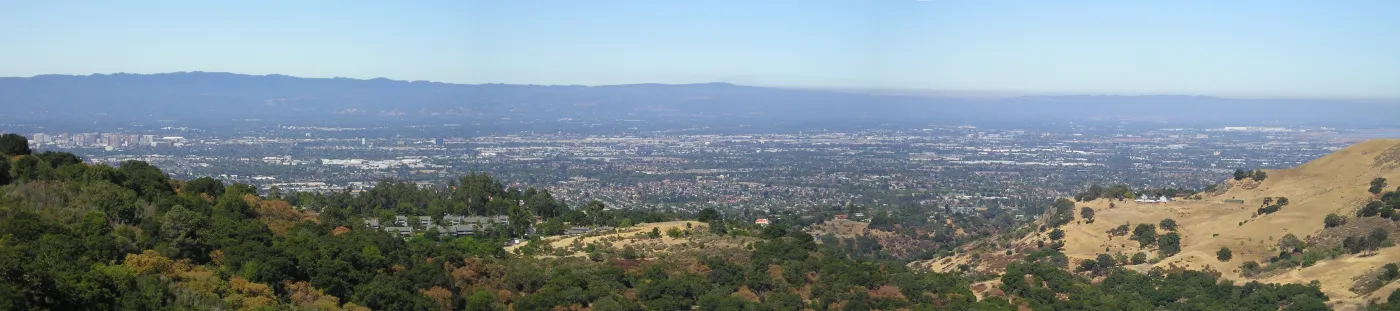
The South Bay fills the floor of the Santa Clara Valley, bounded by the Santa Cruz Mountains to the west, the Diablo Range to the east, and San Francisco Bay to the north. Interstates 280 and 880 and US 101 run the length of the valley; Caltrain and VTA light rail provide transit spines. Santa Clara County has a population of 1.94 million and a median household income of 164,281 dollars (2024). Roughly 41% of residents are foreign-born; immigrants account for two-thirds of the county's STEM workforce. Apple is headquartered in Cupertino, Google's main campus is in Mountain View, Nvidia is in Santa Clara, Cisco is in San Jose, and Netflix is in Los Gatos. Manufacturing, professional services, and healthcare round out the top employment sectors.
What buying in South Bay means
The South Bay is the heart of Silicon Valley and among the most expensive places in the United States to buy a single-family home. Typical buyers are dual-tech-income households with stock-compensation income, often with a target school in mind (Cupertino Union, Saratoga Union, Los Gatos), and a price band that runs from roughly $1M for entry-level San Jose single-family to $5M and above in Saratoga and Los Gatos. The structural pros are job density (you can live within fifteen minutes of almost any tech HQ), school quality, and weather. The structural cons are the absolute price level, school-attendance-zone pricing premiums, and the heavy tax-and-stock-grant exposure of typical buyer balance sheets. Read as one market, the South Bay housing market tracks Silicon Valley payrolls more closely than mortgage rates, which is why demand holds even as prices sit among the nation's highest.
The South Bay is Silicon Valley
When people search for a Silicon Valley realtor, this is the region they mean. Silicon Valley is not a city; it is the everyday name for the Santa Clara Valley, and its residential core is the South Bay: San Jose, Santa Clara, Sunnyvale, Mountain View, Cupertino, Campbell, Los Gatos, and Saratoga. The employers that define the term (Apple in Cupertino, Google in Mountain View, Nvidia in Santa Clara, Adobe in San Jose) sit inside the cities on this page. If you are looking for a Silicon Valley real estate agent, this South Bay guide and my 35 documented closings here are that record.
Buying a home in Silicon Valley
The section above explains what Silicon Valley is. This one answers the practical question: what does buying a home here look like?
The search covers nine cities. Seven have their own advisory guides on this site, linked in the city guides section below, and I also represent buyers and sellers in Cupertino and Milpitas.
Typical buyers are dual-tech-income households whose pay includes restricted stock units (RSUs), the company shares that vest on a schedule as part of your compensation. Sign-on equity (stock grants included in a job offer) and concentrated-stock positions (when most of your net worth sits in a single company's shares) come up just as often. These are routine parts of the financing conversation here, not edge cases. The gap between a lender who underwrites equity compensation weekly and one who does not is the gap between your full budget and a fraction of it.
Single-family prices run from roughly $1M at the entry level in parts of San Jose (Berryessa, East San Jose) to $5M and above in Saratoga and Los Gatos. Sunnyvale, Santa Clara, Mountain View, Cupertino, and Campbell fall between, with most single-family homes starting above $1.6M. School-attendance-zone pricing is the single largest driver of within-city variation: two homes a block apart can sit $500K apart if they feed different schools. The per-city guides below break down each city's price bands, school assignments, and neighborhood trade-offs.
Most prominent cities
- San Jose: tenth-largest US city, huge price-and-neighborhood range, from East San Jose entry homes to Almaden Valley estates.
- Sunnyvale: dense, tech-anchored, Apple and Google adjacency, single-family 1.8M to 2.8M.
- Santa Clara: Nvidia HQ, Levi's Stadium, more affordable than Sunnyvale, single-family 1.7M to 2.4M.
- Mountain View: Google's home city, Castro Street downtown, single-family 2.2M to 3.5M, townhomes a popular entry.
- Saratoga and Los Gatos: top-tier schools, large lots, foothill estates from 3M to 7M-plus.
7 cities with dedicated guides
Every city in South Bay has its own advisory page with schools, hospitals, pricing math, and per-city FAQ:
San Jose
24 documented closings
Tenth-largest US city, huge price and neighborhood range, from East San Jose entry homes to Almaden Valley estates.
Sunnyvale
2 documented closings
Dense, tech-anchored, Apple and Google adjacency, single-family 1.8M to 2.8M.
Santa Clara
1 documented closing
Nvidia HQ and Levi's Stadium, more affordable than Sunnyvale, single-family 1.7M to 2.4M.
Mountain View
1 documented closing
Google's home city, Castro Street downtown, single-family 2.2M to 3.5M, townhomes a popular entry.
Los Gatos
3 documented closings
Top-tier schools and foothill estates, Netflix headquartered here, typical 2.5M to 5M-plus.
Campbell
1 documented closing
Walkable downtown on the Los Gatos Creek Trail, mid-tier South Bay pricing, single-family 1.4M to 2.2M.
Saratoga
1 documented closing
Top-tier Saratoga Union schools, large foothill lots, typical estate pricing 3M to 7M-plus.
Also serving Cupertino and Milpitas
Two more Silicon Valley cities where I represent buyers and sellers: Cupertino and Milpitas.
Cupertino. Cupertino is Apple's headquarters city, and its single-family pricing is driven by attendance areas in the Cupertino Union and Fremont Union High school districts. Much of the stock is ranch-era on modest lots, and verifying the exact school assignment by parcel is the first step of any offer here.
Milpitas. Milpitas is the South Bay's BART gateway: the transit center pairs the BART terminus with VTA light rail next to the Great Mall. Newer townhouse and condo inventory around the station gives buyers an entry price below Cupertino or Sunnyvale, with HOA and Mello-Roos math to verify before any offer.
Call or text me at 415-910-3958 to talk through a Cupertino or Milpitas purchase or sale.
How the South Bay cities compare
A neutral, side-by-side snapshot of South Bay's cities from the most recent U.S. Census Bureau American Community Survey. Sorted by median home value; every figure is city-wide, and individual neighborhoods and parcels vary.
| City | Population | Median household income | Median home value | Median gross rent |
|---|---|---|---|---|
| Los Gatos | 32,773 | $207,891 | $2,000,000+ | $2,969 |
| Saratoga | 30,335 | $241,348 | $2,000,000+ | $3,500+ |
| Mountain View | 82,363 | $179,917 | $1,927,400 | $2,975 |
| Sunnyvale | 153,455 | $181,862 | $1,816,600 | $3,065 |
| Campbell | 42,848 | $147,128 | $1,550,000 | $2,751 |
| Santa Clara | 129,239 | $173,670 | $1,527,900 | $2,985 |
| San Jose | 990,054 | $141,565 | $1,187,800 | $2,617 |
Source: U.S. Census Bureau, American Community Survey 2019-2023 5-year estimates.
Build a South Bay search from the address outward
South Bay buyers often compare cities when the decisive facts sit below the city line. A workable search brief starts with the parcel and a realistic commute, then widens to nearby markets.
- Verify school assignment by address: identify the elementary/middle and high-school districts instead of relying on ZIP code or listing copy.
- Model the real commute: compare the actual office-day route, Caltrain access where relevant, and the time-cost trade-off of moving one city outward.
- Reconcile permits and condition: check additions, conversions, ADUs, seller reports, and the scope and date of every inspection.
- Price the local risks: include insurance, hillside or wildfire exposure, drainage/foundation conditions, HOA obligations, and full property tax.
- Name two alternatives: for every preferred pocket, compare one nearby option that protects the commute and one that protects the budget.
Lily's South Bay record contains 35 documented closings across seven cities, shown below. Pair the transaction evidence with the permit-review process and inspection-contingency framework.
Lily's South Bay track record
35 documented South Bay closings, $45.4M of local volume. Career-wide: 104 documented closings, $115M+ in total volume, with 91 of 104 on the buyer side, 10 closings in the last 12 months, career range $323K to $3.3M, 5.0-star Zillow average across 38+ reviews. Every transaction below links to the address on Zillow.
 Buyer
Buyer
$1.43M
Jun 2026 · Buyer-side
1791 Marcy Lynn Ct, San Jose
 Buyer
Buyer
$2.40M
May 2026 · Buyer-side
155 W Rosemary Ln, Campbell
 Buyer
Buyer
$3.30M
May 2026 · Buyer-side
646 Cheshire Way, Sunnyvale
 Buyer
Buyer
$0.91M
Jun 2025 · Buyer-side
5699 Saxony Ct, San Jose
 Buyer
Buyer
$2.25M
May 2025 · Buyer-side
5499 Mary Jo Way, San Jose
 Buyer
Buyer
$1.27M
Mar 2025 · Buyer-side
21525 Aldercroft Hts, Los Gatos
 Buyer
Buyer
$1.28M
Jan 2025 · Buyer-side
6629 Wildwood Ct, San Jose
 Buyer
Buyer
$2.23M
Nov 2024 · Buyer-side
2070 Rosswood Dr, San Jose
 Buyer
Buyer
$1.30M
Sep 2024 · Buyer-side
170 Chynoweth Ave, San Jose
 Buyer
Buyer
$1.65M
Apr 2024 · Buyer-side
941 Rose Ct, Santa Clara
 Buyer
Buyer
$1.21M
Apr 2024 · Buyer-side
16122 Loretta Ln, Los Gatos
 Buyer
Buyer
$1.35M
Jul 2022 · Buyer-side
3108 Edenbank Dr, San Jose
 Seller
$1.80M
May 2022 · Seller-side
6130 Springer Way, San Jose
 Buyer
Buyer
$1.54M
Apr 2022 · Buyer-side
120 Carlton Ave Unit 33, Los Gatos
 Buyer
Buyer
$1.41M
Mar 2022 · Buyer-side
5319 Silver Point Way, San Jose
 Buyer
Buyer
$2.33M
Dec 2021 · Buyer-side
234 Jason Way, Mountain View
 Seller
$0.97M
Oct 2021 · Seller-side
705 W Fremont Ave APT 2, Sunnyvale
 Buyer
Buyer
$1.35M
Aug 2021 · Buyer-side
5778 Waltrip Ln, San Jose
 Buyer
Buyer
$0.52M
Apr 2021 · Buyer-side
1181 Yarwood Ct, San Jose
 Buyer
Buyer
$0.81M
Feb 2021 · Buyer-side
1249 Lightland Rd, San Jose
 Buyer
Buyer
$1.30M
Jan 2021 · Buyer-side
38 N Almaden Blvd Unit 1801, San Jose
 Buyer
Buyer
$0.98M
Jan 2021 · Buyer-side
241 Vineyard Dr, San Jose
 Buyer
Buyer
$1.00M
Oct 2020 · Buyer-side
1676 Guadalupe Ave, San Jose
 Seller
$1.19M
Jul 2020 · Seller-side
1642 Stanwich Rd, San Jose
 Buyer
Buyer
$0.80M
Jul 2020 · Buyer-side
20800 4th St APT 9, Saratoga
 Buyer
Buyer
$0.60M
Jul 2020 · Buyer-side
5688 Makati Cir APT E, San Jose
Buyer
$0.60M
Jul 2020 · Buyer-side
5688 Makati Cir, San Jose
 Buyer
Buyer
$1.16M
Jun 2020 · Buyer-side
6212 Ginashell Cir, San Jose
 Buyer
Buyer
$0.45M
Jun 2020 · Buyer-side
1242 Coyote Creek Pl, San Jose
 Buyer
Buyer
$1.81M
Mar 2020 · Buyer-side
80 N 8th St, San Jose
 Buyer
Buyer
$0.71M
Jan 2020 · Buyer-side
866 Apricot Ave APT D, Campbell
Buyer
$1.05M
Sep 2019 · Buyer-side
6130 Springer Way, San Jose
 Buyer
Buyer
$1.10M
Apr 2019 · Buyer-side
6148 Dunn Ave, San Jose
Buyer
$0.56M
Mar 2019 · Buyer-side
88 N Jackson Ave Unit 407, San Jose
 Buyer
Buyer
$0.79M
Sep 2018 · Buyer-side
1483 Ramsgate Way, San Jose
Environment and infrastructure
The environmental and infrastructure factors buyers ask about most, summarized at the regional level. Each factor names the cities in this region that carry the notable exposure; see the individual city guides for parcel-level detail.
| Factor | Detail |
|---|---|
| Gas transmission pipelines | PG&E high-pressure gas transmission lines reach the South Bay from the Milpitas Terminal (Line 101 running northwest along the CA-237 and US-101 corridor, with Lines 109 and 132 also crossing the northern valley) and serve San Jose, Mountain View, Santa Clara, and Sunnyvale; no major transmission corridor is documented as a defining feature of Campbell, Los Gatos, or Saratoga. Gas is PG&E even in Santa Clara, which runs its own municipal electric utility; per-parcel alignment should be verified on PHMSA NPMS. See the individual city guides for parcel-level detail. |
| Noise (freeway, rail, flight paths) | Aircraft noise from Mineta San Jose International Airport (SJC) is the defining factor, heaviest in San Jose (downtown and northern neighborhoods, with the County-owned Reid-Hillview general-aviation field a separate source for the Evergreen area) and in Santa Clara and Sunnyvale during 'south flow' operations, with Moffett Federal Airfield adding jet noise over Mountain View. Surface noise comes from US-101, I-280, I-880, CA-87, CA-85, CA-17, and CA-237 plus Caltrain; the foothill towns of Los Gatos (dominated by CA-17) and Saratoga (CA-85) are quieter with no airport directly overhead. |
| Refineries and heavy industry | No South Bay city has an oil refinery (the Bay Area refineries are all in the northern bay); the regional footprint is the historic Silicon Valley semiconductor and tech industry, with light-to-medium industry and legacy electronics sites in San Jose, Santa Clara, Sunnyvale, and Mountain View (the MEW area and the Google/Moffett edge). Campbell, Los Gatos, and Saratoga are residential and commercial with no heavy industry. See the individual city guides for parcel-level detail. |
| Soil and groundwater contamination | Santa Clara County has the highest concentration of EPA Superfund sites of any U.S. county, the legacy of 1960s-1980s semiconductor manufacturing that released trichloroethylene (TCE) into soil and groundwater. The headline cases are the Middlefield-Ellis-Whisman (MEW) study area in Mountain View (a TCE plume roughly 1.5 miles long crossing US-101, with ongoing vapor-intrusion mitigation), the Sunnyvale 'Triple Site' plume beneath roughly 400 residences, multiple Santa Clara sites, and the Fairchild South San Jose plant that contaminated Los Paseos drinking-water wells. Campbell, Los Gatos, and Saratoga lie outside the NPL cluster with only scattered smaller sites. See the individual city guides for parcel-level detail. |
| Air quality and wildfire smoke | The whole South Bay lies in the San Francisco Bay Area air basin, designated nonattainment for the federal 8-hour ozone standard, with periodic wildfire-smoke (PM2.5) episodes in late summer and fall and otherwise generally moderate air quality. The inland San Jose location traps ozone and particulate most readily (felt in Santa Clara too), Mountain View, Sunnyvale, and Campbell get bay-breeze help with near-freeway particulate along US-101, and the foothill settings of Los Gatos and Saratoga make wildfire smoke their most notable concern. |
| Wildfire zone and power shutoffs (PSPS) | Wildfire and PSPS exposure is concentrated in the hillside areas: Los Gatos and Saratoga toward the Santa Cruz Mountains fall within CAL FIRE elevated-to-very-high fire hazard zones and CPUC High Fire-Threat District tiers, and San Jose's western, southern, and eastern foothills (Almaden, Alum Rock, Evergreen) reach high and very-high zones, all with PG&E Public Safety Power Shutoff history. The flat, built-out cities of Campbell, Mountain View, Santa Clara, and Sunnyvale have no wildland-urban interface and are not targeted (regional smoke aside). See the individual city guides for parcel-level detail. |
| High-voltage power lines | The defining infrastructure is the Metcalf Transmission Substation just south of San Jose near Coyote, a PG&E 500/230 kV hub on the Path 15 bulk-power corridor with the adjacent Metcalf Energy Center (the Los Esteros substation serves north San Jose); no single dominant high-voltage corridor is documented for Campbell, Los Gatos, Mountain View, Saratoga, or Sunnyvale. Santa Clara runs Silicon Valley Power (municipal electric), with transmission feeds serving its grid and data centers. See the individual city guides for parcel-level detail. |
| Sea level and shoreline flooding | Exposure is along the northern bayfront: San Jose's Alviso district is the lowest point in the Bay Area (roughly 13 feet below sea level after historical subsidence, behind levees, severely flooded in 1983), and the baylands of Mountain View (the Shoreline area, where the city estimates about 12% of land is in special flood hazard areas) and Sunnyvale (former salt ponds north of US-101) face inundation risk, with Santa Clara carrying minimal exposure on its far-northern fringe. The inland and foothill cities of Campbell, Los Gatos, and Saratoga sit at elevation with no direct exposure (their water risk is creek flooding). See the individual city guides for parcel-level detail. |
These are regional summaries from public agencies and are approximate. Pipeline and power-line alignments, contamination parcels, and wildfire zones differ block by block; verify the exact address with the agency tools linked above and your inspections before you write an offer.
Sources: PHMSA National Pipeline Mapping System; DTSC EnviroStor; State Water Board GeoTracker; EPA Superfund; BAAQMD air data; CAL FIRE Fire Hazard Severity Zones; PG&E PSPS maps; NOAA Sea Level Rise Viewer
The Meticulous Protector, applied to South Bay
Lily's method does not change with the price point: read every disclosure line, verify every claim against the source, model the full carrying cost, walk the property in person, and put the ethical "no" in writing when the numbers fail. It is the methodology behind her 38+ five-star Zillow reviews. What changes in the South Bay is where the risk hides. Offers here are routinely decided in over-ask bidding, so Lily sets the walk-away number with her client before offer night, not during it. Probate sales (sold from a deceased owner's estate, typically as-is with limited disclosures) and fixers get extra scrutiny, and any listing that advertises an ADU (accessory dwelling unit, a secondary unit on the lot) or an addition gets its permits verified, not taken on faith. That habit once ended a $2.5 million Campbell purchase: a five-minute call to the City of Campbell confirmed the ADU had no permit, and Lily advised her client to walk. For tech buyers, she also plans the offer around equity vesting dates, so the down payment is settled money, not paper.